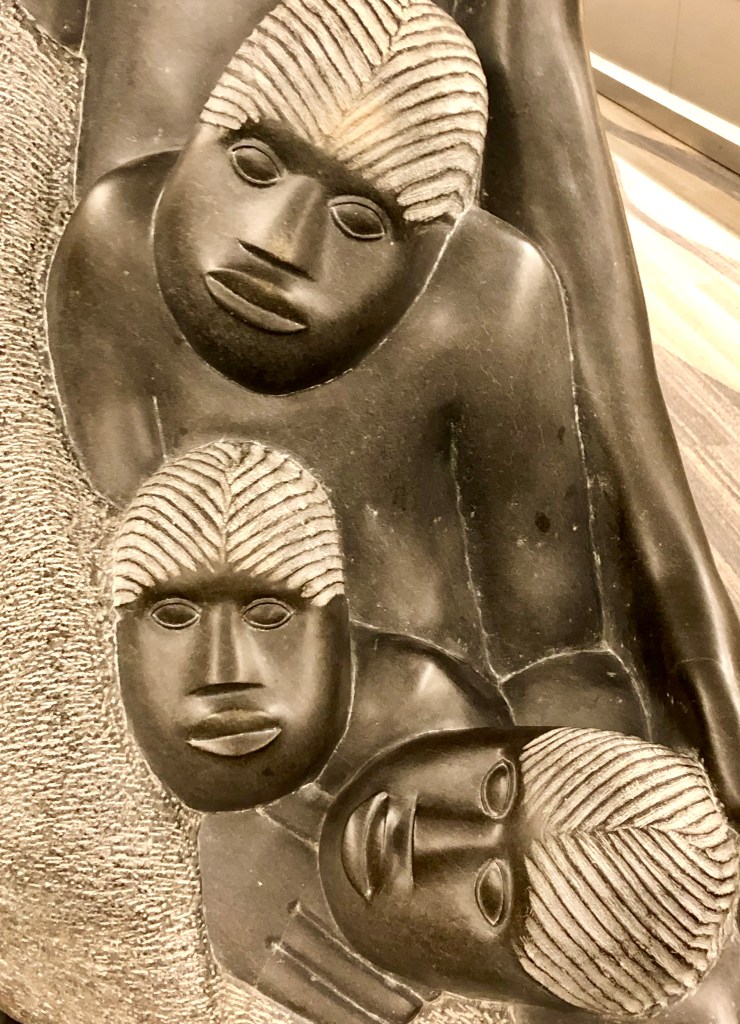
Intertwined

“These are the sons of Israel: Reuben, Simeon, Levi, Judah, Issachar, Zebulun,Dan, Joseph, Benjamin, Naphtali, Gad, and Asher.The sons of Judah: Er, Onan and Shelah; these three Bath-shua the Canaanite bore to him. Now Er, Judah’s firstborn, was evil in the sight of the Lord, and he put him to death. His daughter-in-law Tamar also bore him Perez and Zerah…

“The sons of Perez: Hezron and Hamul. The sons of Zerah: Zimri, Ethan, Heman, Calcol, and Dara, five in all…

“The sons of Hezron that were born to him: Jerahmeel, Ram, and Chelubai. Ram fathered Amminadab, and Amminadab fathered Nahshon, prince of the sons of Judah. Nahshon fathered Salmon, Salmon fathered Boaz, Boaz fathered Obed, Obed fathered Jesse.  Jesse fathered Eliab his firstborn, Abinadab the second, Shimea the third, Nethanel the fourth, Raddai the fifth, Ozem the sixth, David the seventh. And their sisters were Zeruiah and Abigail. The sons of Zeruiah: Abishai, Joab, and Asahel, three. Abigail bore Amasa, and the father of Amasa was Jether the Ishmaelite.

“Caleb the son of Hezron fathered children by his wife Azubah, and by Jerioth; and these were her sons: Jesher, Shobab, and Ardon. When Azubah died, Caleb married Ephrath, who bore him Hur. Hur fathered Uri, and Uri fathered Bezalel.” 1 Chronicles 2:1-6,9-20

God sees fit to record individual names and snippets of stories from the beginning of time. Every person who ever lived is known to this omniscient One. His image imprints value on every life He colorfully intertwines in His orchestration of human history and eternal purposes. The wicked, the faithful, the barren, the foreigner, babies that grow to be warriors and princes and famous artists, all are inextricably bound in this grand humanity Jesus came to redeem.

A family tree grows roots, rings, and branches through generations that are interdependent and vast. As much as we might prefer to lop off a branch or two, or extricate ourselves from a messy connection or prickly variety and shoot off in solitude, the Lord ordains that we draw from each other and grow up together. There may be ‘bad seeds,’ but even with them we hone character and godliness and inspiration from our connectivity.

Are we taking care to grow ourselves, so we can bring refreshment to others? Consistent meditation on the Word, humble worship and repentance, and specific prayer for keen eyes and open hearts, do much to draw nourishment for our minds and spirits. We rise rejuvenated, equipped to respond appropriately, feed the hungry, and encourage with the strength we have received. (Psalm 1:1-3; Isaiah 50:4; John 15:5; 1 Peter 3:15)

Is our mindset gauged by personal drive and preference, or do we actively look for opportunities to engage with others, and ways to contribute and serve? It’s easier and less messy to stand alone, but God didn’t call us to solitary living. How do we deliberately intertwine with the Body to bring about lush life and lasting fruit? To whom will I commend God’s marvelous works? Whom will I nurture through prayer, upbuilding, consolation? (Psalm 145:4-7,10-12; John 15:16; Romans 14:7; 1 Corinthians 14:3; Ephesians 2:20-21)

Lord, may I love what You love, and as You love, and faithfully bear Your grace in the Body. Help me grow up in all things, exercise my gifts with zeal, and do all I can to help others do the same, that You be glorified. (Ephesians 4:15-16)

Permanent, Uttermost, Always

“Another priest arises in the likeness of Melchizedek, who has become a priest, not on the basis of a legal requirement concerning bodily descent, but by the power of an indestructible life… A better hope is introduced, through which we draw near to God…

“This makes Jesus the guarantor of a better covenant.

“The former priests were many in number, because they were prevented by death from continuing in office, but he holds his priesthood permanently, because he continues forever. Consequently, he is able to save to the uttermost those who draw near to God through him, since he always lives to make intercession for them.

“For it was indeed fitting that we should have such a high priest, holy, innocent, unstained, separated from sinners, and exalted above the heavens. He has no need, like those high priests, to offer sacrifices daily, first for his own sins and then for those of the people, since he did this once for all when he offered up himself. For the law appoints men in their weakness as high priests, but the word of the oath, which came later than the law, appoints a Son who has been made perfect forever.” Hebrews 7:15b-16,19b,22-28

Daily and regular sacrifices had their place in emphasizing the need for atonement and reminding Israel of God’s sustaining provision. But how glorious to live on this side of the cross, where daily is permanent, and regular is once for all! When we know that we know our sin has been atoned for, it is finished, we are free indeed from its guilt and shame. (John 19:30)

Imperfect became perfect, human was replaced by holy, until the next time turned to the uttermost, repeated became once. Weak was replaced by unstained, and earthly was exalted above the heavens. Jesus was the perfect forever fulfillment of the law, by the power of His indestructible life- fully man and wholly distinct, our marvelous Redeemer.

So when tempted to wallow in the sludge of regret or entangling sin habits, remember: Jesus is Victor! He has done away with sin’s shackles! He’s risen triumphant! He continually intercedes for us as permanent Advocate and Defender! He is for us! (Romans 8:31-34)

Meditate on these truths. Nestle in their immutable comfort, hold fast to their pledge, and dress in their power. Welcome each day with eagerness, with gratitude for spiritual freedom. Go forth confident in Christ’s amazing gift of access to the Father’s throne, bearing the grace and mercy He gives in every moment of need. (Hebrews 4:14-16)

Why do we spiritually languish, and settle for less than triumphant in so many areas of our living? Have we grown lazy in action because we are lazy in thought? When do we take time to recall God’s rich word to us, and practice it as our own in faith, boldness, action? We are saved to the uttermost, and own a hope better than the world can offer.

What difference does Jesus’s permanent and ongoing priesthood make in my everyday hope? Zeal? Relationships? Attitudes?

I draw near to You, Lord, to take refuge in Your priesthood. May Your forevers keep me living and loving to the uttermost, always.

After Famine

“Elisha said, ‘Hear the word of the Lord: Tomorrow about this time a seah of fine flour shall be sold for a shekel, and two seahs of barley for a shekel, at the gate of Samaria.’ Then the captain on whose hand the king leaned said to the man of God, ‘If the Lord himself should make windows in heaven, could this thing be?’ But he said, ‘You shall see it with your own eyes, but you shall not eat of it.’

“Now there were four men who were lepers at the entrance to the gate. And they said to one another, ‘Why are we sitting here until we die? If we say, “Let us enter the city,” the famine is in the city, and we shall die there. And if we sit here, we die also. So now come, let us go over to the camp of the Syrians. If they spare our lives we shall live, and if they kill us we shall but die.’ So they arose at twilight to go to the camp of the Syrians. But when they came to the edge of the camp, behold, there was no one there. For the Lord had made the army of the Syrians hear the sound of chariots and of horses, the sound of a great army… So they fled away and abandoned their tents, their horses, and their donkeys… And when these lepers came to the edge of the camp, they went into a tent and ate and drank, and they carried off silver and gold and clothing and went and hid them. Then they came back and entered another tent and carried off things from it and went and hid them…

“Then the people went out and plundered the camp of the Syrians. So a seah of fine flour was sold for a shekel, and two seahs of barley for a shekel, according to the word of the Lord.” 2 Kings 7:1-8,16

The Lord has a way of redeeming the lack in our lives and drawing attention to His marvelous ways by doing so. Practically, He uses dearth to draw us to Him as Jehovah Jireh, the great provider, and we learn through cycles of need and plenty that He is enough, and always gives all we need. Isn’t it true after life’s famines, where we hunger for so long, that anything we taste and eat- food, health, companionship, inspiration, peace- is sweeter than it’s ever tasted before? (Psalm 145:15-16)

The amazing thing about God is that He not only meets our needs, but satisfies every desire with good things and often does more than we ask or imagine. As He puts to rest our frenzied fleshly need, not willing to let us be satisfied with lesser things, He is magnified. (Psalm 103:5; Ephesians 3:20; John 4:13-14)

How is He using a famine in finances, health, emotional support, or a relationship, to point us to His inexhaustible storehouse? Where is a gnawing for meaning at a new season of life, or purpose in a new assignment or location, drawing us to find deeper satisfaction in Him? Do we trust Him enough to look for even unconventional ways He might provide?

Father, teach me in every famine to see You anew, trust Your economy, and give You thanks and highest praise for Your kept promises.

For What Sake?

“Paul, a servant of God and an apostle of Jesus Christ, for the sake of the faith of God’s elect and their knowledge of the truth, which accords with godliness, in hope of eternal life, which God, who never lies, promised before the ages began and at the proper time manifested in his word through the preaching with which I have been entrusted by the command of God our Savior;

To Titus, my true child in a common faith:

Grace and peace from God the Father and Christ Jesus our Savior…

“For there are many who are insubordinate, empty talkers and deceivers, especially those of the circumcision party. They must be silenced, since they are upsetting whole families by teaching for shameful gain what they ought not to teach. One of the Cretans, a prophet of their own, said, ‘Cretans are always liars, evil beasts, lazy gluttons.’ This testimony is true. Therefore rebuke them sharply, that they may be sound in the faith, not devoting themselves to Jewish myths and the commands of people who turn away from the truth. To the pure, all things are pure, but to the defiled and unbelieving, nothing is pure; but both their minds and their consciences are defiled.  They profess to know God, but they deny him by their works. They are detestable, disobedient, unfit for any good work.” Titus 1:1-4,10-16

Paul’s heart beat for the sake of his God and His people. He was fueled by a call and desire to see believers grow in faith, knowledge, and godliness, and knew these were inextricably bound. What he believed, preached, and wrote was laced with the grace and peace of Christ and communicated with affection. His motives stood in stark contrast to the shameful gain and folly of others, and he backed his words with works.

For the sake of growing godliness in His people, God uses many to carry on His works of service, spreading hope, and manifesting the power of His word. He calls some to silence falsehood and deception, or rebuke sin and impurity, in order to establish others sound in the faith. Are we caught up in that effort, that goal, for those in common faith? Are we zealous for all that accords with godliness? Or do we spend and plan and live for our own pleasure? (2 Kings 19:34)

How are we involved in the building up of God’s children? What do we actually pray, say, contribute, and do for the sake of the faith of those God has entrusted to us? If we offer ourselves for His service, He will lead and use our willingness for their sake.(Romans 12:1-2)

“Lord, speak to me that I may speak
In living echoes of your tone.
As you have sought, so let me seek
Your erring children, lost and lone.

Oh, lead me, Lord, that I may lead
The wand’ring and the wav’ring feet.
Oh, feed me, Lord, that I may feed
Your hungry ones with manna sweet.

Oh, teach me, Lord, that I may teach
The precious truths which you impart.
And wing my words that they may reach
The hidden depths of many a heart.

Oh, use me, Lord, use even me,
Just as you will, and when, and where
Until your blessed face I see,
Your rest, your joy, your glory share.” ~Frances R. Havergal (1872)

Lord, replace selfishness with pure desire to expend myself for the sake of the faith of Your children. (2 Corinthians 5:15)

The Goad of the Book

“Hilkiah… found the Book of the Law in the house of the Lord. And Hilkiah gave the Book of the Law to Shaphan, and he read it… Then Shaphan the secretary… read it before the king.

“When the king heard the words of the Book, he tore his clothes…  ‘Go, inquire of the Lord for me, and… for all Judah, concerning the words of this book… For great is [his] wrath kindled against us, because our fathers have not obeyed the words of this book…’

“[Huldah the prophetess said], ‘Because your heart was penitent, and you humbled yourself before the Lord, when you heard how I spoke against this place.., that they should become a desolation and a curse,.. I also have heard you, declares the Lord…’

“Then the king sent, and all the elders of Judah and Jerusalem were gathered to him. And [he] went up to the house of the Lord, and with him… all the people, both small and great. He read in their hearing all the words of the Book of the Covenant that had been found in the house of the Lord. And the king… made a covenant… to walk after the Lord and to keep his commandments… with all his heart and all his soul.” 2 Kings 22:8,10-11,13-14,19; 23:1-3

“Is not my word like fire, declares the Lord, and like a hammer that breaks the rock in pieces?” Jeremiah 23:29

The Book of the Law, found by Hilkiah, was so hot in his hands that he passed it to Saphan. Reading it lit a fire in him, and he brought it to the God-fearing king. Its words were a hammer-blow to the heart of earnest Josiah, penetrating his sense of reverence and how he should lead God’s people with conviction. He responded with humility, surrender, and action. (2 Kings 22:1-2)

We cannot genuinely encounter the living Word of God and not be changed. Its active, personal, divinely-inspired words convict, reveal, and convince. If this is not occurring when we read, spend time in, or listen to the instruction of the Word, we must check ourselves for sin-blockage and heart attitude, because the powerful Word never returns void. (Isaiah 55:10-11; 2 Timothy 3:16)

What is our motive in reading? To grab a quick bite? To check off a duty, satisfy a legalistic ‘done’ so we feel good about ourselves? Or do we go hungry, teachable, expectant? Do we approach with a yen for approval of our plans, or humbly seeking the Lord’s direction? Are we full of justification and excuses, or open to the pierce of its double edged blade? (Hebrews 4:12)

How is the Book goading us? What new commitment to holiness or obedience, or changes in thought or behavior, has it effected? Regular reading, study, meditation, and application of God’s Word makes a difference. It alters our outlook, corrects our worldview, steadies our emotions. It burns until we pass it on. Will we crawl along as mere babes, full of hearing and teething on basic principles, or progress to the solid food of hard teaching that pricks our heart affections, prods fresh ambition and action? (Hebrews 5:11-6:1)

Lord, awaken me morning by morning hungry for the Book, and cause me to listen as one taught by the Almighty. Convict, change, embolden, inspire, fill, and lead. May my life exalt above all things Your name and Word. (Psalm 138:2; Isaiah 50:4)

Covered with Light

“Bless the Lord, O my soul!
    O Lord my God, you are very great!
You are clothed with splendor and majesty,
    covering yourself with light as with a garment,
    stretching out the heavens like a tent.
He lays the beams of his chambers on the waters;
he makes the clouds his chariot;
    he rides on the wings of the wind;
he makes his messengers winds,
    his ministers a flaming fire.

He set the earth on its foundations,
    so that it should never be moved.
You covered it with the deep as with a garment;
    the waters stood above the mountains.
At your rebuke they fled;
    at the sound of your thunder they took to flight.
The mountains rose, the valleys sank down
    to the place that you appointed for them.
You set a boundary that they may not pass,
    so that they might not again cover the earth.

You make springs gush forth in the valleys;
    they flow between the hills…
From your lofty abode you water the mountains;
    the earth is satisfied with the fruit of your work…

He made the moon to mark the seasons;
    the sun knows its time for setting…

O Lord, how manifold are your works!..

May the glory of the Lord endure forever;
    may the Lord rejoice in his works,
who looks on the earth and it trembles,
    who touches the mountains and they smoke!

I will sing to the Lord as long as I live;
    I will sing praise to my God while I have being.” Psalm 104:1-10,13,19,24a,31-33

The concept of being ‘covered with light’ sounds like an oxymoron. After all, light exposes, opens up, reveals, uncovers. But almighty God is wholly other, unique, transcendent, and is both Light Himself and covered with light. He shines the shekinah glory that is impenetrable and self-existent. He is indescribable and like none other. He covers the deep, and His light and love are deeper still. (Genesis 1:3; John 1:4,9; 8:12; Ephesians 3:17-19)

The clothing of our Lord is splendor and majesty, light and life. We see Him all around, and are invited into His breeze and breathless beauty. What we make of it and how we interact with it determines our mindset and ongoing resolve. The psalmist proclaims in praise the manifold wonders of God, and wills to sing His praise as long as He lives.

Likely we rouse ourselves for a number of activities, and muster energy for social situations, competitions, and hard assignments. We rely on light, and gravity, the foundations of the earth and rhythm of days without giving them much thought. We are earthly and horizontally minded, and fit ourselves into nice tidy places of convenience and complacency. We gaze at the moon, forgetting God’s power that sustains it, and depend on water with nary a thought for its tidal power held by holy hands, and its boundaries divinely ordained.

How regularly do we rouse our souls to bless the Lord? How often do we hush our busyness to contemplate God’s light and all it reveals? Where do we see evidence of the light of the knowledge of the glory of God in the face of Jesus Christ, and rejoice in it? (2 Corinthians 4:6)

Father, cover me and fill me with Your light, so all may see that You, O Lord, are God, and my God.

Though the Lord is High…

“O Lord, our Lord,
    how majestic is your name in all the earth!
You have set your glory above the heavens.” Psalm 8:1

“The Lord is high above all nations,
    and his glory above the heavens!
Who is like the Lord our God,
    who is seated on high,
who looks far down
    on the heavens and the earth?” Psalm 113:4-6

“I bow down toward your holy temple
    and give thanks to your name for your steadfast love and your faithfulness,
    for you have exalted above all things
    your name and your word…

For though the Lord is high, he regards the lowly.” Psalm 138:2,6a

“For as the heavens are higher than the earth,
    so are my ways higher than your ways
    and my thoughts than your thoughts.” Isaiah 55:9

High over heavens and earth. Over all nations and peoples. High above our thoughts and ways. Infinite in wisdom, grace and power, transcendent above all earthly might and measure. This King of kings is high and lifted up. His train fills the temple as His glory fills the earth and His faithfulness reaches to the skies. (Psalm 36:5; Isaiah 6:1)

And though He is high, He not only regards, but loves, redeems, and keeps the lowly, the humble and contrite and pure in heart, the poor in spirit. He crowns them with honor and glory to be worshipers. (Psalm 51:17; Matthew 5:3;8)

“When I look at your heavens, the work of your fingers,
    the moon and the stars, which you have set in place,
what is man that you are mindful of him,
    and the son of man that you care for him?

Yet you have made him a little lower than the heavenly beings
    and crowned him with glory and honor.” Psalm 8:3-5

“Have this mind.., which is yours in Christ Jesus, who, though he was in the form of God, did not count equality with God a thing to be grasped, but emptied himself, by taking the form of a servant, being born in the likeness of men. And being found in human form, he humbled himself by becoming obedient to the point of death, even death on a cross. Therefore God has highly exalted him and bestowed on him the name that is above every name, so that at the name of Jesus every knee should bow, in heaven and on earth and under the earth, and every tongue confess that Jesus Christ is Lord, to the glory of God the Father.” Philippians 2:5-8

This God condescended to be among us, become like us, God with us. Jesus descended from the glory of heaven in the flesh to stoop and take a place among sinners, so He could raise us to be with Him. He pours out wisdom above our highest thought and reason, and spreads His purposes far beyond our grandest efforts and intentions. What wondrous love is this! (Isaiah 7:14; Matthew 1:23; 2 Corinthians 5:21; Hebrews 2:9-10,14-15,17)

How do we receive and appropriate this transcendent Holy One? Looking up, we must fall down, and live the highest, think the loftiest, love the best we can by His Spirit. The High God deserves our purest worship, deepest affection, truest allegiance, and holiest reverence. Though He is high, He loved us. And though we are low, we can lift heart and voice to Him.

Lord, may I exalt Your highness in the way I love and live.

Keeping a Holy District

“When you allot the land as an inheritance, you shall set apart for the Lord a portion of the land as a holy district, 25,000 cubits long and 20,000 cubits broad. It shall be holy throughout its whole extent.  Of this a square plot of 500 by 500 cubits shall be for the sanctuary, with fifty cubits for an open space around it. And from this measured district you shall measure off a section 25,000 cubits long and 10,000 broad, in which shall be the sanctuary, the Most Holy Place. It shall be the holy portion of the land. It shall be for the priests, who minister in the sanctuary and approach the Lord to minister to him, and it shall be a place for their houses and a holy place for the sanctuary. Another section, 25,000 cubits long and 10,000 cubits broad, shall be for the Levites who minister at the temple, as their possession for cities to live in.

“Alongside the portion set apart as the holy district you shall assign for the property of the city an area 5,000 cubits broad and 25,000 cubits long. It shall belong to the whole house of Israel.” Ezekiel 45:1-6

The instructions here are to allot a portion of the land for those who would serve every tribe throughout the land. It required careful measure and thought and a guarding against encroachment, because the holy place, the sanctuary, and the priests who served there, needed this special place for ministry. For us, we are not so much to separate or compartmentalize the holy from the material, but to ensure that there is a holy place in every square inch of our lives. The sanctuary is paramount. To appoint for it distinguished care and space and time is vital, yet its fruit is meant to encroach upon the whole land of our days.

We may be well-meaning and disciplined, but to order a segment of the week for church, or of personal life for spiritual exploration, but then fail to carry that holy communion into the rest of our plans and activities, we miss God’s intent. He calls us to guard that sanctuary so jealously, so carefully, that what we glean there- the wisdom, God’s countenance, gratitude and grace and a Christ-mind- we appropriate in every aspect of life. Work, family, recreation, service, eating, drinking, and conversation should all be touched by the Almighty with a sacred impression of our holy place.

How will we measure out this portion for the Lord, and where? A devotional life does not just happen. When we set apart Christ as Lord in our hearts, we will always encounter opposition, because the enemy exists to disrupt any sanctuary. When is our time, and what is our place, and plan? The holy district must be a designated in the landscape of our every day. How diligently do we protect this priority and keep this assignment? (John 10:10; 1 Peter 3:15)

Father God, help me value and guard all You’ve entrusted to me, keeping preeminent and permanent Your holy place in my heart. Establish me within to take You into every district of my days, that others see You and are blessed. (Colossians 2:6)

How Long Will You Go Limping?

“So Ahab sent to all the people of Israel and gathered the prophets together at Mount Carmel. Elijah came near the people and said, ‘How long will you go limping between two different opinions? If the Lord is God, follow him; but if Baal, then follow him.’ And the people did not answer him a word. Then Elijah said, ‘I only am left a prophet of the Lord, but Baal’s prophets are 450 men. Let two bulls be given us, and let them choose one bull… and lay it on the wood, but put no fire to it. And I will prepare the other bull and lay it on the wood and put no fire to it. You call upon the name of your god, and I will call upon the name of the Lord, and the God who answers by fire, he is God.’ All the people answered, ‘It is well spoken…’ And they took the bull that was given them, prepared it and called upon the name of Baal from morning until noon, saying, ‘O Baal, answer us!’ But there was no voice… And they limped around the altar that they had made… As midday passed, they raved on.., but there was no voice. No one answered; no one paid attention…

“Elijah came near and said, ‘O Lord,.. let it be known this day that you are God, that I am your servant, and that I have done all these things at your word. Answer me, O Lord,.. that this people may know that you, O Lord, are God, and that you have turned their hearts back.’ Then the fire of the Lord fell and consumed the burnt offering and the wood and the stones and the dust, and licked up the water that was in the trench.When all the people saw it, they fell on their faces and said, ‘The Lord, he is God; the Lord, he is God.’” 1 Kings 18:20-24,26,29,36-39

The trouble with little-g gods is that they steal, kill, and destroy. They steal affections, away from what is true, noble, right, and excellent. They kill discernment, clouding over vision with la la and altars of our own making, grandiose intentions of self-sacrifice and the better good. They destroy authentic worship by replacing Spirit with feelings, and truth with opinion. (John 4:24; 10:10; Philippians 4:8)

Does my personal preference trump God’s prescribed way, my limited sight His wider, all-encompassing one? Have I entrenched ‘safety limits,’ restricting the risks I’m willing to take and discomforts I’m willing to bear for Him? Or will I test and trust the Lord, who is high and lifted up above my provincial world, and say, “Here am I, send me”? (Isaiah 6:1-8)

We can follow our gods so long, thoughtlessly, and habitually that we do not even realize we’re limping, impaired in judgment, vision, and strength. Would we pause to assess whether we’ve abandoned one-on-one intimacy with our Savior to join the 450, numbed to the dumbness of crowd speak and practice? God hears our prayers and speaks with fire when we turn from dancing with the masses to direct communion.

Do we want all limping healed, and to run without fainting? Shake off the sloth of entangling gods! (Isaiah 40:31; John 5:5-8; Hebrews 12:1-2)

Lord, identify and eradicate every god I limp alongside. By Your Spirit, may I serve and exalt You, the living and true, all my days. (1 Thessalonians 1:9)

How Much Do We Want the Cloak?

“Now when the Lord was about to take Elijah up to heaven by a whirlwind, Elijah and Elisha were on their way from Gilgal. And Elijah said to Elisha, ‘Please stay here, for the Lord has sent me as far as Bethel.’ But Elisha said, ‘As the Lord lives, and as you yourself live, I will not leave you.’ So they went down to Bethel…

“Elijah said to him, ‘Elisha, please stay here, for the Lord has sent me to Jericho.’ But he said, ‘As the Lord lives, and as you yourself live, I will not leave you.’ So they came to Jericho…

“Then Elijah said to him, ‘Please stay here, for the Lord has sent me to the Jordan.’ But he said, ‘As the Lord lives, and as you yourself live, I will not leave you.’ So the two of them went on. Fifty men of the sons of the prophets also went and stood at some distance from them, as they both were standing by the Jordan. Then Elijah took his cloak and rolled it up and struck the water, and the water was parted to the one side and to the other, till the two of them could go over on dry ground.

“When they had crossed, Elijah said to Elisha, ‘Ask what I shall do for you, before I am taken from you.’ And Elisha said, ‘Please let there be a double portion of your spirit on me.’ And he said, ‘You have asked a hard thing; yet, if you see me as I am being taken from you, it shall be so for you…’ And as they went on and talked, behold, chariots of fire and horses of fire separated the two of them. And Elijah went up by a whirlwind into heaven. And Elisha saw it and cried, ‘My father, my father!.. And he saw him no more.

“Then he took hold of his own clothes and tore them. He took up the cloak of Elijah that had fallen from him and went back and stood on the bank of the Jordan… and struck the water, saying, ‘Where is the Lord, the God of Elijah?’ And when he had struck the water, the water was parted to the one side and the other, and Elisha went over.” 2 Kings 2:1-2,4,6-14

There is great poignancy in these slowly changing scenes. Love is palpable across the miles. A strangely calm urgency spurs the pair on from Bethel- a place of worship that had been corrupted, to Jericho- a city of God’s victory, to the Jordan- where He had miraculously provided. Conversation is intimate, too sacred to be overheard. Elisha, whom Elijah had called under the cover of his cloak, matched his master and mentor’s gait, keenly absorbing all he could from the companion he knew would soon depart. (Joshua 6:2-5; 1 Kings 13:1-4; 17:1-6; 19:19-21)

He wanted his spirit. He desperately needed his cloak to withstand the windy challenges ahead, to plod on for the ministry of the Word, to follow God at whatever cost. Please. Give it, please.

How tenaciously do we follow our Lord? What lengths will we go- in discipline, time set aside, persistence- to have more of His Spirit? (Genesis 32:26; Ephesians 5:18)

Father, teach me from each divine imprint along my daily journey. Cloak me with Your Spirit’s grace and power for every step, for Your glorious sake .