Say So, and Sing!

Oh give thanks to the Lord, for he is good,
    for his steadfast love endures forever!
Let the redeemed of the Lord say so,
    whom he has redeemed from trouble…

Some wandered in desert wastes,
    finding no way to a city to dwell in;
hungry and thirsty,
    their soul fainted within them.
Then they cried to the Lord in their trouble,
    and he delivered them from their distress.
He led them by a straight way
    till they reached a city to dwell in.
Let them thank the Lord for his steadfast love,
    for his wondrous works to the children of man!
For he satisfies the longing soul,
    and the hungry soul he fills with good things.

Some sat in darkness and in the shadow of death,
    prisoners in affliction and in irons,..
Then they cried to the Lord in their trouble,
    and he delivered them from their distress.
He brought them out of darkness and the shadow of death,
    and burst their bonds apart.
Let them thank the Lord for his steadfast love,
    for his wondrous works to the children of man!
For he shatters the doors of bronze
    and cuts in two the bars of iron.

Some were fools through their sinful ways,
    and because of their iniquities suffered affliction;..
Then they cried to the Lord in their trouble,
    and he delivered them from their distress.
He sent out his word and healed them,
    and delivered them from their destruction.
Let them thank the Lord for his steadfast love,
    for his wondrous works to the children of man!
And let them offer sacrifices of thanksgiving,
    and tell of his deeds in songs of joy!” Psalm 107:1-2,4-10,13-17,19-22

Trouble is part of the life of the redeemed. We cannot avoid it; it takes many forms. But the Lord uses distress as a vehicle for us to recognize our helplessness, cry out for Him, and recognize Him as the great Deliverer. Through this exercise we learn a rhythm of gratitude for His steadfast, unfailing love.

C139E03A-05B8-43D9-87C9-444DA7ACD20D_1_201_a

We may feel we are in an unending cycle of misery, imposed by outside circumstances or of our own making– stifled in a job, trapped in a difficult relationship, miserable in a physical affliction, uncertain about the future. Each trouble reminds us for what Jesus came to die, and from what we have been redeemed. God designs our very distresses in order to sanctify them for our growth and His glory. He trains us to look out from our choking and fretting and selves, and up to our gracious Redeemer. Jesus is the One who slakes our thirst, frees our souls from bondage, burns His light into our darkness, heals our brokenness, and brings peace into our storms. (Isaiah 53:4-5; Mark 4:37-39; John 4:14; 8:12; Galatians 5:1)

Will we take this psalm to heart and sing its song? Will we trace His wondrous works to us, recount His unending goodness and grace, and give thanks?

“O for a thousand tongues to sing
my great Redeemer’s praise,
the glories of my God and King,
the triumphs of his grace!
 ~Charles Wesley (1739)

Lord, You are good, Your steadfast love endures, You redeem, You hear every cry, You deliver. Fill my days with saying so!

According to the Blessing

“Then you shall keep the Feast of Weeks to the Lord your God with the tribute of a freewill offering from your hand, which you shall give as the Lord your God blesses you… Every man shall give as he is able, according to the blessing of the Lord your God that he has given you.” “They gave according to their means, as I can testify, and beyond their means, of their own accord, begging us earnestly for the favor of taking part in the relief of the saints.” “Give, and it will be given to you. Good measure, pressed down, shaken together, running over, will be put into your lap. For with the measure you use it will be measured back to you.” Deuteronomy 16:10,17; 2 Corinthians 8:3-4; Luke 6:38

Regulated celebrations were God’s way of reminding His people He was not only their God, to whom honor was due, but Provider and Giver of all good gifts, to whom thanks was due. Glad tributes to Him and generous giving to others stem from hearts that acknowledge His as Source, Sustainer, and Sovereign. (1 Corinthians 4:7; James 1:17)

Bless the Lord, O my soul,
    and all that is within me,
    bless his holy name!
Bless the Lord, O my soul,
    and forget not all his benefits,
who forgives all your iniquity,
    who heals all your diseases,
who redeems your life from the pit,
    who crowns you with steadfast love and mercy,
who satisfies you with good
    so that your youth is renewed like the eagle’s.

The Lord works righteousness
    and justice for all who are oppressed.
He made known his ways to Moses,
    his acts to the people of Israel.
The Lord is merciful and gracious,
    slow to anger and abounding in steadfast love.
He will not always chide,
    nor will he keep his anger forever.
He does not deal with us according to our sins,
    nor repay us according to our iniquities.
 Psalm 103:1-10

The Lord has blessed His people with a divine measure of benefits, be they mercies and pardon, material means, or vigor of days. Recent celebrations of 90 years of life; assurance of salvation at age 97; a first birthday; 69, and 40, years of marriage; weddings, graduations, and chemo rounds, are cause to think on the value of our time, our every breath. Do we offer back the days and years according to the blessing of their being entrusted to us? Does all our being resound with freewill tribute of Bless the Lord, O my soul”?

When God entrusts to us insights, ideas, and solutions, how and where are we contributing them? How do we handle means, and opportunities to serve? Do I hoard my cache of goods, wisdom, energy, because I view all as mine to control, or share my bounty out of joyful delight to spread its sweetness? Would I beg God for the favor of participating in His kingdom work, and offer my expertises and my calendar to do so? Where am I seeking opportunities to take part in the relief of the needy, counsel to the confused, comfort to the hurting, hope to the overwhelmed?

Father, according to the blessings You have lavished on me, so let me live and give. Steer my desire and my path to the ways You would have me bless You, and your saints.

One plus All equals Undivided

Hear, O Israel: The LORD our God, the LORD is one. You shall love the LORD your God with all your heart and with all your soul and with all your might. And these words that I command you today shall be on your heart. You shall teach them diligently to your children, and shall talk of them when you sit in your house, and when you walk by the way, and when you lie down, and when you rise. You shall bind them as a sign on your hand, and they shall be as frontlets between your eyes. You shall write them on the doorposts of your house and on your gates.” “Teach me your way, O LORD, that I may walk in your truth; unite my heart to fear your name.” “All mine are yours, and yours are mine, and I am glorified in them… Holy Father, keep them in your name, which you have given me, that they may be one, even as we are one.” Deuteronomy 6:4-9; Psalm 86:11; John 17:10-11

The LORD— Father, Son, and Holy Spirit, is one. His command that we love Him with all of our heart, mind, soul, and strength is a call for us to be undivided in heart to fear and love and live for a unified Him. One God, loved by all of me, is an unbreakable union made possible by Jesus. It is what He came to introduce, lived to display, and died to achieve. Jesus’s love for God brought unwavering commitment to God’s cause, and His love for His people compelled Him to span the bridge over the great divide between our sin and God’s holiness. His wide open arms that ‘love us that much’ bring God and man together in a unity that cannot be broken.

2D3072B3-DC05-4F04-810B-8FB21620AF08_1_201_a

Our world is divided in many ways: geographically, ideologically, culturally. There are some areas where people will never agree, distinctions that will never disappear, differences that cannot be resolved, but in Christ, the Spirit brings an uncommon and beautiful unity that defies human invention and explanation. (Romans 8:14-16,38-39)

People long for that unity, and cannot help but notice a healthy, palpable oneness when it is present in the Body of Christ. It may attract, it may repel, but it will certainly identify us as Christ’s and affect those observing. The more we love God with all our being, and senses, and impulses, and thoughts, the more His love permeates what we do and say and how we relate to others. As God’s children love Him with their all, they are freer and fuller to love one another, differences notwithstanding. (2 Corinthians 2:15-16; John 13:35)

Are there affections I withhold from God? Do I reserve certain strength to play with the world, or areas of thought to indulge in dark imaginings? Would I surrender all my heart, mind, soul, and strength in adoration of my loving God? And are there strange and foreign names by which I label or dismiss others, or cordon off myself? What am I doing to keep in Jesus’s name, and love others through Him?

Lord, I immerse all I am in You. Unite Your people under Your banner of love, that the world would see and know You as the one true God. (Song of Solomon 2:4)

From Pain and Panic to Perspective and Prayer

As soon as King Hezekiah heard it, he tore his clothes and covered himself with sackcloth and went into the house of the Lord. And he sent… to Isaiah.., ‘This is a day of distress, rebuke, and disgrace; children have come to the point of birth, and there is no strength to bring them forth. It may be that the Lord your God will hear the words of the Rabshakeh,.. sent to mock the living God..; therefore lift up your prayer for the remnant that is left.’ [Sennacherib] sent to Hezekiah, saying..: ‘Do not let your God in whom you trust deceive you by promising that Jerusalem will not be given into the hand of the king of Assyria. You have heard what the kings of Assyria have done to all lands. Shall you be delivered?’ 

Hezekiah received the letter, and read it; [he] went up to the house of the Lord, and spread it before the Lord. And Hezekiah prayed to the Lord: ‘O Lord of hosts, God of Israel, enthroned above the cherubim, you are the God, you alone, of all the kingdoms of the earth; you have made heaven and earth. Incline your ear, O Lord, and hear; open your eyes, O Lord, and see; and hear all the words of Sennacherib, which he has sent to mock the living God. Truly, the kings of Assyria have laid waste all the nations and their landsSo now, O Lord our God, save us from his hand, that all the kingdoms of the earth may know that you alone are the Lord.’ 

“‘Thus says the Lord:.. Have you not heard that I determined it long ago? I planned from days of old what now I bring to pass… I will defend this city to save it, for my own sake.'” Isaiah 37:1-4,9-11,14-21,26,35

King Hezekiah had every reason to panic. The mighty, cruel armies of Assyria were bearing down, Israel the chosen target in their hungry sights. His people and God had been ridiculed, he himself mocked and maligned by Sennacherib’s general. Then we see the blessed as soon as. Immediately, upon hearing of the enemy advance, the godly king entered the house of the Lord to pray, and sent for Isaiah to pray with him for their nation. He took his pain and panic to the only place worthy, placing them before the One he knew was enthroned above all. (Isaiah 36)

85F41C03-FAF4-440B-8E7C-591A846958CE_1_201_a

It is in the place of prayer, exalting God alone, that we gain His perspective on the turmoil and battle that rages about us. As long as we live, there will be the ‘Rabshekah:’ rebel-rousers and opposition, those who accuse, taunt our faith, attempt to shake our confidence in God. Though buffeted, we need not be jarred from our sure foundation, God our Rock. In this world, we have trouble, but in the Lord, we know peace. (Psalm 18:1-2; Matthew 7:24-27: John 16:33)

Are we willing to make the climb, courageous enough to ‘take the letter’ of our concerns, confusion, heartache, and fears, and spread them before the Lord? Do we spend the time to pray and plead until God is finished speaking with us? (Genesis 17:22; 18:33)

Good Father, keep me bowing before Your throne above, even as the world here below encroaches. May I trust, and exemplify, Your Lordship.

For Unto Us

For to us a child is born,
    to us a son is given;
and the government shall be upon his shoulder,
    and his name shall be called
Wonderful Counselor, Mighty God,
    Everlasting Father, Prince of Peace.” Isaiah 9:6

Unto you. Unto me. Unto us.

59EF2E3D-AC9D-432F-B866-F9406575DA75_1_201_a

Jesus was born. A child yet a king, helpless yet perfect, hungry yet needing nothing, young yet wise, under authority yet having all authority, sinless yet becoming sin for us as our Savior. (2 Corinthians 5:21)

He is one and only Son of God, and Son of man. Fully divine, and fully human. Conceived by the Holy Spirit, and born of a virgin woman. With God in the beginning, and from the line of Abraham and David. (Matthew 1:2,6,16,18,20-21; John 1:1-2; 3:16)

The government was, and is, and always shall be, upon his shoulder. Between His shoulders we rest, underneath His everlasting arms we are secure, and by His arm we are ruled and rewarded, held and upheld and carried, redeemed and delivered. (Deuteronomy 33:12,27; Isaiah 40:10-11; 41:10; 50:2)

He has a name, “Jesus,” a strong tower to which we can run and be safe, and saved from sin. His name is Immanuel, “God with us,” a name above every other name, before which one day all will bow. He owns one indescribable name known only to Him, and also is identified as King of kings, Lord of lords. (Proverbs 18:10; Isaiah 7:14; Matthew 1:21,23; Philippians 2:9; Revelation 19:12,16)

His name is Wonderful, from everlasting to everlasting working wonders. He is Counselor, abiding with us forever to teach, remind, help, comfort, console, convict. (Psalm 77:14; John 14:16-17,26; 16:8)

He is Mighty God, incomparably strong, almighty, the One against whom none and nothing can prevail. He is Victor, the shield round about us, our fortress, high tower, rock. He contends with those who contend with us, and shares His power with the faint. (Psalm 3:3; 18:2; Isaiah 40:25,29-31; 49:25; 1 Corinthians 15:55-57)

He is the Everlasting, beloved Abba Father. How great is His love for us that we’re called His children! He has called generations of children from the beginning, and keeps us to the end, never fainting or failing and always showing compassion. He has carved our names in the palms of His hands, knowing we are but dust, and disciplining us as His own. (Psalm 103:13; Isaiah 40:28; 41:4; 49:16; Romans 8:15-17; Hebrews 12:7-11; 1 John 3:1)

He is Prince of Peace. His peace is not as the world gives. He gives peace with God through redemption, and is our peace with others, breaking down walls of hostility. His peace rules over the storms, and abides in the midst of them. His peace is beyond human understanding, more powerful than any tribulation, and guards our hearts and minds in His power and name. (Mark 4:37-39; John 14:27; 16:33; Romans 5:1; Philippians 2:14; 4:7)

To us, this Savior has come. To us He is real, alive, and present.

What difference is He making in our thinking, our living, our loving? These truths about Jesus transform every doubt, fear, wound, grief, motivation, and longing. He is here, in and for us.

Incomparable God, thank You for all You have given to me in Jesus. In turn, I offer myself to You, that I live and breathe and love fully unto You, and for Your renown and glory.


Mere Words vs. the Word

In the fourteenth year of King Hezekiah, Sennacherib king of Assyria came up against all the fortified cities of Judah and took them. And the king of Assyria sent the Rabshakeh to King Hezekiah at Jerusalem, with a great army. And he stood by the conduit of the upper pool on the highway to the Washer’s Field… And the Rabshakeh said.., ‘On what do you rest this trust of yours? Do you think that mere words are strategy and power for war? In whom do you now trust, that you have rebelled against me?.. If you say, ‘We trust in the Lord our God,’ is it not he whose high places and altars Hezekiah has removed?

Then the Rabshakeh stood and called out in a loud voice in the language of Judah: ‘Hear the words of the great king, the king of Assyria! ‘Do not let Hezekiah deceive you, for he will not be able to deliver you. Do not let Hezekiah make you trust in the Lord by saying, ‘The Lord will surely deliver us. This city will not be given into the hand of the king of Assyria… Beware lest Hezekiah mislead you. Has any of the gods of the nations delivered his land out of the hand of the king of Assyria.., that the Lord should deliver Jerusalem out of my hand?’ But they were silent and answered him not a word, for the king’s command was, ‘Do not answer him.’” Isaiah 36:1-2,4-5,7,13-15,18,20-21

The taunts of the haughty Assyrian king seem long ago and far away, but they are as common today as they were in ancient Israel 3000 years ago. The ancient kings personify flesh–driven passions, agendas, and persuasions who ridicule and tease to veer God’s people off the path of truth. Their words, by way of accusation and threat, can topple our confidence, or turn us to cling to the true Word that does not change and will always stand.

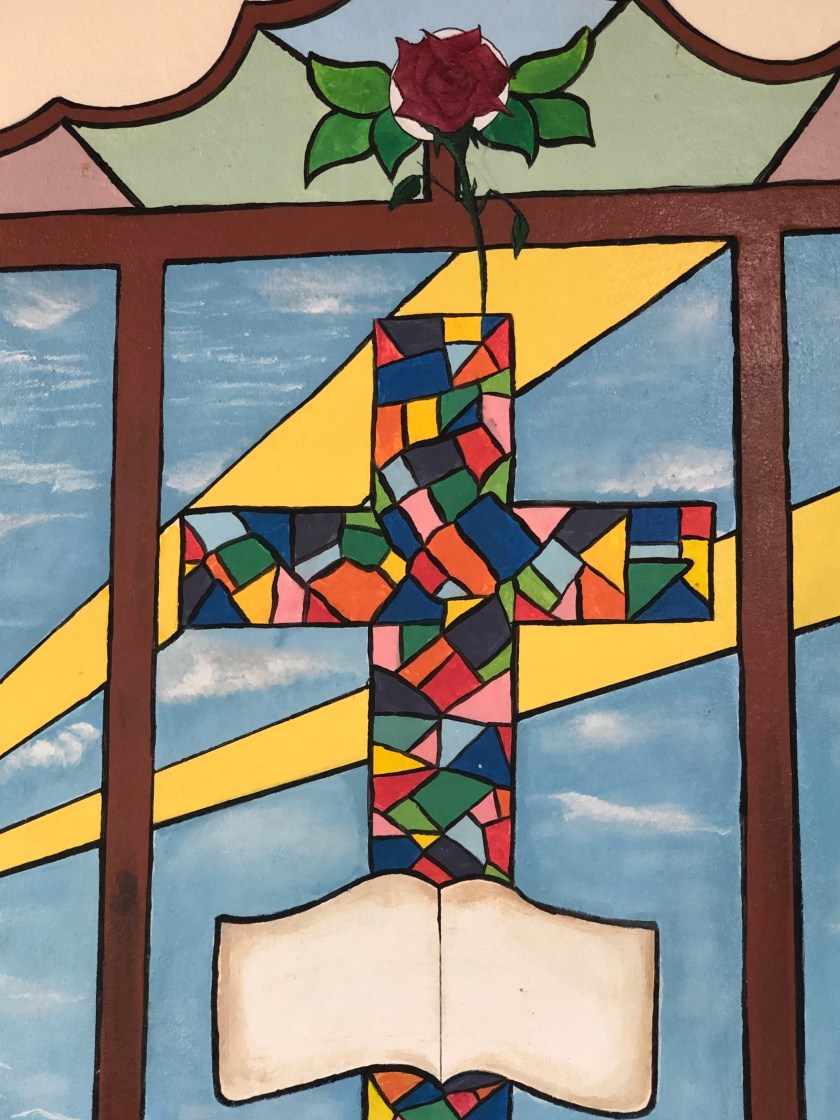
Painted Cross, Puerto RIco

We fortify our cities with infrastructure, material wealth, civic leaders, government authorities, and industry. Opposition threatens our self-made security in the form of rival powers with differing or destructive agendas, greed for success, competing business, and social or philosophical movements. Spiritually, those who love the Lord and are fortified by His word are publicly accused of false stances, distorted views, self-serving motives, or unworthy allegiances. Since Eden, the enemy has used words to undermine, deceive, attack, and try to shake our devotion and resolve. (Genesis 3:1-5)

These tests present opportunities to cling evermore to the unchanging, living, powerful Word of God. The words of man may hurt and shake us, but they need not upend and break us. The hearers from Judah answered not a word because of their sovereign’s stronger command, and Hezekiah took the stinging attacks to his Lord, affirming what he knew was true about Him. The effects of verbal enemy poison can always be abated by the mightier, lovelier, redemptive Word of God. What are we investing of time and attention to know it well enough to handle it rightly, and spread its healing power? (Isaiah 37:14-17; John 1:1; 2 Timothy 2:15; Hebrews 4:12)

Lord Jesus, may I hold tight to You, the Living Word made flesh, now glorified. It is Your word that counts, stands, delivers, and cannot be shaken. (Isaiah 40:8; Matthew 24:35; John 1:14; James 1:21)

He Will Judge

He who planted the ear, does he not hear?
He who formed the eye, does he not see?
He who disciplines the nations, does he not rebuke?
He who teaches man knowledge— the Lord—knows the thoughts of man.” 

Let the heavens be glad, and the earth rejoice;..
    for [the Lord] comes to judge the earth.
He will judge the world in righteousness,
    and the peoples in his faithfulness.”  

Righteousness and justice are the foundation of his throne.” 

He will judge the world with righteousness,
    and the peoples with equity.” 

The Lord reigns; let the peoples tremble!
    He sits enthroned… exalted over all the peoples.
The King in his might loves justice.
    You have established equity;
you have executed justice and righteousness.
    Holy is he!”  Psalm 94:9-11; 96:11,13; 97:2; 98:9; 99:1-2,4-5

Assigning motive is a dangerous practice. We set our correctness radar and hand out tickets for reactions and behavior like those with authority to condemn. We base our assumptions on personal worldview, or limited perception of a situation, or a narrative imposed on us that may or may not be so. But do we know every fact? Can we see with no filter? Are we able to discern someone else’s intentions? Omniscient God is the only One who knows the human heart and the whole truth, and understands why people do what we do. (Romans 8:27; 1 Corinthians 2:11)

June sunset w pocks and streaks

In this world, we see in a mirror dimly. It is difficult enough to understand ourselves- why we despair, what stokes our impulses, why we are enraptured by certain beauties, why some people and situations attract us more than others. Even with His Spirit, we know God with limited understanding, though we crave and strive to know Him better. What would make us think that we can comprehend the inner workings of another person?

We look at the outside of a person or situation, yet only God sees and judges righteously by the heart. We seem to be certain how others feel and why they act out, yet bristle when someone falsely assigns an attitude or motive to us. We assess, surmise, determine, and blame, yet very quickly defend ourselves when accused by another, proving it is easier to play judge than to be judged. (1 Samuel 16:7; Matthew 7:1-2)

What would change if we met others at the foot of the cross, the great equalizer, where dripped Jesus’s cleansing blood for every sinner? How would we perceive and treat one another differently if all labels– victim, privileged, left-wing, right-wing, inexperienced, enlightened, oppressed, elite– were set aside, except that of ‘image-bearer’?

Would I, when observing behavior that wrenches my heart, bow down and worship the omniscient Lord and Judge of all, ascribing to Him the glory due His name? Would I set aside pontificating and assigning camps to the people created in His image, and instead exalt Him?

Will we look with hope to the time when “Every valley shall be lifted up, and every mountain and hill be made low; the uneven ground shall become level, and the rough places a plain. And the glory of the Lord shall be revealed, and all flesh shall see it together”? (Isaiah 40:4-5)

Exalted Lord, I trust Your judgments. Search me, know my heart, and cleanse from any grievous way. Lead me to live and communicate with Your righteousness, purity, and equity. (Psalm 98:9; 139:23-24)

All Sides, No Sides

But some men came down from Judea and were teaching the brothers, ‘Unless you are circumcised according to the custom of Moses, you cannot be saved.’ And after Paul and Barnabas had no small dissension and debate with them, Paul and Barnabas and some of the others were appointed to go up to Jerusalem to the apostles and the elders about this question. So, being sent on their way by the church, they passed through both Phoenicia and Samaria, describing in detail the conversion of the Gentiles, and brought great joy to all the brothers… And after there had been much debate, Peter stood up and said to them, ‘Brothers, you know that in the early days God made a choice among you, that by my mouth the Gentiles should hear the word of the gospel and believe. And God, who knows the heart, bore witness to them, by giving them the Holy Spirit just as he did to us, and he made no distinction between us and them, having cleansed their hearts by faith.'” Acts 15:1-3,7-9

“The Lord your God is God of gods and Lord of lords, the great, the mighty, and the awesome God, who is not partial.” Deuteronomy 10:17

“Here there is not Greek and Jew, circumcised and uncircumcised, barbarian, Scythian, slave, free; but Christ is all, and in all.” Colossians 3:11

How prone we are to have a side, and want to take sides! We can be tenacious in our opinions, our alliances, our preferences, and in our zeal be unaware of the divisions we cause in the church, neighborhoods, society, even families, because of our narrow or single-view. Dissension is not a new problem– it began in the Garden, festered in the early church, and foments in cultures today. As God’s children, how are we to handle these challenges?

D9AF3D4F-554E-4318-8572-29EF24680ABF

“When Joshua was by Jericho, he lifted up his eyes and looked, and behold, a man was standing before him with his drawn sword in his hand. And Joshua went to him and said to him, ‘Are you for us, or for our adversaries?’ And he said, ‘No; but I am the commander of the army of the Lord.’ And Joshua fell on his face to the earth and worshiped. The commander of the Lord‘s army said to Joshua, ‘Take off your sandals from your feet, for the place where you are standing is holy.’ And Joshua did so.” Joshua 5:13-15

How? We worship the Lord of all, align with Him instead of a side, and proceed as His representative. We open wide the doors of our hearts to others in unprejudiced love, and listen attentively to all sides of a matter. We pray for understanding, and genuinely express affirmation and compassion.

Open discussion and respectful, civil debate lead to conclusions that enlighten, unify, and encourage. Sometimes there is healthy compromise, sometimes God clarifies Scripture anew. It is vital we be willing to place our rigid viewpoints, allegiances, and preferences on the altar and scoot around to look at issues from other perspectives while seeking truth and the mind and plan of Christ. (Acts 15:23-32; Romans 12:2; 1 Corinthians 1:10-13; 2:15-16)

Lord, let me never hold onto a side more tightly than I hold to You. Teach me impartial, gracious listening, clear speaking, and let all I convey be glorifying to You.

“All the Great Work”

Consider today the discipline of the Lord your God, his greatness, his mighty hand and his outstretched arm, his signs and his deeds that he did in Egypt to Pharaoh the king of Egypt and to all his land, and what he did to the army of Egypt, to their horses and to their chariots, how he made the water of the Red Sea flow over them as they pursued after you, and how the Lord has destroyed them to this day, and what he did to you in the wilderness, until you came to this place, and what he did to Dathan and Abiram.., how the earth opened its mouth and swallowed them up, with their households, their tents, and every living thing that followed them, in the midst of all Israel. For your eyes have seen all the great work of the Lord that he did. You shall therefore keep the whole commandment that I command you today, that you may be strong, and go in and take possession of the land that you are going over to possess, and that you may live long in the land that the Lord swore to give [your fathers] and their offspring, a land flowing with milk and honey.” Deuteronomy 11:2-9

In our flesh, we might define “great work” as peace, prosperity, happiness, comfort, plenty. After all, ‘things are great’ and ‘I’m feeling great’ are not natural responses to illnesses, sadness, weariness, unemployment, unrest. But God’s word lists together for remembrance discipline, greatness, His mighty hand and outstretched arm, signs and deeds of judgment, destruction, fantastic plagues, death, displacement, and loss. These ALL are the great works He calls us to consider. (Exodus 7:14-12:32; 14:21-31; Numbers 16:25-33)

This is because God uses all things to bring glory to Himself and work good for His people and kingdom. In the peaceable, pleasant, and pretty things, we quickly see His loving hand. In the harsh, hurtful, and confusing events, we must trust it. The same hand that slays is the one that soothes- all in sovereign love and perfect wisdom. (Isaiah 43:7; Romans 8:28)

Furrowed ridges in rain-filled ditch

When we do not understand why emotions run amok and out of control, why certain events transpire and certain words flame, we can trust that omnipotent God knows and uses “all these great things” to accomplish His high and holy purposes beyond our comprehension, and will waste nothing in His righteous economy. What appears as a scary, sleuthing serpent is actually the hand of Jesus fingering the soft sand of our souls to conform its shape to His beauty, to reflect His light. (Jeremiah 33:3; Romans 11:33)

Am I in the habit of picking and choosing what I deem comes from God’s hands? Do I label some things “great” and others “not so great, not for me, thank you,” what I like, “God’s kind gift,” and the hard and harsh things, “out of His control”? Every gift comes from Him, and we understand His rich, many-faceted character better when we receive all He gives as useful and redemptive in His plans for us. (Job 2:10; Matthew 5:45; James 1:17)

Father God, open my eyes to see all Your great work, and consider it just that. Show me Your ways, that I may know You, and gratefully live for Your pleasure and honor. (Exodus 33:18)

There’s Something About Time Spent

At that time the Lord said to me, ‘Cut for yourself two tablets of stone like the first, and come up to me on the mountain and make an ark of wood. And I will write on the tablets the words that were on the first tablets that you broke, and you shall put them in the ark.’ So I made an ark of acacia wood, and cut two tablets of stone like the first, and went up the mountain with the two tablets in my hand... I myself stayed on the mountain, as at the first time, forty days and forty nights, and the Lord listened to me that time also… And he wrote on the tablets, in the same writing as before, the Ten Commandments that the Lord had spoken to you on the mountain out of the midst of the fire on the day of the assembly. And the Lord gave them to me. Then I turned and came down from the mountain and put the tablets in the ark that I had made. And there they are, as the Lord commanded me.” Deuteronomy 10:1-5,10

The apostles returned to Jesus and told him all that they had done and taught. And he said to them, ‘Come away by yourselves to a desolate place and rest a while.’ For many were coming and going, and they had no leisure even to eat. And they went away in the boat to a desolate place by themselves. Now many saw them going and recognized them, and they ran there on foot from all the towns and got there ahead of them.” Mark 6:30-33

We have eyes, we have ears, we have moments and hours. And every day we decide what we will do with them all. Before us is an overstuffed menu of what to read, watch, listen to; who to agree with, disagree with, argue with, or contradict; activities of work, service, self-improvement, pleasure. Moses had thousands of complaining Israelites, the apostles had crowds of curious, needy onlookers, and they chose to ‘come’ and spend time with their Lord.

BFBF3A19-7118-4A7F-9D58-B1E7B7B85595

There is something wonderful and life-giving about spending time with Jesus. It is divine conversation, listening and hearing, pleading and receiving instruction. It restores our souls, it inverts our human thinking from man-driven horizontal to God-kissed vertical. It refreshes and resets our emotion-colored limited perspective to a clear eternal one. It replaces frenzy with peace. Are we brave enough to turn off and turn aside, then turn toward our beckoning Lord? Would we close the screen, the paper, the remote, and open God’s word? Would we put away and put off in order to put ourselves before His throne? How deliberate are we to push away the plate of stale and slanted media fare that leaves us wanting and unsatisfied, and be sated by the sweet and savory of God’s living bread? (Psalm 23:1-3; 32:8; Jeremiah 29:13; John 6:33-35)

We will give an account for how we employ the hours we are given. Let us spend time with our loving, wise Prince of Peace whose shoulders bear the government of all the world. (Isaiah 9:6; Romans 14:12)

Lord, may I readily respond to Your every beckon. May I relish and be transformed by time spent with You, so those I see will desire it too.