Ruined Cathedral, Vibrant Church

The Lord spoke to Moses, saying, Command the people of Israel to bring you pure oil from beaten olives for the lamp, that a light may be kept burning regularly. Outside the veil of the testimony, in the tent of meeting, Aaron shall arrange it from evening to morning before the Lord regularly. It shall be a statute forever throughout your generations. He shall arrange the lamps on the lampstand of pure gold before the Lord regularly.'” Leviticus 24:1-4

“You are the light of the world. A city set on a hill cannot be hidden… Let your light shine before others, so that they may see your good works and give glory to your Father who is in heaven.” “For God, who said, ‘Let light shine out of darkness,’ has shone in our hearts to give the light of the knowledge of the glory of God in the face of Jesus Christ.” “You shine as lights in the world, holding fast to the word of life… in the midst of a crooked and twisted generation.” Matthew 5:14,16; 2 Corinthians 4:6; Philippians 2:15-16

I watched in sad horror at the images on the screen of the magnificent, centuries-old Notre Dame burning, stricken at the ruin of such a lovely masterpiece of sacred architecture, sadder still at the sense of worship lost to the burn of worldliness. When God instructed Moses to keep lamps burning continually in the tabernacle, He was reminding them that His constant flaming presence in their worship, their lives, required maintenance and commitment. Our LORD does not change in His holiness and glory, yet we can easily crowd Him out by building edifices to ourselves and other things we value more than Him, and His light gets snuffed out, the outstanding steeple rising high to the sky, pointing us to heaven, falls to get lost in the sea of our horizontal culture.
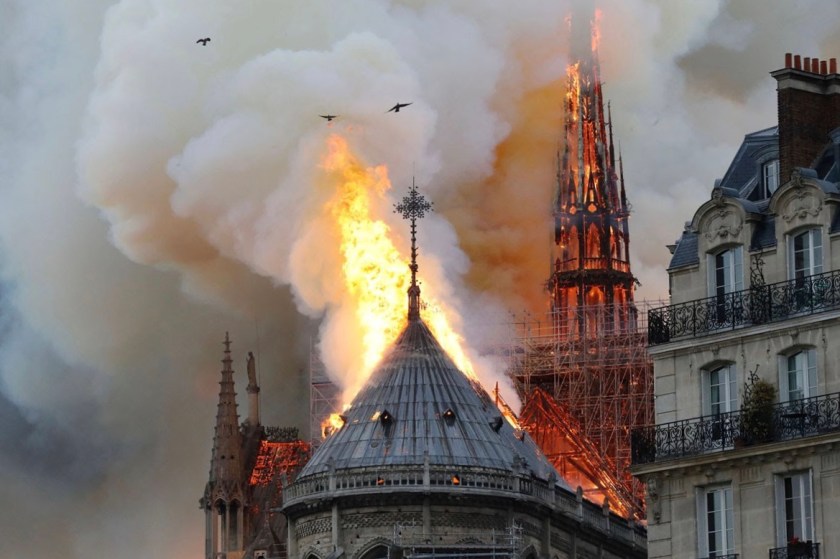
Notre Dame burning 4-19

Many cathedrals today are hollow repositories for relics and wonder and tourist observation, but no true worship. Their lofty arches, domes, spires designed to raise our sights and affections, their very cross shape to unite us toward the altar, hold beauty that today feeds curiosity and spectating more than inspiring humility and gratitude. The spirit has burned out and vacated the premises, and we are left to bear God’s light. But that is a high and happy calling we should be eager to obey.

If God’s light has shone in my heart, giving me understanding and the joy of salvation, and my body is His temple, my assignment His ambassador, where and how am I shining? What holy light do I bring to conversation and deliberation, to the church on Sunday mornings, and the workplace during the week? Where am I being the church, the arms and hands of Christ, to my world, standing out like a steeple among low-faced living, limited aspirations, meaningless occupation of time? (1 Corinthians 6:19-20; 2 Corinthians 5:18,20)

Lord, as Your light-bearer, let me shine so bright that I bear Your flame in every room, connection, effort, and show You off. Keep my heart ever before Your altar, and Your light burning with Your glory in and through me wherever I am.


 

In Everything You Do, I Am the LORD

You shall be holy, for I the Lord your God am holy. Every one of you shall revere his mother and his father, and keep my Sabbaths: I am the Lord your God. Do not turn to idols: I am the Lord your God. When you reap the harvest of your land, you shall not reap your field right up to its edge, neither shall you gather the gleanings. You shall leave them for the poor and the sojourner: I am the Lord your God. You shall not steal; you shall not deal falsely; you shall not lie to one another. You shall not profane the name of your God: I am the Lord. You shall not oppress your neighbor or rob him. You shall not curse the deaf or put a stumbling block before the blind: I am the LordYou shall do no injustice in court. You shall not be partial to the poor or defer to the great, but in righteousness shall you judge your neighbor. You shall not go around as a slanderer: I am the Lord. You shall not hate your brother, but you shall reason frankly with your neighbor. You shall not take vengeance or bear a grudge, but you shall love your neighbor as yourself: I am the Lord. You shall stand up before the gray head and honor the old man: I am the LordYou shall do no wrong in measures of length or weight or quantity. You shall have just balances: I am the Lord your God.” Leviticus 19:2-4, 9-18, 32,35-36

God commands Moses to tell the Israelites to be holy, for the LORD their God is holy, then  proceeds to list an array of everyday situations that require holiness, each ending with “I am the LORD.” Hearing this refrain over and over plants its truth and truths deep in our motivations and psyche until it is obvious this remembrance is what God wants at the fore in how we see life and everything we do. Because I am Who I am, consider your work and others and station in life through the lens of my covenant relationship with you. I am the LORD. Be holy. Respect your parents, worship my way, treat others with generosity, equity, grace, respect, love… because I am the LORD. I am LORD over your parents, your devotion, your means of making a living, the poor among you, your tongue and hands, your judgment and conversations and relationships, your business dealings. Everything.

20180429_070443

If God’s civil law included all these specifics, how are they translating to me and my everythings today? What difference would it make if when I first arise, I said, “You are the LORD,” and before I choose what to eat and what to read, “You are the LORD”? What might change if, when planning my schedule and contacts with others, and before I spend money and give advice, I said, “You are the LORD”? Not only will my focus and accountability be to Jesus rather than to self, but I will be reminded that He is the Sovereign in control and I am not. He is my Source and ‘raison d’etre.’ He is infinite, and all I plan and do is a drop in a bucket of His grand and providential scheme, all I determine myself is subservient to His good, pleasing and perfect will. (Romans 12:1-2)

Father, may my ongoing refrain be “You are the LORD,” my highest aim be to make that obvious in everything I do. (Colossians 3:17)

Words Like Honey

The law of the Lord is perfect, reviving the soul;
the testimony of the Lord is sure, making wise the simple;
the precepts of the Lord are right, rejoicing the heart;
the commandment of the Lord is pure, enlightening the eyes;..
the rules of the Lord are true, and righteous altogether.
More to be desired are they than gold, even much fine gold;
sweeter also than honey and drippings of the honeycomb.
Moreover, by them is your servant warned; in keeping them there is great reward… Let the words of my mouth and the meditation of my heart be acceptable in your sight, O Lord, my rock and my redeemer.” Psalm 19:9-11,14

I memorized this familiar passage when I was a child, and have always loved the rhythm and cadence of the phrases describing God’s word, full of power and sweeter than honey. The Hebrews used to put a spot of honey on their children’s tongues as they learned the Torah, teaching them that the holy words were indeed a delight, sweet and to be savored. How fitting that the prayer at the end of this psalm asks for pleasing words from David’s mouth.

When we take delight in the word of God, we see, by understanding and application, that it revives, makes wise, rejoices our hearts, enlightens our eyes, and in its unshakeable truth and beauty and bounty is to be greatly desired. Could not my words, issuing from a heart soaked in His, minister the same to others? If God’s word is more valuable than gold and sweeter than honey, how do my words measure against them? Am I taking care to choose my words thoughtfully, to weigh them against truth, to filter them through sensitivity and grace, to pray for a guard over my lips and for meaningful responses? (Psalm 1:1-2; 39:1; 141:3)

20180422_181308

What will it take to make my words sweet to the soul and healing to the body? When someone pours out their heart, have I steeped myself in God’s word enough to be able to discern with wisdom, and offer an appropriate reply, palpable comfort, hopeful promise, true truths that will make a difference? When I walk into a nest of buzzing gossip, or a mud-pit of coarse talk or profanity, do my words season with salt, preserving what is holy and retarding corruption? When murmuring, complaining, and catty criticism diminish others, what am I doing to reverse the destruction by building up? Am I quick to squelch meaningless or ungodly babbling by elevating the conversation? How well do I steer conversations away from superficial topics to significance? How rich is my storehouse of words, and what am I doing to fill it? (Proverbs 4:22; 16:24; Colossians 4:6; 2 Timothy 2:16)

Holy Father, Living Word, make my words gracious like Yours in the lives of others. Keep me soaking in Your word daily so when I open my mouth, You come out.

Faithfulness of Faithfulness

For your steadfast love is before my eyes, and I walk in your faithfulness.” “The steadfast love of the Lord never ceases; his mercies never come to an end; they are new every morning; great is your faithfulness.” “If we are faithless, he remains faithful— for he cannot deny himself.” Psalm 26:3; Lamentations 3:22-23; 2 Timothy 2:13

I noticed this morning the distinction between my faithfulness and God’s, as the psalmist’s commitment is to walk in that of the Lord, not his own. What does it mean to walk in God’s faithfulness? It means taking each step trusting His fidelity, not my own; walking in His keeping power, His steadfast love, His perseverance, His unchanging character, His constancy. It is not so much a determination to be and remain faithful myself, committed to a steady walk with Him, as it is to recognize and depend moment by moment on God’s faithfulness to me, to give light to my path, strength to my feet, clear vision to my mind, purpose to my ways. It is taking strides each day with growing faith, in freedom won for me on the cross, abundance of peace and joy He provides, and gladness that comes with knowing my Redeemer as my friend. (John 10:10; 15:14; 16:33; Psalm 16:11

DSC_0363

“For your steadfast love is great above the heavens; your faithfulness reaches to the clouds.” Psalm 108:4

There is something beautiful and greatly alluring about the unchanging character of my God. No matter my waffling in trust, my flakiness in behavior, my weak resolves and regretted words, He does not change, and He is good through and through. I count on my God this day, and every day, that He will be true to His character, He will keep His word, He will not fail me nor leave me, He will fulfill all He has determined for me. His word will be a lamp unto my feet, He will keep me from stumbling and provide the way out from temptation, He will guard my path. His faithfulness undergirds the way I think about myself and all I do with a sure foundation, an unshakeable hope, a significant purpose. If in Him I live and move and have my being, in Him I can surely walk anywhere with confidence and joy. (Joshua 23:14; Psalm 119:105; Jeremiah 29:11; Luke 24:44; Acts 17:28; 1 Corinthians 10:13; Hebrews 13:5; Jude 1:24)

What field ripe for harvest, what request for counsel or help, what new challenge, what work has God put before me? If I step forward in His immeasurable faithfulness, I can trust that He Who calls me is faithful and will do it. This gives expectancy and zeal for opportunities He brings, and an excitement to look for them. (1 Thessalonians 5:24)

Lord, remind me that wherever I go, wherever You take me, it is in Your faithfulness that I walk. Keep me dedicated to doing just that, secure in You and with Your unchanging nature and glory in mind.


The Benefits of Hush

Guard your steps when you go to the house of God. To draw near to listen is better than to offer the sacrifice of fools. Be not rash with your mouth, nor let your heart be hasty to utter a word before God, for God is in heaven and you are on earth. Therefore let your words be few. For a dream comes with much business, and a fool’s voice with many words. Let not your mouth lead you into sin… For when dreams increase and words grow many, there is vanity; but God is the one you must fear.” “The more words, the more vanity.” Ecclesiastes 5:1-3,6-7; 5:11

Every time I speak, I am not listening. Every time I speak, I make noise. There is much to be said for being quiet, slowing down, and remembering God is in heaven, I am on earth; He is God, I am not. He is worthy of my hush.

When the day begins, senses awaken and all sorts of things begin: thoughts of what is on the calendar, plans for work ahead; sounds inside and outside: media, motors, birds, cars, conversation; motion, much to see, to prepare, to adorn, to ingest, to decide. But I can still start each day ‘going to the house of God’ to listen, to hush, to respond in worship and trust, to position myself aright before Him. It is here, in the quiet, I set aside dreams and foolish inclinations, impulsive words and ideas and self-imposed sacrifices, and can learn to fear the Lord. This is where I take on Him, get dressed in Him, let His words soak in. The reverence instilled in the sanctuary makes all the difference when I step out into the world, guarding my soul and spirit with a hush of quiet confidence and my countenance with His grace and shine. (Numbers 6:25-26; Colossians 3:12-17)

IMG_1976

What leads me to rash choices and talk? Where do I give in to emotional reactions, loose and “many” words? What steps need guarding along the way, what plans must I implement to spend quiet time in the sanctuary so I can exercise self-control and wisdom when faced with difficult situations or important decisions? “Set a guard, O Lord, over my mouth; keep watch over the door of my lips!” Do I entrust my will to His keeping? (Psalm 141:3)

Lord, hush my heart, hush my mouth, and keep me still before You, beholding Your power and glory so I know You better. I surrender to Your rule over my senses and Your sway over every moment, every day. (Psalm 46:10; 63:2)

Bringing Light to Abolished Death

Therefore do not be ashamed of the testimony about our Lord, nor of me his prisoner, but share in suffering for the gospel by the power of God, who saved us and called us to a holy calling, not because of our works but because of his own purpose and grace, which he gave us in Christ Jesus before the ages began, and which now has been manifested through the appearing of our Savior Christ Jesus, who abolished death and brought life and immortality to light through the gospel. I am not ashamed, for I know whom I have believed, and I am convinced that he is able to guard until that day what has been entrusted to me. Follow the pattern of the sound words that you have heard from me, in the faith and love that are in Christ Jesus. By the Holy Spirit who dwells within us, guard the good deposit entrusted to you.” 2 Timothy 1:8-10,12-14

“The last enemy to be destroyed is death. ‘Death is swallowed up in victory.’ ‘O death, where is your victory? O death, where is your sting?’ The sting of death is sin, and the power of sin is the law. But thanks be to God, who gives us the victory through our Lord Jesus Christ.” 1 Corinthians 15:26,54-57

At this holy time of year, we are somber remembering the death of our Savior. I drive by a church with a shrouded cross, or see a crown of thorns, and am quieted, sobered, contemplating the suffering, the agony of body and spirit, the weight of sin my Redeemer bore, for me. But His death was not final. His time in the sealed grave assured all He was lifeless, and set the scene for Him to be raised to life and do away with death forever for those He came to save. His crucifixion and most glorious resurrection mysteriously and absolutely abolished death for those who believe. He is alive, and His victory is true!

RIley's cross 2

This side of Calvary, I am left with a testimony and a holy calling, as was Paul. How does my life, how do my words, shine light on the death of death? What evidence do I bear of spiritual victory? I may speak of this beautiful truth, telling how Jesus’s death swallowed the ugliness and horror of sin’s consequences, how His resurrection assured victory over sin and life eternal for those who appropriate its work, but I can also exemplify this truth in how I behave. Jesus lives in me, and His presence gives power and victory in my choices to say no to sin, to speak blessing instead of cursing, encouragement instead of criticism, gratitude instead of complaining. He strengthens me to be occupied with meaningful, productive work that bears lasting fruit, that enriches others, that has a significant impact on my community and culture. His is the victory over impatience, greed, rudeness, pride. It is He Who sets my heart’s agenda to be God-directed and others-focused over self-rewarding.

Blessed Savior, You have put death to death. Hallelujah! May I daily put to death, in Your resurrection power, all that is opposite of You, and live unashamed, unstung by sin, manifesting Your grace and victory. (Romans 1:16; Colossians 3:5-10)


Defining our Conspicuity

[Do] nothing from partiality. Do not take part in the sins of others; keep yourself pure. The sins of some people are conspicuous, going before them to judgment, but the sins of others appear later. So also good works are conspicuous, and even those that are not cannot remain hidden.” “In the same way, let your light shine before others, so that they may see your good works and give glory to your Father who is in heaven.” 1 Timothy 5:21-22,24-25; Matthew 5:16

“Conspicuity: easily seen or noticed; readily visible or observable; attracting special attention, as by outstanding qualities or eccentricities; the property of being clearly discernible; the state or quality of being clear or bright; brightness.” 

Last evening I said something with an attitude and tone of voice I immediately wished I could retract. My defensiveness and sarcasm were conspicuous, and my spirit was stricken. (Thank You, Lord) I thought about what triggered me reaction, and recognized that just as I am bothered by the media’s seemingly uncanny ability to drive opinion and ‘hot talk,’ constantly teasing with tidbits of controversy, inflammatory behavior, any morsel that will keep people stirred up and talking and watching or listening, I had fallen into the same proclivity to jump in the ring and respond in kind. Is this what I want to stand out about me? What does God want? Certainly not this behavior, which becomes our second nature unless it is checked and bridled by a higher Master.

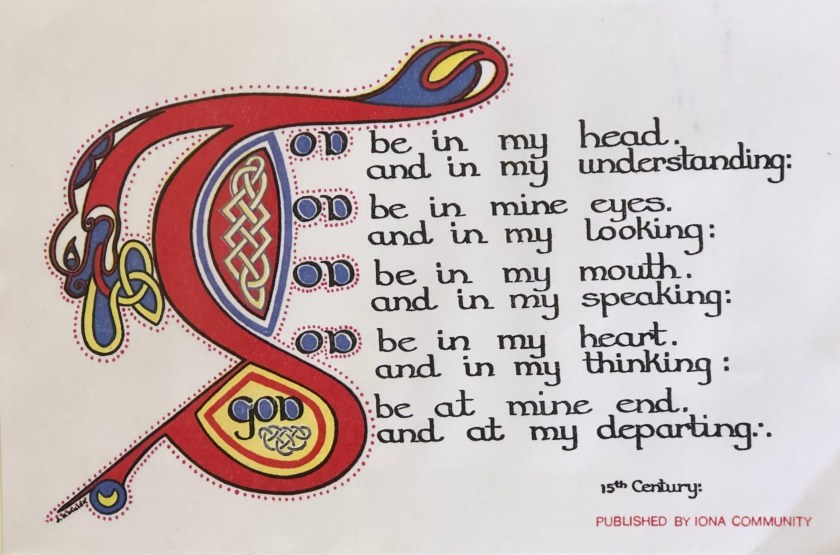
God be in my head calligraphy, 15th century

To you, O Lord, I lift up my soul. O my God, in you I trust; let me not be put to shame. Make me to know your ways, O Lord; lead me in your truth and teach me. He leads the humble in what is right, and teaches the humble his way. All the paths of the Lord are steadfast love and faithfulness.” Psalm 25:1-2,4-5,9-10

Paul alerts Timothy to the choice we have in our conspicuity; we will be known either for our sins, behavior that dishonors our Lord, or for good works, actions and words that not only honor Him but point others to Him. Every decision will steer us one way or the other. He has charged us to do good works that reflect His character and light in the world, and has prepared them beforehand for us to do, so it is vital we stay in tune with our Leader to know the good way and draw His strength to choose it. Seems simple, but in our culture of touchy contention and polarizing opinions and assertion of our ‘rights,’ and where many make themselves conspicuous through social media, crafting their identity through images and experiences. the flesh can win out if we are not vigilant to guard against it. How do I define myself? (Philippians 2:10,13)

Lord, You were always conspicuous in Your love, mercy, undivided attention to others, kindness, and manifestations of Your power– yet the attention You drew was always to the gospel message of salvation and to the glory of Your Father. May the way I live and serve draw attention to You also, that others know the true God and eternal life through You. (John 17:3-4,6,17)


Remember Who You Are

I thank him who has given me strength, Christ Jesus our Lord, because he judged me faithful, appointing me to his service, though formerly I was a blasphemer, persecutor, and insolent opponent. But I received mercy because I had acted ignorantly in unbelief, and the grace of our Lord overflowed for me with the faith and love that are in Christ Jesus. The saying is trustworthy and deserving of full acceptance, that Christ Jesus came into the world to save sinners, of whom I am the foremost. But I received mercy for this reason, that in me, as the foremost, Jesus Christ might display his perfect patience as an example to those who were to believe in him for eternal life. To the King of the ages, immortal, invisible, the only God, be honor and glory forever and ever. Amen.” 1 Timothy 1:12-17

What Paul was, was bad. We first meet him in the Bible as Saul in Acts 7, giving approval to those stoning the godly, Spirit-filled Stephen as he preached the truth about Jesus. He harshly persecuted Christians, imprisoned them, raged against and threatened them, carrying out orders from the chief priests with fury and zeal. But then, he was drastically saved by the power of the Lord Who crashed into his rebel-against-God life. His running from God was halted and reversed, his spiritual blindness gave way to new spiritual sight. (Acts 7:58; 8:1; 9:9-19; 22:20; 26:10-11)

But Paul, forgiven and transformed by the Spirit, would never forget who he was without Christ. He taught, reasoned, and preached the gospel, he planted churches, effectively ministering to leaders and congregations and bearing much spiritual fruit, but his natural depravity was always fresh in his mind. This letter to Timothy is one of his last, written from prison after having walked with Jesus by faith for years, and still he calls himself the chief of sinners. Mercifully and wholly forgiven, Paul knew his appointment and calling came from God, and it was Him he desired to honor. He knew that against the shroud of his blasphemous past and his dark heart of flesh, in contrast to his insolence and ignorant unbelief, the grace and love of Jesus sparkled like a translucent gem, and he was delighted to give Him the glory.

Yosemite waterfall, looking up

When our early walk of dependent faith becomes a trot through complicated life, and the ride of time gets going, we may slide, even subconsciously, into living on auto-pilot, trusting our own inclinations, our ability to make decisions on the spot, to say and do the right thing. But it’s here self-effort blooms and a bit of self-credit and glory not belonging to us sneaks in. Beware! We must never forget our first love, and how He captivated us. We must always remember we were enemies of Christ, rescued by the grace of God for purposes and His glory alone. We must continually trust Him with all our heart, acknowledge Him in all our ways. Remembering who we were helps keep us grounded, and thankful. It also extricates pride and magnifies His grace and glory. (Proverbs 3:5-6; Isaiah 42:8; Romans 5:6-8; Revelation 2:4)

May I, Lord, the foremost of sinners, ever hide behind You, the glorious King of the ages.


There’s Something About Red

For the life of the flesh is in the blood, and I have given it for you on the altar to make atonement for your souls, for it is the blood that makes atonement by the life. For the life of every creature is its blood: its blood is its life.” “And being in agony he prayed more earnestly; and his sweat became like great drops of blood falling down to the ground.” “And when they came to the place that is called The Skull, there they crucified him.” “You were ransomed from the futile ways inherited from your forefathers… with the precious blood of Christ, like that of a lamb without blemish or spot.” “The blood of Jesus cleanses us from all sin.” Leviticus 17:11,14; Luke 22:44; 23:33; 1 Peter 1:18-19; 1 John 1:7

There is nothing like the color red. God made it to stand out. A stately Mrs. Lincoln in a rose garden, a male cardinal on a rainy day, ripe cherries on a fruit tray, glossy berries on a holly tree. Our blue blood courses through our veins, giving us life, but when we are cut and it hits the air, we bleed red, shocking with its color. We can be both drawn to and repulsed by it, a shout that seems not to fit in anywhere but is always a “pop” that startles our attention. The Bible has a scarlet thread woven from beginning to end that stands out as the theme of redemption and ties its unified story together.

In the garden, God covered Adam and Eve’s newly discovered shame with clothes of animal skins that necessitated the first blood sacrifice, and when God instituted the law at Sinai, the consecrated priests were to atone for sin through the shed blood of animal sacrifices. Not only was the life of the creature in their blood, but that very blood offered is what gave the ‘life’ of forgiveness and cleansing to the people. For us, our sins are scarlet and crimson shocks against God’s holiness, but wondrously, mysteriously, His red blood sacrificed on Calvary covers and cleanses them to become white as snow and wool. What wondrous love is this! (Genesis 3:7-13,21; Isaiah 1:18)

“See from His head, His hands, His feet,
Sorrow and love flow mingled down!
Did e’er such love and sorrow meet,
Or thorns compose so rich a crown?”  ~Isaac Watts (1707)

DSC_0945

Where do I need His blood applied? Though I am by God’s grace clothed with salvation, what areas in my life continue on in red rebellion against His holiness and purity? What stubbornness pulses through me untouched, and needs to be sweated out like drops of blood in full surrender through agonizing prayer? What ongoing habits do I need to leave once for all at the foot of the cross? I can know what is true, yet fail to live as though I do. May it no longer be! (Romans 6:1,4,7)

Lord and Savior, whenever I see red, remind me of Your precious blood and life given so new, abundant life could be received. As You bring sins to my mind, let me reason with You in sincere confession and proceed as one fully washed and forgiven. May I never cease to thank You. (Isaiah 1:18; John 10:10; 13:8-10; 1 John 1:9)


You Must Be Born Again

Now there was a man of the Pharisees named Nicodemus, a ruler of the Jews. This man came to Jesus by night and said to him, ‘Rabbi, we know that you are a teacher come from God, for no one can do these signs that you do unless God is with him.’  Jesus answered him, ‘Truly, truly, I say to you, unless one is born again he cannot see the kingdom of God.’ Nicodemus said to him, ‘How can a man be born when he is old? Can he enter a second time into his mother’s womb and be born?’ Jesus answered, ‘Truly, truly, I say to you, unless one is born of water and the Spirit, he cannot enter the kingdom of God. That which is born of the flesh is flesh, and that which is born of the Spirit is spirit. Do not marvel that I said to you, “You must be born again.”’” John 3:1-7

For an upstanding, on-the-surface-righteous Pharisee who had risked his reputation to approach Jesus, this requirement to be born again was startling and confusing. Why would he need to change at all, and besides, how could he possibly enter his mother’s womb again? But Jesus’s words dug deep, aimed to penetrate the soul and spirit of this legalistic leader. It was not Nicodemus’s behavior He was after, but his heart, and any heart not reborn cannot be His, no matter outward conformity to morality or rules.

fullsizeoutput_5dbb

Whatever our lives look like, unless we are born again, we cannot be God’s child. Today, we want our first birth to be sufficient. We want to be affirmed for who we are, for all our bents and choices, all our natural tendencies and hard-wired personalities. We strut our stuff for the world to see and celebrate, and expect God will join in the party. But our Savior’s words will quash our frivolity if we are willing to hear and heed: we must be born again.

Every one of us is born with inordinate affections, proclivities that are not of God, and He knows it. This has been the case since Eden, and Jesus graciously offers a way out. To say that because I was born this way you must accept it, is either not to hear Jesus’s clear words, or to ignore them as irrelevant for me. Jesus is no respecter of persons; His command is for all. We must be born of the Spirit if we are to enter the kingdom of heaven. (Romans 5:12,15-17; 1 Corinthians 15:45; Hebrews 4:12)

Why do I resist His words? Because I am in love with ruling my life? Do I chafe at His command as harsh, because He made me the way I am and I’m fine, thank you, instead of receiving it as a gracious invitation to believe in Him and have life abundant and eternal as a new creation? How compellingly do I extend His loving offer to the Nicodemuses in my life? (John 3:16; 10:10; 2 Corinthians 5:17)

O God, thank You for not leaving us to ourselves, for Your gift of rebirth, of salvation. Please awaken those dead to You to heed Your call to be born again, and may we all live and move and have our full being in You. (Acts 17:28)