How We See Things

Before the year of famine came, two sons were born to Joseph. Asenath, the daughter of Potiphera priest of On, bore them to him. Joseph called the name of the firstborn Manasseh. ‘For,’ he said, ‘God has made me forget all my hardship and all my father’s house.’ The name of the second he called Ephraim, ‘For God has made me fruitful in the land of my affliction.’ Gen 41:50-52

Joseph, eleventh of twelve sons of his father Jacob, was hated by his jealous brothers. When, on his father’s errand, he checked on their welfare in the sheep fields, they stripped him, threw him in a dry pit, and sold him as a slave to Midianite traders. Then Potiphar, captain of the Egyptian Pharaoh, bought him, and in his service, Joseph was falsely accused and confined in prison, where “his feet were hurt with fetters; his neck was put in a collar of iron.” Later, when his brothers came to buy grain in Egypt, they admitted to having watched and ignored his soul distress and begging. In all his suffering, Joseph stays hidden in his Lord. While the names of his son’s hint at his hardship – longing, abandonment, affliction- he chose to emphasize God’s goodness, steering of his mind, fruitfulness, and blessing. The way he saw things, God ruled, God was present, God was good, God was using his circumstances to work all things for His grander purpose. (Genesis 37;39:3,5,21;42:21;50:19-21; Psalm 105:18)

Bird w blue, San Francisco Bay

How do I see things? Joseph’s was no fake or trite, “I’m fine;” his attitude was fixed in a true, God-graced, eternal perspective. Is mine? Joseph knew his God, and saw his every circumstance as sovereignly orchestrated by Him, and this freed him to make the most of wherever he was, pressing on to know God better, serving others with the compassion and wisdom He supplied. How about me? If I bore fruit during difficult times, would it be puny and weak and sighing, or large and robust and happy? If I were naming my ‘offspring’ in a land of affliction, would they reflect complaining or trust? Do I focus on and whine about my ills as a victim, or on God’s grace and His purposes as His chosen? Is my default thinking “woe is me,” or “Wow is God!”?

“Praise to the Lord, who o’er all things so wondrously reigneth,
Who, as on wings of an eagle, uplifteth, sustaineth.
Hast thou not seen How thy desires all have been                                                                 
Granted in what He ordaineth?                                                                                                   Praise to the Lord, who doth prosper thy work and defend thee,
Who from the heavens the streams of His mercy doth send thee.
Ponder anew What the Almighty can do,
Who with His love doth befriend thee.
”  ~Joachim Neander (1650-1680)

Father, as You superintend my life, my days and seasons, please fill my vision with You. Lift my head to see You rather than hardship, to be able to rejoice in the freedom and blessing You give in every turn of events that I might know You more deeply and make You known. May I name all my fruit, which You graciously allow and bestow, for You, for Your glory and praise.


 

Naming God

Jacob said to his household and to all who were with him,.. ‘Let us arise and go up to Bethel, so that I may make there an altar to the God who answers me in the day of my distress and has been with me wherever I have gone…’ And Jacob set up a pillar in the place where he had spoken with him, a pillar of stone. He poured out a drink offering on it and poured oil on it. So Jacob called the name of the place where God had spoken with him Bethel. Genesis 35:2-3,14-15

Jacob had behaved himself in many situations that warranted the hatred, suspicion, and uneasiness he experienced. God knew him well, and orchestrated circumstances to teach and break and sanctify him; and for all his conniving ways, Jacob was spirited, determined, insightful, tenacious, and knew his God too. And so it was, after returning to his homeland with his wives and large family, he set to return to Bethel (“house of God”), where God had earlier promised him descendants that would bless the earth, to build an altar. This time, it was to more than a present and personal God, but to the God Who had stayed with him and answered every distress. (Genesis 28:11-19)

Rock in Highlands

Jacob’s descendent David would say something similar of God, though his life was quite different and he faced different hardships. Others through the Bible, owning different personalities and proclivities and called to different lives, also knew God always answers us in our distress and is always present. (Psalm 34:4; Joshua 1:5; Hebrews 13:5)

God has many names, though His character remains the same. Certain attributes mean more to us at certain moments or seasons in our lives; our experience with Him identifies Who He is to us. As we go through life, God reveals Himself in new and different ways, and we can keep naming Him, crying out in desperation or surrender, anguish or adoration, memorializing distinct aspects of His infinitely good character. Our worship is elevated when we recount His names that have been especially personal in specific situations, noting them in a special way as we read through the Scriptures, voicing them in praise. How well do I know Him? For what shall I name and remember Him today?

Almighty God, You are the One Who sees after me, my ever present Help in trouble, my Everlasting Father, Good Shepherd, Prince of Peace. I adore and exalt Your name that is above all names. In all times, cause me to remember You and all You mean to me, singing and spreading Your glorious name with thanksgiving and joy. (Genesis 16:13-14;17:1; Psalm 46:1; Isaiah 9:6; John 10:11; Philippians 2:9)

Sometimes We See, Always We Follow

 “Now faith is the assurance of things hoped for, the conviction of things not seen.” “We walk by faith, not by sight.”  Hebrews 11:1; 2 Corinthians 5:7
I saw the dolphin fins, and punched my paddle deep and rhythmically in the glistening water to catch up with the majestic morning feeders. Delighting in the cool air and dawn’s early light, I rejoiced in the gift of life and smiled at the playful poking and flipping before me. In my periphery I saw a dark shadow barely rise, slowly but briefly gliding along the blue green surface. A manatee. I turned to follow, my heart racing, watching for him to appear again. Paddle, paddle, pause, scan… then I heard his shooshing exhale as he broke the surface with his homely snout, followed by a long glistening body with bumpy skin that displayed its full length before arcing down deep. Amazed, I wanted to hear his breath and see him again, so I paddled in pursuit. A splash of a pelican diving for fish here, a clanging of a flag mast against a metal pole there, nothing would distract me from my keen watch for the remarkable creature to resurface. Although I could not see him, I could follow what I knew of the direction he swam.
fullsizeoutput_58b9
Do I as eagerly, as steadfastly, chase after God? He too is marvelous, and more so! Sometimes we see Him clearly, and sometimes we just know the direction He prescribes and follow Him unseen. Sometimes He surfaces obviously in glorious splendor or powerful conviction, and sometimes He quietly calms us with His invisible but palpable presence. Sometimes we hear His breath in the encouragement of a friend, or sense His softening of a harsh or resistant attitude, or see His hand changing a loved one’s heart or moving in response to prayer. But other times all is silent, and we feel dry, our course is clouded. We can still follow. When even His shadow is not visible, God’s word and truths still stand and His Spirit still guides, so I can confidently go into the unknown knowing He goes before me and will direct my ways.

“And your ears shall hear a word behind you, saying, ‘This is the way, walk in it,’ when you turn to the right or when you turn to the left.” “I will instruct you and teach you in the way you should go; I will counsel you with my eye upon you.” Isaiah 30:21; Psalm 32:8

“Immortal, invisible, God only wise, In light inaccessible hid from our eyes,
Most blessed, most glorious, the Ancient of Days, Almighty, victorious, Thy great name we praise.                                                                                                                                      Unresting, unhasting, and silent as light, Nor wanting, nor wasting, Thou rulest in might;
Thy justice like mountains high soaring above Thy clouds which are fountains of goodness and love.”  ~ Walter Chalmers Smith (1824-1908)

Father, keep me pressing on, plunging in to all You have for me, trusting Your ways and  word and direction when I do not see You. May I faithfully follow You, the immortal, invisible, and only wise God, to Whom be glory forever. (1 Timothy 1:17)

Love from the Ladder

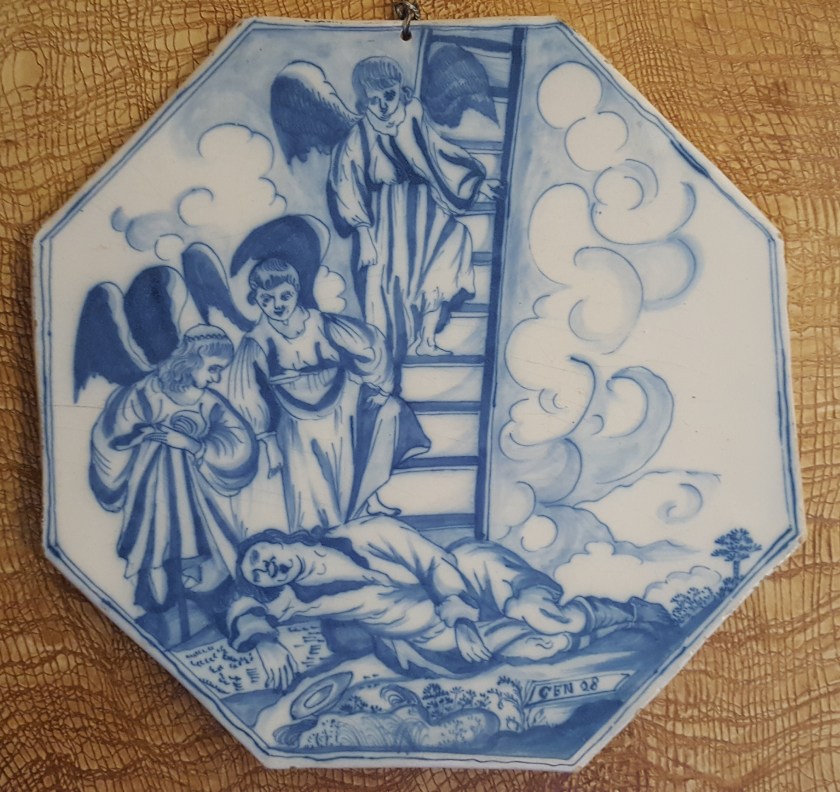
Jacob left Beersheba and went toward Haran. And he came to a certain place and stayed there that night, because the sun had set. Taking one of the stones of the place, he put it under his head and lay down in that place to sleep. And he dreamed, and behold, there was a ladder set up on the earth, and the top of it reached to heaven. And behold, the angels of God were ascending and descending on it! And behold, the Lord stood above it and said, ‘I am the LORD, the God of Abraham your father and the God of Isaac. The land on which you lie I will give to you and to your offspring. Your offspring shall be like the dust of the earth, and you shall spread abroad to the west and to the east and to the north and to the south, and in you and your offspring shall all the families of the earth be blessed. Behold, I am with you and will keep you wherever you go, and will bring you back to this land. For I will not leave you until I have done what I have promised you.’ Then Jacob awoke from his sleep and said, ‘Surely the LORD is in this place, and I did not know it.’ And he was afraid and said, ‘How awesome is this place! This is none other than the house of God, and this is the gate of heaven.’” Genesis 28:10-17

At this point in his life, Jacob was no stellar individual. His name that meant “deceiver” had borne itself out in conniving, lying, and deception with both his brother and father. The consequence of the jealous hatred he stirred up against his twin Esau was ‘banishment’ to fetch a wife in Haran, a journey that would keep him away for decades and from seeing his mother again. But it was here, in this aloneness, that the covenant God, the LORD, met him.

jacob's ladder- delft

Hard-headed Jacob slept with a stone for his pillow, and God in grace came to him by way of angels on a ladder that stretched to heaven. The Lord identified Himself, spoke personally of His promise to Jacob and his descendants. There was absolutely nothing Jacob had done to deserve this favor; all was of benevolent El Shaddai, and His pledge was broad in every measure. Jacob’s would be the land as far as he could see, numberless descendants, and the Lord’s abiding presence.  (Genesis 17:4-8; 25:23; 26:2-4)

It is often when we are at the end of ourselves, our effort, our expending of our misdirected energies, that God’s grace most beautifully comes to us. He gets us in a place where we cannot ignore or deny our stiff neck, and must acknowledge that He is the high and lofty One, He the One Who is constantly awake and at work when we are shrouded in the sleep of spiritual apathy, He the lover of our unlovable souls.

My Lord, thank You for Your abounding grace. Ever humble me before You, grateful for the low places You put me so I can glory in Your initiative and measureless love in my life. You Who are ‘in this place’ took my place on the cross, so I am able to live in the gate of heaven all my days. Hallelujah!

“Come Away by Yourselves”

The apostles returned to Jesus and told him all that they had done and taught. And he said to them, ‘Come away by yourselves to a desolate place and rest a while.’ For many were coming and going, and they had no leisure even to eat. And they went away in the boat to a desolate place by themselves. Now many saw them going and recognized them, and they ran there on foot from all the towns and got there ahead of them. When he went ashore he saw a great crowd, and he had compassion on them, because they were like sheep without a shepherd. And he began to teach them many things.” Mark 6:30-34

He had just been rejected in His home town by offended, accusing nay-sayers, His cousin and friend John the Baptist had just been cruelly, capriciously beheaded, and yet Jesus kept on, focused on His mission. Grief and being spurned were a very real part of life, as was pressure to work and teach and serve, but the Rabbi knew the importance of rest, and taught His disciples by example. It was vital for those who would follow Jesus to get away with Him, for leisure and rejuvenation. His communion with His Father is what clarified His priorities, renewed His energy, and fueled His lovingkindness toward the crowd. At once, many more chased Him down, needs and demands multiplied, winds of resistance blew, but Jesus was calm, orderly, in control. Fixed on His God, He lived moment by moment in His power and peace.

IMG_6805

For us, as in this story, the flurry of temptation to activity, the pressure to check off to-dos and meet demands and expend ourselves to exhaustion, never wanes. We have one more load, email, task, appointment, note, chapter, errand… added to the weight of all that has gone undone, the unmet intentions, frustrated plans, still-unconfirmed decisions. Our self-imposed frenzy can often distract and muddy our thinking, deplete our strength, even rob our joy. It is imperative we regularly ‘come away’ with our Savior, to leave the coming and going, turn off the devices, close the door, and be still. Do we deliberately schedule, and guard, this time? We cannot control every interruption, sadness, practical need, or emergency, but we can take control of many factors that assure needed rest in Him.

Sweet hour of prayer! sweet hour of prayer! That calls me from a world of care,
And bids me at my Father’s throne, Make all my wants and wishes known.
In seasons of distress and grief, My soul has often found relief,
And oft escaped the tempter’s snare, By thy return, sweet hour of prayer!

Sweet hour of prayer! sweet hour of prayer! Thy wings shall my petition bear
To Him whose truth and faithfulness Engage the waiting soul to bless.
And since He bids me seek His face, Believe His Word and trust His grace,
I’ll cast on Him my every care, And wait for thee, sweet hour of prayer!  ~William W. Walford (1845)

My Lord, keep me accepting Your loving invitation to be with You, to believe Your word, and trust Your grace. May the soul rest I find in Thee supply all I need for life’s pressing crowds.

Deflecting Defilement

“Now when the Pharisees gathered to him, with some of the scribes who had come from Jerusalem, they saw that some of his disciples ate with hands that were defiled, that is, unwashed. And the Pharisees and the scribes asked him, ‘Why do your disciples… eat with defiled hands?’ And he called the people to him and said to them, ‘Hear me, all of you, and understand: There is nothing outside a person that by going into him can defile him, but the things that come out of a person are what defile him.’ And he said to them, ‘Do you not see that whatever goes into a person from outside cannot defile him, since it enters not his heart but his stomach, and is expelled? What comes out of a person is what defiles him. For from within, out of the heart of man, come evil thoughts, sexual immorality, theft, murder, adultery, coveting, wickedness, deceit, sensuality, envy, slander, pride, foolishness. All these evil things come from within, and they defile a person.’” Mark 7:1-2,5,14-15,18-23

The senses God has given us take in what is external, our eyes and ears especially keen on observing the errors of those around us. But Jesus has a peculiar and fascinating way of probing the heart and exposing what He cares about most. When the Pharisees nitpicked about externals, Jesus turned their argument inside out by inquiring about their internal, deeper condition. The defilement they saw was according to a tradition; the defilement He uncovered was according to natural man’s intention. Ouch.

Much human attention and energy is spent these days pointing out others’ faults, whether in the public arena or in our churches, work places, or own families. Unconsciously or not, we castigate others to make ourselves look good, we degrade and put down to elevate our egos, how we want others to feel about who we are and what we do. We fixate on small externals in others while ignoring the big internals in us, and Jesus will not have it. True defilement is all that is visible and invisible that dishonors Him and diminishes the value of His image-bearers. Considering Jesus’ list in these verses shines a penetrating light on our deepest motives, but He bids us come clean. (Matthew 7:3)

kJjZJVXERRmbmnIm7Z6Ijw

What do I push down and cover up because I don’t want to face dealing with it? Do I really desire purity, or am I smugly content to rock on in perceived superiority over others? Will I ask the Spirit to identify and extricate evil thoughts that have taken root and grown into ugly, horrible attitudes and behaviors that defile not only relationships, but the portrayal of Christ in me to the world?

Guard me from deflecting my own defilement, O God. Make me willing and grant me courage to look within, and deal with all that is heinous. “Have mercy on me, O God, according to your steadfast love; according to your abundant mercy blot out my transgressions. Wash me thoroughly from my iniquity, and cleanse me from my sin! You delight in truth in the inward being, and you teach me wisdom in the secret heart. Create in me a clean heart, O God, and renew a right spirit within me.” Amen. (Psalm 51:1-2,6,10)

Ever Growing

“And other seeds fell into good soil and produced grain, growing up and increasing and yielding thirtyfold and sixtyfold and a hundredfold… The sower sows the word… Those that were sown on the good soil are the ones who hear the word and accept it and bear fruit, thirtyfold and sixtyfold and a hundredfold.” Mark 4:8,14,20

Jesus gives a picture His followers can readily understand in describing how the seed of God’s word takes effect in our lives. The word is powerful; our hearts’ soil– our response to it– makes all the difference. The progress here describes a life that takes in God’s word and because of it, produces fruit in greater measure over time. A grand display of mature godliness doesn’t appear overnight. A seed must nestle in, burst open, take root, and gradually grow; often all this initial movement is unseen, underground in the soil of one’s heart and deep in the recesses of the mind. (Acts 20:32; Hebrews 4:12)

We can take great encouragement from this parable in our own lives, and what we observe and hope for in those we love. We may want instant “fruit”- immediate victory over long-standing habits of sloth, irritability, a crass tongue. We may expect that once we set to task, once we pray, our outlook will transform, our love for the unloveable will quickly sprout, our courage where we were shy will take wing– but most growth is gradual and requires patient plodding. When we allow God’s word to take root, and begin to practice His character and ways as we understand them better, we increasingly produce fruit.

9sQDu7jFQy+HntF79%qpMQ

Consider plants that are tucked in the ground, and with time and water and fertile soil, spread their roots, then sprout above the soil’s surface, then unfold in young fresh green, then strengthen and begin to change color and grow and deepen into their purply black array. All the while the seed’s energy and identity runs its course through the stems and leaves, much as God nourishes and imprints us with Himself as we mature and bear fruit. We sow the Word, we meditate on it and taste its goodness; our language begins to change, our reactions soften, our thought-processes are more steady, our compassion deepens, our tone of voice becomes gentler, our efforts have greater clarity and vigor. For others, we accept that small changes are evidence of unseen ones that are being made strong, we rejoice in hints of the Spirit’s work and look expectantly for more. We persevere in hopeful prayer. We know that highly-fertilized greenhouse plants with lots of show seldom last.

Lord my Gardener, daily prepare my heart and sow Your word deep in me. Please keep me persevering, applying, ever growing to bear a hundredfold of fruit for You.

Weeping for a Night, Joy in the Morning

When Mordecai learned all that had been done, [he] tore his clothes and put on sackcloth and ashes, and went out into the midst of the city, and he cried out with a loud and bitter cry. He went up to the entrance of the king’s gate, for no one was allowed to enter the king’s gate clothed in sackcloth. And in every province, wherever the king’s command and his decree reached, there was great mourning among the Jews, with fasting and weeping and lamenting, and many of them lay in sackcloth and ashes…” “Then Mordecai went out from the presence of the king in royal robes of blue and white, with a great golden crown and a robe of fine linen and purple, and the city of Susa shouted and rejoiced. The Jews had light and gladness and joy and honor. And in every province and in every city, wherever the king’s command and his edict reached, there was gladness and joy among the Jews, a feast and a holiday.” Esther 4:1-3; 8:15-17

Weeping may tarry for the night, but joy comes with the morning.” Psalm 30:5

How quickly can be a divine turn of events! Mordecai and his people were doomed to destruction due to the crafty plot of wicked, jealous Haman. The death knell hung heavy and spread quickly to devastate the Jews throughout Persia and Media. He wept, he challenged his adopted niece Queen Esther to entreat the king, he sought his Lord. He knew his God could change what was then inevitable, but it would take His merciful favor worked out in a drastic, supernatural way. And God, ever the mighty change agent, came through. Within days, sackcloth was exchanged for royal robes, impending death turned to exalted life and honor. The edict that would spare no Jews was overruled by a new proclamation they could defend themselves against any enemy, and Mordecai, the one despised by pompous Haman, was promoted even as Haman was executed. God, without being named, divinely turned all inside out and upside down to accomplish His purpose of salvation.

5rQtlmCsRCeuYe2UY3Q

And He still does so today. We are born under the curse of death, apart from Him, marked by sin for destruction. But Jesus intervenes, applying His atoning death on our behalf, writing the edict that rescues us from the enemy and changes our fate forever. By faith we receive His gift, in Him our helplessness turns to rejoicing and gladness. How glorious is His grace! And once we know Him, how magnificent His changing of our course of life, of heart, of habit, of season! He daily gives a way out in temptation, strength in weakness, sight for blindness, light in darkness, hope in despair, fresh mercies. (1 Corinthians 10:13; 2 Corinthians 12:9-10; Luke 7:22; Psalm 112:4; Isaiah 9:2; Psalm 42:5,11; Lamentations 3:22-23)

What brokenness, stubborn obstacles, fears, inhibitions, impossibilities, will I bring to my Lord today to transform? Will I, unwavering in faith, be bold to hope against hope, convinced that God is able to do all He promises and intends? (Romans 4:19-21)

O God, You Who put to death and raise to life, know all that needs to be inverted in me. Have Your way in every part, that I be changed, and You be exalted in light and gladness and joy and honor.

At Table with Jesus

And as he passed by, he saw Levi the son of Alphaeus sitting at the tax booth, and he said to him, ‘Follow me.’ And he rose and followed him. And as he reclined at table in his house, many tax collectors and sinners were reclining with Jesus and his disciples, for there were many who followed him. And the scribes of the Pharisees, when they saw that he was eating with sinners and tax collectors, said to his disciples, ‘Why does he eat with tax collectors and sinners?’ Jesus said to them, ‘I came not to call the righteous, but sinners.’” Mark 2:14-17

Jesus lived intentionally every moment. As He walked along, as He taught, as He passed by, He was always about His Father’s business, always alert to opportunity to make a difference in someone’s life, always a bubbling fount of truth and love to those He encountered, always present. His call to Levi (Matthew) was effectual; the one with a dubious reputation because of his line of work (think shady used car salesman) heard his Savior’s call and could not resist. He not only followed, but he couldn’t get enough, and invited Jesus, and his colleagues, to follow him home.

DSC_0155_2

The gathering that ensues, when we realize what is really taking place, can startle many of us, maybe make us uneasy. Jesus went, and reclined at Levi’s table with ‘many;’ we imagine Him conversing, laughing, asking penetrating and get-to-know-you questions as He, effusive with care, interest, and compassion, dined with the social outcasts. Jesus, the perfect, holy One, was relaxed, available, at ease, in the moment. And not accidentally. This was Who He was. He had come to seek and to save the lost, and was therefore in His element. (Matthew 9:36; Luke 19:10)

What drives me as I go on my way each day? Am I more bent on my preferences and agenda than on looking for and seizing divine opportunities? Am I so enthusiastic and deliberate to get involved with those I see as “impossibles” or “pricklies,” to go where they are, to love on them? What providential appointments do I, because of neglect, prejudice, a closed heart, or a harried schedule, miss? Whom will I invite to sit with Jesus? The same Savior Who moves me to follow Him can transform my thinking and desires and mission toward others He is inviting to the table.

“Jesus! what a Friend for sinners! Jesus! Lover of my soul;
friends may fail me, foes assail me, He, my Savior makes me whole.
Hallelujah! what a Savior! Hallelujah! what a Friend!
Saving, helping, keeping, loving, He is with me to the end.” ~J. Wilbur Chapman (1910)

Savior, You Who have befriended me, teach me to be Your kind of friend to others. Open wide my heart and mind to look for the lost, to go out of my way to care about and spend time with those unloved by others, to include them, to share with them my attention over a feast of the Bread of life. (John 6:35; 10:10)

For Such a Time

Hathach went out to Mordecai… in front of the king’s gate, and Mordecai told him all that had happened to him, and the exact sum of money that Haman had promised to pay into the king’s treasuries for the destruction of the Jews. Mordecai also gave him a copy of the written decree issued in Susa for their destruction, that he might show it to Esther and explain it to her and command her to go to the king to beg his favor and plead with him on behalf of her people. ‘[Tell Esther,] “Do not think to yourself that in the king’s palace you will escape any more than all the other Jews… Who knows whether you have not come to the kingdom for such a time as this?”’ Then Esther told them to reply to Mordecai, Go, gather all the Jews to be found in Susa, and hold a fast on my behalf, and do not eat or drink for three days, night or day. I and my young women will also fast as you do. Then I will go to the king, though it is against the law, and if I perish, I perish.’” Esther 4:6-8,13-16 

Esther recognized the seriousness of the edict against all Jews, and, knowing the law was against her in attempting to approach the king without being summoned, was yet moved by the sense of God’s providence. We can infer that her uncle had taught her of God’s marvelous, hidden, supernatural ways, and that she understood it was He Who had placed her in the palace at this particular time for a special work. Emboldened by the fasting and prayer from her people, she arranged the settings for conversation and maneuvered patiently through timing to uncover the perpetrator’s plot. Her thoughtful, clever planning unfolded and she dauntlessly approached the king with her request.

IMG_5212

Without a mention of God’s name in this book, His hand actively moves throughout, and His voice urges us to follow Esther’s example of willing, confident bravery in our appointed time and place. “He himself gives to all mankind life and breath and everything. And he made from one man every nation of mankind to live on all the face of the earth, having determined allotted periods and the boundaries of their dwelling place.” If God is sovereign, it is not only a comfort to rest in the hard places where He has us, but it should motivate us to be bold and act in the challenges and opportunities He presents. What a privilege to be part of His grand scheme of life and history and kingdom building! (Acts 17:25-26)

What each of us goes through is unique to God’s plan for us. He masterfully entwines our lives with others to give us chances to support, lean on, pray, get involved, observe glimpses of His beauty in all that transpires. I am where I am because of His grace; His providence rules, and in that I can rejoice. Am I prone to compare with envy, or criticism, or dissatisfaction, or do I gratefully accept my lot and place and expectantly listen for His personal call to me?

Father, You have me here and now for Your such time. Keep my knees bowed, my hands and feet ready for Your every assignment, that Your will be done.