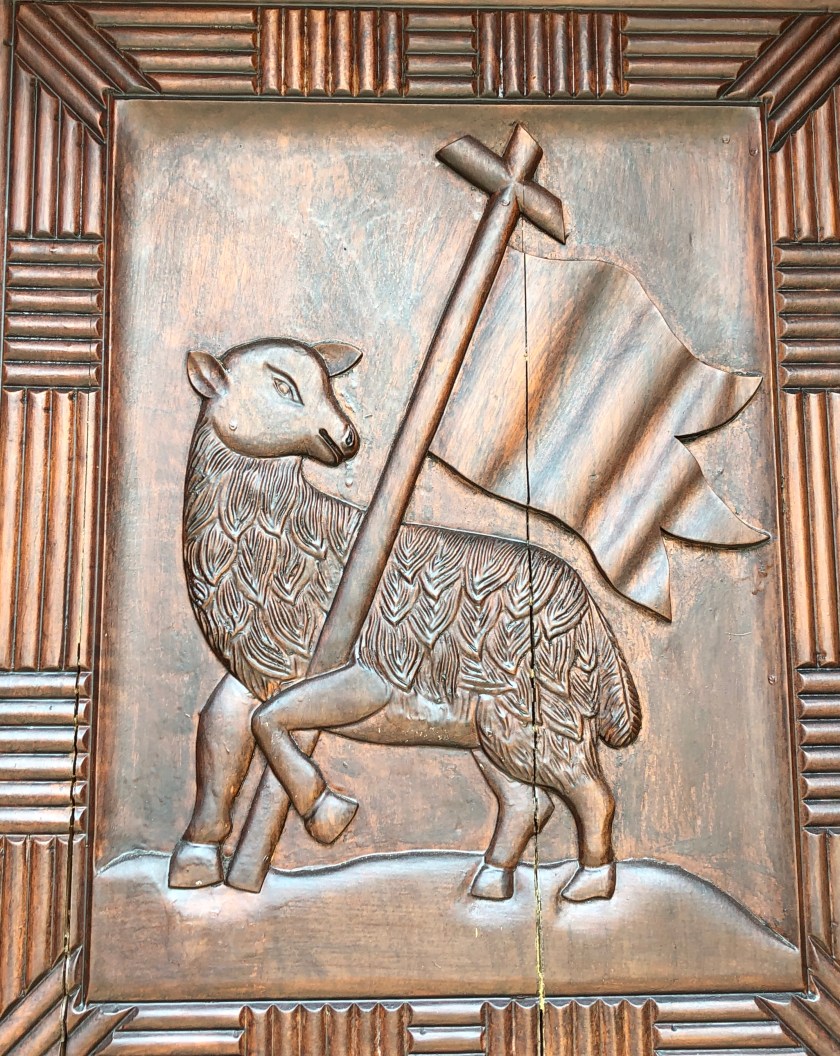
Lord of All These Things

And when he got into the boat, his disciples followed him. And behold, there arose a great storm on the sea, so that the boat was being swamped by the waves; but he was asleep. And they went and woke him, saying, ‘Save us, Lord; we are perishing.’ And he said to them, ‘Why are you afraid, O you of little faith?’ Then he rose and rebuked the winds and the sea, and there was a great calm. And the men marveled, saying, ‘What sort of man is this, that even winds and sea obey him?’” Matthew 8:23-27

Imagining how quickly this storm rose, and that it was so boisterous the seasoned fishermen thought they would drown, we know Jesus did not calm just the space around their vessel. He who made the mountains encircling part of the Sea of Galilee rules the wind currents that ride and swoop over those ridges, and the tumult of the deep waters within. He stirs, and He roils, and He calms just the same, ‘asleep’ and at peace in His sovereign power; and we can rest our souls in Him.

6046CE85-8B81-4258-9654-5D0FD7D071D2_1_201_a

This same Jesus knows our every challenge, every twinge of unwanted jealousy or chafing rub in a relationship, every pang of hurt feelings and unmet longings and not belonging. And He is Lord of all these things. Jesus understands our temptations, the rage of unholy desire and the urge to get revenge or see others get their due. And He is Lord of those things too. Jesus knows our weaknesses and failings and regrets, He is not surprised at our trials or struggles or conundrums, and He is greater than them all, Lord of and over all these things. (Isaiah 45:21; 46:9-10)

“The Most High does not dwell in houses made by hands, as the prophet says, ‘Heaven is my throne, and the earth is my footstool… Did not my hand make all these things?’ Acts 7:48-50

Where am I fearful of life’s turbulence, resisting the spray of stinging water, or set rocking by circumstances beyond my control? Are my eyes wide with sorrow or angst at the unsettled places and unknown dangers, or would I fix them on my Savior at rest, calmly reigning over all these things? Do I shudder at relational conflicts and refuse to believe that sovereign God works invisibly in every storm, and can use the squalls to stretch and change and mature me, and supernaturally achieve His divine purposes through them?

“Peace I leave with you; my peace I give to you. Not as the world gives do I give to you. Let not your hearts be troubled, neither let them be afraid.” “I have said these things to you, that in me you may have peace. In the world you will have tribulation. But take heart; I have overcome the world.” John 14:27; 16:33

In my tempests and when my sea is glass, Sovereign Lord, may I trust You the same. May I so breathe Your Spirit that all is peace, inside and out, to the honor of Your Throne.


Shedding the Old and Journeying On

Terah took Abram his son and Lot the son of Haran, his grandson, and Sarai his son Abram’s wife, and they went forth together from Ur of the Chaldeans to go into the land of Canaan, but when they came to Haran, they settled there. And Terah died in Haran. Now the Lord said to Abram, ‘Go from your country and your kindred and your father’s house to the land that I will show you. And I will make of you a great nation, and I will bless you.., so that you will be a blessing…

“So Abram went, as the Lord had told him. Abram was seventy-five years old when he departed from Haran. And Abram took Sarai his wife, and Lot his brother’s son, and all their possessions,.. and they set out. When they came to the land of Canaan, Abram passed through to the place at Shechem, to the oak of Moreh. At that time the Canaanites were in the land. Then the Lord appeared to Abram and said, ‘To your offspring I will give this land.’ So he built there an altar to the Lord. From there he moved to the hill country and pitched his tent, with Bethel on the west and Ai on the east. And there he built an altar to the Lord and called upon the name of the Lord. And Abram journeyed on, still going toward the Negeb.” Genesis 11:31-12:2,4-9

It is easy to read a couple of paragraphs, watch changing scenes, and think these things transpired quickly. Yet in real time, decades go by and many miles are traveled. At some point in their adult life and so-far childless marriage, Abram and Sarai went with his father Terah from Ur toward Canaan, but stopped in Haran, where Terah settled until his death at least 60 years later. But Abram, 75, determined to heed the call of God, journeyed on southward, traversing 400 miles of enemy land. This shedding the old and entering the new was a process of step-by-step obedience.

I watched wind manhandling heavy, tired palm fronds before dawn this morning, working its push around and through their drying life. The majestic branches had once held their heads high, but over time, became the lower limbs of this regal tree, and would soon drop off.

Isn’t this like so many of our Harans, our habits and comfy places that, as we heed God’s voice, gradually dry up and fall away? Fears, sloth, prejudices, resentments, superior attitudes, resistance to change, can all break off and lose power if we would cut off their food supply and allow the Spirit’s wind to shake them loose. Transformation seldom happens instantaneously, but deliberate, consistent, obedient walking in the Spirit trains new muscles and corrects vision, and over time, we shed our old limps. (Romans 8:9-11; Galatians 5:16)

Not that I have already obtained this or am already perfect, but I press on to make it my own… One thing I do: forgetting what lies behind and straining forward to what lies ahead, I press on toward the goal.” Philippians 3:12-14

Holy Spirit, help me shake off and forget the old, and get in step with Your new for me today. Have full sway in every part of me so I live fully for You. (Isaiah 43:18-19)

Come, Heavy Laden, and Rest

And on the seventh day God finished his work that he had done, and he rested on the seventh day from all his work that he had done. So God blessed the seventh day and made it holy, because on it God rested from all his work that he had done in creation.” “My presence will go with you, and I will give you rest.” “Come to me, all who labor and are heavy laden, and I will give you rest. Take my yoke upon you, and learn from me, for I am gentle and lowly in heart, and you will find rest for your souls. For my yoke is easy, and my burden is light.” “And he said to them, ‘Come away by yourselves to a desolate place and rest a while.’ For many were coming and going, and they had no leisure even to eat.” Genesis 2:2-3; Exodus 33:14; Matthew 11:28-30; Mark 6:31

Rest can be elusive in days of coming and going, and nights of tossing and turning and active minds. There is always much that deters us from rest, yet it is commanded, and exemplified, by our Creator as necessary and good. He who made us also made rest for us. He knows we need it for restoration of our souls, and invites us to find it in His presence. His strong shoulders bear us up, His companionship is our solace.

When we choose rest, urgency’s tyranny loses its hold on us. When we choose rest, our minds are renewed with clean air and fresh insight. When we choose rest, we have time to contemplate the holy, the eternal, to gaze at Almighty God’s wondrous world and nestle close to Jesus’s riven side. When we choose rest, lines blur between what we think important and what God would have us do, and our eyes lift to see the Spirit working and leading and making a divine way for His will to be done.

Why is it so hard to cease the coming and going, to say no to requests, to prioritize demands, to delegate, to simplify? Can we not be satisfied with an excellent job and rest? What self-serving drive compels us to push constantly for more, farther, better? While we are called beyond complacency, we are also called to the humble and desolate alone where it is well with our souls, where there are no comparisons, no compulsions, no fears or even thoughts of missing out on something greater than being with our Lord.

Would we heed His beckon today? Would we take time to practice the blessedness of His present companionship, to get familiar with His heartbeat and enjoy the silences as well as the conversation? Would we bring all the cares and stresses and fears that encumber our thoughts and hamper our steps to Jesus, and submit to His yoke, and learn the joy and balance of a shared load? Would we intentionally come away from whatever pulls our attention and affections and take leisure with Him and His word?

“Jesus, I am resting, resting,
in the joy of what thou art;
I am finding out the greatness
of thy loving heart.”  ~Jean Sophia Pigott (1876)

My loving Lord, thank You for Your invitation to rest. I RSVP with a willing “yes.”

Beautify the House

“Ezra went up from Babylonia. He was a scribe skilled in the Law of Moses that the Lord had given, and the king granted him all that he asked, for the hand of the Lord his God was on him. Ezra had set his heart to study the Law of the Lord, and to do it and to teach his statutes and rules in Israel. ‘And I, Artaxerxes the king, make a decree to all the treasurers in the province Beyond the River: Whatever Ezra the priest, the scribe of the Law of the God of heaven, requires of you, let it be done with all diligence, up to 100 talents of silver, 100 cors of wheat, 100 baths of wine, 100 baths of oil, and salt without prescribing how much. Whatever is decreed by the God of heaven, let it be done in full for the house of the God of heaven…’

“Blessed be the Lord, the God of our fathers, who put such a thing as this into the heart of the king, to beautify the house of the Lord that is in Jerusalem, and who extended to me his steadfast love before the king and his counselors, and before all the king’s mighty officers. I took courage, for the hand of the Lord my God was on me, and I gathered leading men from Israel to go up with me.” Ezra 7:6,10,21-23,27-28

“The Lord said to me, ‘I am watching over my word to perform it.’” “It is God who works in you, both to will and to work for his good pleasure.” Jeremiah 1:12; Philippians 2:13

Ezra’s was a special gifting, a unique call from God, and God’s hand was on him to perform it. No one could imagine that the Persian king Artaxerxes would not only release Ezra and whatever Jews he wanted to take with him to return from exile to Jerusalem, but would supply him all the riches that had been taken in their capture, and grant legal protection and favor. But God does the unimaginable!

Christmas lights in trees, Johnson City, TX

It is Ezra’s attitude and action I admire. Because he was a diligent student of God’s word, making a priority of learning, doing, and teaching it, His God was evident to, and revered by, this foreign king. He also received his assignment with vigor and humility, immediately acknowledging that it was God’s favor and hand that enabled them to return “to beautify the house of the LORD.” There was no want of personal credit or praise or ‘attaboys.’

When we set our hearts to seek and serve the Lord, He enlists us to be a part of adorning His kingdom in manifold ways. Tending wisely and courageously to our work, on mission for God’s purpose, according to His given skills, with the goal of magnifying His beauty, others see Him and not us, and He receives the glory.

In what ways has the Lord called us to beautify the ‘house’ of His church, our homes, our communities and places of work? Are we utilizing all the wisdom, creativity, and energy He supplies? Our material resources and individual talents? How well are we living out His word so others acknowledge Him?

Father, compel me to beautify Your house, apply Your word, and praise Your name wherever I am, all for Your blessing and renown.

The Attraction of Glad and Generous Hearts

And they devoted themselves to the apostles’ teaching and the fellowship, to the breaking of bread and the prayers. 43 And awe came upon every soul, and many wonders and signs were being done through the apostles. 44 And all who believed were together and had all things in common. And they were selling their possessions and belongings and distributing the proceeds to all, as any had need. And day by day, attending the temple together and breaking bread in their homes, they received their food with glad and generous hearts, praising God and having favor with all the people. And the Lord added to their number day by day those who were being saved.” “Now the full number of those who believed were of one heart and soul, and no one said that any of the things that belonged to him was his own, but they had everything in common. And with great power the apostles were giving their testimony to the resurrection of the Lord Jesus, and great grace was upon them all. There was not a needy person among them, for as many as were owners of lands or houses sold them and brought the proceeds of what was sold and laid it at the apostles’ feet, and it was distributed to each as any had need.” Acts 2:42-47; 4:32-35

In a time before social media, there still may have been FOMO, “fear of missing out,” yet in the early days of the church, the fellowship of believers was warm and inviting rather than exclusive. The joy of new belief, and the power and spiritual fire of the Holy Spirit on believers, ignited a zeal for living and sharing and meeting needs that was contagious and irresistible.

A48EA07D-2DFB-45B4-9EC6-F927106F7539_1_201_a

There is something about the Spirit-filled life that sees nothing as mine and all as Gods’ to be given and used for His kingdom, and something about that bounty and generosity exuding from God’s children, that attracts onlookers and draws people in. Our senses, our emotions, can be caught up in swells of joy and affection and attention that are freely offered. Somehow, resistances dissolve, hard hearts soften, grudges begin to melt, and protective layers and masks start to slide away when we are warmly embraced by arms open and overflowing with love.

“By this all people will know that you are my disciples, if you have love for one another.” John 13:35

An effective way to reach a hungry world is to attract them through genuine love and caring, and welcome them in to our fellowship. When we open our homes and lives in glad generosity, holding out the bread of life that satisfies forever, and sincerity that may stupefy, our homes, nor our meals, need not be perfect. What keeps me stingy with my time and stuff? Why do I resist being the uncommon one to invite those outside in? What difference would it make if I offered each day to Jesus, then offered His spiritual food in tangible ways to those He puts in my path? When and where will I set a table of understanding, help, and lavish love for those who need Jesus?

Lord, may the way I gladly love and serve be a magnet for others to know You, that they see and savor Your generous grace.


The Triggers of Thorns and Thistles

And to Adam he said, ‘Because you have listened to the voice of your wife and have eaten of the tree of which I commanded you, “You shall not eat of it,” cursed is the ground because of you; in pain you shall eat of it all the days of your life; thorns and thistles it shall bring forth for you; and you shall eat the plants of the field.'”

Now Adam knew Eve his wife, and she conceived and bore Cain. And again, she bore his brother Abel. Now Abel was a keeper of sheep, and Cain a worker of the ground. In the course of time Cain brought to the LORD an offering of the fruit of the ground, and Abel also brought of the firstborn of his flock and of their fat portions. And the LORD had regard for Abel and his offering, but for Cain and his offering he had no regard. So Cain was very angry, and his face fell. The LORD said to Cain, ‘Why are you angry, and why has your face fallen?  If you do well, will you not be accepted? And if you do not do well, sin is crouching at the door. Its desire is contrary to you, but you must rule over it.’ Cain spoke to Abel his brother. And when they were in the field, Cain rose up against his brother Abel and killed him. Then the LORD said to Cain, ‘Where is Abel your brother?’ He said, ‘I do not know; am I my brother’s keeper?’” Genesis 3:17-18; 4:1-9

A firstborn has a unique position, and Cain was not only his parents’ first child, but the first child to exist on earth, and the first to be born in sin, and it showed. We do not know the source of sibling rivalry or bickering that brewed, but we see tension between the first brothers in the description of their sacrifices to the LORD. Cain brought an offering, Abel brought first fruits. Perhaps the toil with thorns and thistles had gotten the best of this worker of the soil, and Cain resented that any of his hard-earned produce had to be given to a God Who made things hard for him. (Psalm 51:5; Romans 5:12,19)

8B7A751A-34A7-4F7F-8B67-C921D429FD15

Resentment led to selfishness led to comparison led to jealousy led to anger. In mercy, the LORD addressed this sin tendency and offered a way to deliverance, but Cain rebelled and refused and let sin master him. His unchecked anger led to murder, and culpability disguised itself as denial and defensiveness.

Oh, beware the triggers that set off a stream of destruction! We are all victims of the fall, and all face thorns and thistles as a result. Yet we all have the grace of God to lead us to endure and flourish in this world, and can with firm faith rule over sin. (1 Peter 5:8-10)

What sets growing sin’s gangly tentacles in me? Infringements on my ‘rights’ to ease, self-sufficiency, and independence? Coming up short in comparison against another? Someone’s unreasonable request, bad attitude, biting words or tone of voice? Will I accept the Lord’s gracious offer to stem the irritant and step away?

Father, keep me vigilant in recognizing my sin and applying Your grace and victory at first hint. (John 16:33)


“Come, and Have Breakfast.”

Simon Peter, Thomas, Nathanael, the sons of Zebedee, and two others of his disciples were together. Simon Peter said to them, ‘I am going fishing.’ They said to him, ‘We will go with you.’ They went out and got into the boat, but that night they caught nothing. Just as day was breaking, Jesus stood on the shore; yet the disciples did not know that it was Jesus. Jesus said to them, ‘Children, do you have any fish?’ They answered him, ‘No.’ He said to them, ‘Cast the net on the right side of the boat, and you will find some.’ So they cast it, and now they were not able to haul it in, because of the quantity of fish. That disciple whom Jesus loved therefore said to Peter, ‘It is the Lord!’ When Simon Peter heard that it was the Lord, he put on his outer garment, for he was stripped for work, and threw himself into the sea. The other disciples came in the boat, dragging the net full of fish, for they were not far from the land, but about a hundred yards off.

When they got out on land, they saw a charcoal fire in place, with fish laid out on it, and bread. Jesus said to them, ‘Bring some of the fish that you have just caught.’ So Simon Peter went aboard and hauled the net ashore, full of large fish, 153 of them. And although there were so many, the net was not torn. Jesus said to them, ‘Come and have breakfast.’ Now none of the disciples dared ask him, ‘Who are you?’ They knew it was the Lord. Jesus came and took the bread and gave it to them, and so with the fish.” John 21:2-13

It is not often we get interrupted in the middle of our agenda or work and are directed to remarkable success and invited to a lovely meal. But Jesus is not a predictable Sovereign, and delights to reveal Himself extraordinarily in our ordinary.

Raw fish

When I have toiled long and arduously with no results to measure, am I willing to cast my nets in another place? When I have spent dark nights of the soul with tears, with no light or answers, would I look for and sup with my Savior? When I labor according to all the rules, but cannot see His hand, would I listen carefully to recognize and heed His voice, and draw nigh?

“Come, everyone who thirsts, come to the waters; and he who has no money, come, buy and eat! Come, buy wine and milk without money and without price.” “And let the one who hears say, ‘Come.’ And let the one who is thirsty come; let the one who desires take the water of life without price.” Isaiah 55:1; Revelation 22:17

Jesus injects Himself into our every frustration, He appears in our ways and days with a bounty of grace, He redirects our efforts, He offers inexplicable satisfaction to our deepest part. We must press on with open eyes, open ears, open minds and hearts, ever willing to respond anew to His perfect voice. He has charge over outcomes, He alone sates the soul.

Lord, keep me casting my nets at Your instruction, daily nourished by a heavenly breakfast with Thee.


Apply the Hyssop 

 Then Moses called all the elders of Israel and said to them, “Go and select lambs for yourselves according to your clans, and kill the Passover lamb. Take a bunch of hyssop and dip it in the blood that is in the basin, and touch the lintel and the two doorposts with the blood that is in the basin. None of you shall go out of the door of his house until the morning. For the Lord will pass through to strike the Egyptians, and when he sees the blood on the lintel and on the two doorposts, the Lord will pass over the door and will not allow the destroyer to enter your houses to strike you.” Exodus 12:21-23

Purge me with hyssop, and I shall be clean; wash me, and I shall be whiter than snow.” Psalm 51:7

After this, Jesus, knowing that all was now finished, said (to fulfill the Scripture), ‘I thirst.’ A jar full of sour wine stood there, so they put a sponge full of the sour wine on a hyssop branch and held it to his mouth. When Jesus had received the sour wine, he said, ‘It is finished,’ and he bowed his head and gave up his spirit.” John 19:28-30

The hyssop used to spread the blood of the Passover lamb over lintels of doors was a branch of protection from the angel of death, swathing a sign of faith and the mark that would free from slavery.

In David’s prayer of deep repentance, hyssop was requested as the branch of cleansing, and freedom from sin.

At Jesus’s crucifixion, the hyssop branch offering a sponge of vinegar quenched Jesus’s thirst so His work of the cross could be announced as finished. Thus, it wrought freedom, by Christ’s death, from eternal death, that we might live forever in our Savior’s presence.

EF0861F8-5EA8-4607-9AEE-36D203866A1E_1_201_a

Hyssop, an herb in the mint family that was used in ancient times for cleansing, medicinal application, and flavoring, is a sturdy, fragrant creation of God. We can follow its use through Scripture with figurative hands, and apply its properties to our daily needs. Will we hold fast the stalk of God’s promised ministry to us?

Apply the hyssop, Lord, when looms the dreaded death of dreams, hope, vitality, or opportunity. Guard me from its sting, protect me from its victory. Deliver me from fear, and secure me under Your heavenly cover. (Psalm 91:3-6; 1 Corinthians 15:54-55)

Apply the hyssop, Lord, when I fall to temptation. Wash me clean from every sin of thought, my complaining attitudes, my selfish actions, my careless words and huffy tone of voice against others. All are an affront to You. Forgive me. Purify me through and through. Heal me once for all from long-held sin habits, freeing me to new spiritual vitality.

Apply the hyssop, Lord, as I thirst for Thee. In me deepest pain and lack, “as a deer pants for flowing streams, so pants my soul for you, O God.” I yearn for Your grace, for more of Your Holy Spirit, Your wisdom, patience, perspective, strength, zeal, insight, and peace. Slake my thirst until I want no more. You alone satisfy the longing soul. (Psalm 42:1)

Amen.

The Faces of our Places (Or: How Grows Your Garden?)

Jesus went out with his disciples across the brook Kidron, to a place called Gethsemane, where there was a garden. Judas, who betrayed him, also knew the place, for Jesus often met there with his disciples. And he said to his disciples, ‘Sit here while I pray.’ And he took with him Peter and James and John, and began to be greatly distressed and troubled. And he said to them, ‘My soul is very sorrowful, even to death. Remain here and watch.’ And going a little farther, he fell on the ground and prayed, ‘Abba, Father, all things are possible for you. Remove this cup from me. Yet not what I will, but what you will.’ And he came and found them sleeping, and said, ‘Could you not watch one hour?’ And again he went away and prayed, saying the same words. Being in agony he prayed more earnestly; and his sweat became like great drops of blood falling down to the ground. And he came the third time and said to them, ‘Are you still sleeping and taking your rest? It is enough; the hour has come. The Son of Man is betrayed into the hands of sinners. Rise, let us be going; see, my betrayer is at hand.’

“Judas, having procured a band of soldiers and some officers from the chief priests and the Pharisees, [came] with lanterns and torches and weapons. He drew near to Jesus to kiss him, but Jesus said to him, ‘Judas, would you betray the Son of Man with a kiss?‘ So [they] arrested Jesus and bound him.” Mark 14:32-37,39-42; Luke 22:44,47-48; John 18:1-3,12

The garden was a place of regular fellowship, meaningful communion in the cool of shade, sweetened by fragrances of flowering bushes, likely lush hanging pomegranates and figs. A familiar, comfortable, beautiful oasis. But this place of peace and refreshment became a place of disappointment, and sorrow, where Jesus’s closest companions fell asleep after being asked to stay alert and support Him in prayer. It was a place of personal, agonized wrestling in prayer as the Perfect One faced taking on the sin of the world and being forsaken by God, the unblemished Lamb having His hands and feet driven through with crude nails. This hallowed Gethsemane became a place of ultimate surrender of His will to the Father’s. Then it was darkly shadowed by the brutish betrayal of one friend, the cowardly fleeing of others, and his cruel, unjust arrest.

Garden bench, Highlands, NC

A garden has many faces. Special places in our lives can be graced with joy-filled fellowship and contentment. We cherish them and long to stay, undisturbed. But sometimes their peace is brutally interrupted by tragedy, despair, hurt, sorrow. No Gethsemane is consistently peaceful, no garden always free of some weed of confusion, sting of bereavement, or barrenness of soul. 

The Lord gives us gardens to tend, places to meet with him and find comfort. And the communion we share is meant to supply for the seasons of fallowness and suffering, the will to yield to His sovereign plan even when it involves pain.

How does my garden grow? How am I handling the space entrusted to me?

Father, keep me vigilant and surrendered, a faithful tender of the garden You’ve entrusted to me. Bloom here and show forth Your glory.

Set First the Altar

“‘Thus says Cyrus king of Persia: The Lord, the God of heaven, has charged me to build him a house at Jerusalem, which is in Judah. Whoever is among you of all his people, may his God be with him, and let him go up to Jerusalem, which is in Judah, and rebuild the house of the Lord, the God of Israel—he is the God who is in Jerusalem’… Now people of the province came up out of the captivity of those exiles whom Nebuchadnezzar the king of Babylon had carried captive to Babylonia. They returned to Jerusalem and Judah, each to his own town… When the seventh month came, and the children of Israel were in the towns, the people gathered as one man to Jerusalem. Then arose Jeshua the son of Jozadak, with his fellow priests, and Zerubbabel the son of Shealtiel with his kinsmen, and they built the altar of the God of Israel, to offer burnt offerings on it, as it is written in the Law of Moses. They set the altar in its place, for fear was on them because of the peoples of the lands, and they offered burnt offerings on it to the Lord, burnt offerings morning and evening. And they offered the daily burnt offerings, as each day required. From the first day of the seventh month they began to offer burnt offerings to the Lord. But the foundation of the temple of the Lord was not yet laid.” Ezra 1:2-3; 2:1; 3:1-4,6

At the pronouncement and provision of Persia’s king Cyrus, tens of thousands of exiles made their way back to Israel and settled in their towns. The task of rebuilding the temple loomed before them in an uncertain and fearful time, having returned to a land where they were unwelcome. When the priests gathered, their first act was to establish the altar and sacrifice burnt offerings to their LORD according to God’s command.

Cross in stone 5, Turkey

At the start of a new year, or any new calling or untried path, there are unknowns that can bring tentative emotions and fear. We may see the big picture and be overwhelmed at the enormity of a task, and wonder how it can all be done. We may be choked by failing health associated with age, precarious employment, ongoing treatments with unknown results and side effects, significant challenges with children, impenetrable walls in relationships dear to us. Rebuild the whole temple? Impossible! But we can start with first things. We can begin with the altar.

As Elisabeth Elliot would say, “Do the next right thing.” Establishing a regular place and time for worship, laying down our burdens on the altar of Christ’s sufficiency, practicing consistent sacrifice of self-interest and effort, do much to assuage our fears and clarify our perspective. When we set first the altar, the delight it affords fuels our energy and wisdom for next steps.

What fears lurk at present– of what others think, of my loved ones’ choices, of future security? What regrets or failures weigh on my soul? What inordinate responsibilities encumber my mind and mess with my peace?

Sufficient Savior, draw me daily to the altar of Your cross, where You vanquished my burdens forever. Keep me worshiping You first and always. (Hebrews 10:10)