“Your Faith is Showing”

We give thanks to God always for all of you,.. remembering before our God and Father your work of faith and labor of love and steadfastness of hope in our Lord Jesus Christ. For we know, brothers loved by God, that he has chosen you, because our gospel came to you not only in word, but also in power and in the Holy Spirit and with full conviction… You received the word in much affliction, with the joy of the Holy Spirit, so that you became an example to all the believers… For not only has the word of the Lord sounded forth from you in Macedonia and Achaia, but your faith in God has gone forth everywhere… For they themselves report… how you turned to God from idols to serve the living and true God.” 1 Thessalonians 1:2-9

This letter to new believers in Thessalonica must have been a great encouragement. It is one thing to believe, to have your mind and perspective and life-direction change, and another for people to recognize and affirm the changes as becoming on you. Paul expresses his gratitude to God for this young church’s labor and commitment that were marked by faith, love, steadfast hope, and joy. The secret fuel was their receiving of God’s powerful word as truth, and allowing it to work in and through them. In doing so, their transformation from idol-worshipers to God-worshipers in a living and active faith blazed forth as an irresistible beacon in the whole region. (1 Thessalonians 2:13)

fullsizeoutput_5dc5

Does my faith so show and shine? Emulating scriptures’ examples, how eagerly do I offer my best, toil in reverent fear of God even if I do not understand His ways, move out and on in trust He will guide and provide? How readily do I take God at His word, and speak it, believing it is living and active, over others in blessing? Where do I choose to identify with God over enjoying the fleeting pleasures of sin, and serve steadfastly, knowing my labor is not in vain? How willingly do I take risks when God calls, trusting Him with every need, fear, unknown, and result? Are my days and actions marked with courageous sacrifice, joy in suffering, bold loving, unwavering hope? What evidence of my faith in Jesus do those I love and live among see? (Matthew 5:16; 1 Corinthians 15:58; Hebrews 4:12; 11:1-40)

Lord, light up my eyes, keep me rejoicing and singing and purposefully pleasing You. May I not weary in doing good but work and serve wholeheartedly, in Your name, and for Your honor. May all my actions give evidence to my faith in Your character and promises, and magnify You as the trustworthy One Who is worthy of every effort. (Psalm 13:3,5-6; Galatians 6:9; Colossians 3:17,23; 2 Thessalonians 3:13; Hebrews 11:6; James 2:17-18)

More than a Watchman

Give ear to my words, O Lord; consider my groaning. Give attention to the sound of my cry, my King and my God, for to you do I pray. O Lord, in the morning you hear my voice;
in the morning I prepare a sacrifice for you and watch.” “For God alone, O my soul, wait in silence, for my hope is from him.” “My soul waits for the Lord more than watchmen for the morning, more than watchmen for the morning.” Psalm 5:1-3; 62:5; 130:6

A night watchman, stationed on some promontory and with eyes adjusted to the dark, watches like a hawk for any movement, anything amiss, any possible threat. As the hours stretch closer to dawn, his eyes strain toward the horizon, willing the light to arrive. Night after night, the watchman waits with eager anticipation, confident the sun will boast its entrance once again, washing his world with day. O, that I would be so consistent, so vigilant, in prayer!

XSrf+pItSuOpfDfYmKrzeA

As a watchman fulfills his duty, he looks not so much for no disruption, as he is trained and prepared to handle what might come, but he looks for the morning light, under whose realm all will be visible and clear. When I pray, am I like the psalmist, prepared with my sacrifice of praise, of careful words, to the Lord? Do I fix my soul in Him, and eagerly watch, not so much for my answers, my design to unfold, but for His appearance? This watching seems to require less a clarity and direction of vision as an act of the will, a deliberate choice to beseech Him and wait expectantly, not passively, for Him to appear in whatever circumstance or life over which I pray. Watching means stationing myself where I can see, in the word where I understand God’s marvelous and mysterious ways and learn His personality and motivations, in the Body where I behold His wondrous grace and complementary gifts and binding together of His people. It means trusting that He hears and will act, and boldly taking action on His promises.

If we are to wait more than a watchman, we need be aware of the distractions that would steal our attention and distort keen eyes. We need to make preparation of thought, schedule time for prayer, and guard it as our only assignment and purpose, setting aside all that would detract from our intention. We can determine to follow the examples of Daniel, Paul, Epaphras, who diligently and regularly wrestled in prayer. What is keeping us from waiting on God? What are we waiting for? (Daniel 6:10-11; Galatians 4:19; Colossians 4:12)

Lord, establish my soul on Your ramparts! As I ask You to be attentive to my cries, make me fully attentive to You. Awaken expectancy in my daily watching and waiting for You, that when Your morning light appears, You will receive all the praise.

Not All About Me

“If anyone sins in that he hears a public adjuration to testify, and though he is a witness, whether he has seen or come to know the matter, yet does not speak, he shall bear his iniquity.” Leviticus 5:1

It struck me as I read this single verse, tucked into rich and detailed teaching about laws for sin offerings, that from the start, God did not intend for us to live as the center of our universe. It would be easy to read this statement and think the guilty party is the one needing a witness for conviction, or is perhaps the false witness who made an unfair or dishonest charge against the defendant, but in fact, God here holds accountable the one who has known of the matter and refused to testify. His standard is justice, but His means for accomplishing that requires we set aside ourselves for the good of the whole.

I remember how grateful I was for a man, driving a car to the right of mine and entering an intersection beside me at our signal, after a woman ran a red light and hit my car, stopping to give over an hour of his time and care to state a witness report to the police. Dozens of people had witnessed the accident, all moved on around our disturbance and went on their way, but this one turned back to help. His testimony ended up breaking the tie of word-against-word, thus supporting a just resolution, and his example to me is one I will not forget.

IMG_8024

Why testify? It will cause inconvenience, stress, maybe some whispering or misunderstanding. It will take precious time, possibly preparation; certainly it will disrupt my schedule. If we know something that would promote justice and help another, then every excuse not to speak points to self– me, me, me. But life isn’t all about me.

I am not my own, but the Lord’s, bought at the highest price. He calls me to serve others in love, doing nothing from selfish ambition or conceit, but in humility counting others more significant than I, and looking to their interests. How often would I choose to turn my back, divert my eyes, to what I think is my benefit but could really be another’s hurt? Have I ever hindered justice because of my negligence or selfishness? Jesus Himself, in serving perfect justice, gave His life for me; how can I not give back? (John 10:15; 1 Corinthians 6:19; Galatians 5:13; Philippians 2:3-4)

“To serve the present age,
My calling to fulfill:
Oh, may it all my pow’rs engage
To do my Master’s will!                                                                                                                    Arm me with jealous care,
As in Thy sight to live;
And O Thy servant, Lord, prepare
A strict account to give!”  ~ Charles Wesley (1762)

Holy God, fix my eyes on Thee and so wrench them from me. Engage all my faculties– heart, hands, eyes, mouth– to serve others, and in so doing, love You first and best.

Atonement Then and Now

“If anyone sins unintentionally in any of the Lord‘s commandments about things not to be done, and does any one of them, though he did not know it, then realizes his guilt, or the sin which he has committed is made known to him, he shall bear his iniquity. He shall bring to the priest his offering, and the priest shall make atonement for him for the sin which he has committed, the mistake that he made unintentionally, and he shall be forgiven. It is a guilt offering; he has indeed incurred guilt before the Lord.” Leviticus 4:2,22-23,35; 5:17-19

The burden in the Old Testament was that of sin, and the way for which it was atoned. The guilty was to bring an offering to the Priest, who would sacrifice it on his behalf. The only way to be forgiven was through recompense and restitution, and there was a constant stream of sacrificial blood on the altar. The high calling of priests was a heavy and messy burden in itself, requiring regular handling of the sacrifices according to God’s specific commands on behalf of the people. Sin was sin, and holy God would have none of it, so justice must be met through the substitution offering. (Leviticus 11:44-45)

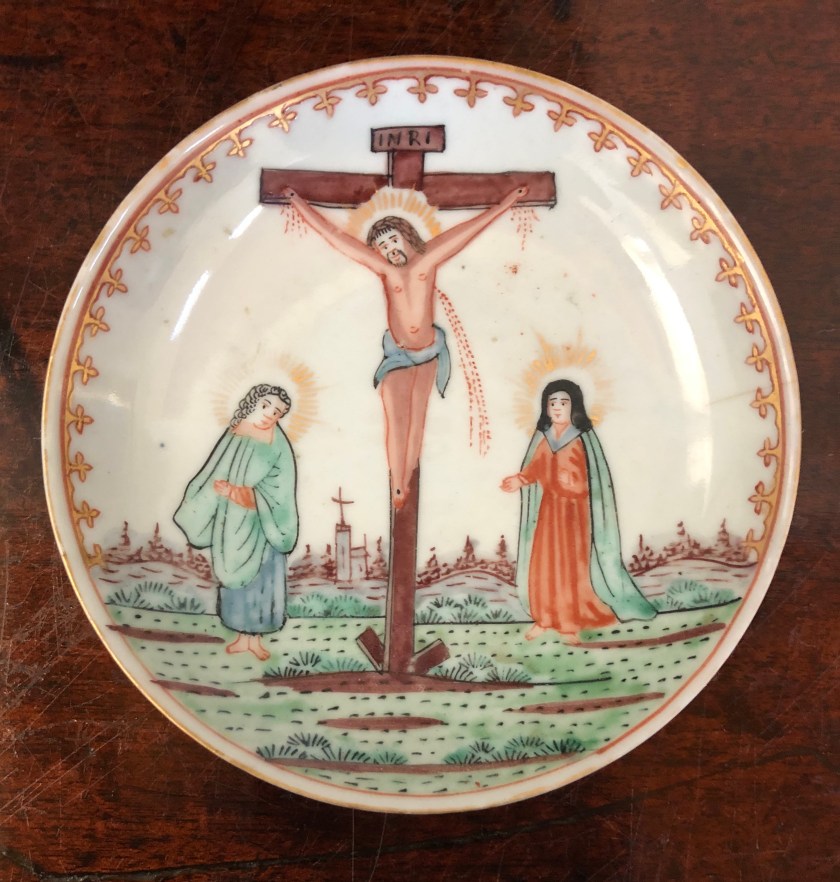
The burden in the New Testament is also that of sin, but by grace and the death of Jesus, our penalty has been paid! Our Great High Priest entered the Most Holy Place once for all, to satisfy justice, to redeem our debt, to win our atonement and secure our sanctification, that there need be no more shedding of blood. He opened the way between man and God forever that we may now directly approach His throne of grace with confidence and gratitude. (Hebrews 4:14-16; 8:11-12,15,26; 10:11-12,19-22)

Crucufixion saucer w Mary, John, Chinese Export 1745

And you, who once were alienated and hostile in mind, doing evil deeds, he has now reconciled in his body of flesh by his death, in order to present you holy and blameless and above reproach before him… you [who] were dead in your trespasses, God made alive together with him, having forgiven us all our trespasses, by canceling the record of debt that stood against us with its legal demands. This he set aside, nailing it to the cross.” “If we confess our sins, he is faithful and just to forgive us our sins and to cleanse us from all unrighteousness.” Colossians 1:21-22; 2:13-14; 1 John 1:9

On this side of the cross, an added gift for us is the indwelling Holy Spirit, Who warns and counsels us against sin, Who gives power to withstand temptation, Who convicts of even unintentional sin, making us aware of our erring thoughts and ways. He is the One Who teaches us the deep things of God and fills our hearts with joy at understanding the application of our blessed atonement. The Spirit indwells us, guaranteeing our eternal inheritance and enabling us to bear His manifold fruit. Atoned for, “at-one” with Him, we are freed from guilt and free to live for His glory. (John 14:15-16; 16:8-11,13; Romans 6:6-14; Galatians 5:22-23; Ephesians 1:14; 6:13-17)

Father, help me daily live in the truth and freedom and assurance of the atonement accomplished by Jesus, to the praise of Your immeasurable love and mercy and glory.

Surrounded

O Lord, how many are my foes! Many are rising against me; many are saying of my soul, ‘There is no salvation for him in God.’ But you, O LORD, are a shield about me, my glory, and the lifter of my head. I cried aloud to the LORD, and he answered me from his holy hill.  I lay down and slept; I woke again, for the LORD sustained me. I will not be afraid of many thousands of people who have set themselves against me all around.” Psalm 3:1-6

David wrote this psalm when he was fleeing his impetuous son Absalom, who had ordered the murder of his half-brother Amnon for raping his sister, set General Joab’s field afire, conjured up a revolt by stealing the hearts of Israel, and conspired to take over the kingdom in his father’s stead. At the time, although he still had hundreds of loyal supporters, all was bleak for David as he wrestled with a broken heart and fear for Israel’s future. I imagine him overwhelmed with grief and regret at realizing the sons of his flesh had repeated his own sins of lust and murder, and the consequences were coming hard and fast, and reeling with a sense he’d failed again as a father and as the righteous leader God had in grace called him to be. David knew deep in his soul that the LORD would never leave him or fail at His purposes, yet the foes of opposition and doubt all around him snarled a deafening chant against what was true. Until David looked up. His God, his shield all around him, lifted his head and heard his cry. (2 Samuel 7:8-13; 13:1-15:18)

IMG_7865

There are days when it seems every way we turn, where there are decisions to be made, temptations to flee, conflicts to handle, tasks to perform, pressures to achieve, opposition to combat, we’re surrounded by enemies taunting us with doubt, discouragement, depression. ‘God isn’t really interested, you are a loser, that habit can never be broken, you’ll never get well, what difference do you make?’ When we listen to these ‘thousands’ round about us, we succumb to defeat, but when we recognize we are surrounded by the LORD our shield and lifter of our heads, our perspective changes to one of courage, trust, and peace. Wrapped securely in the LORD, we might hear, but cannot be touched by, the enemy.

“The beloved of the Lord dwells in safety. The High God surrounds him all day long, and dwells between his shoulders.” “You are a hiding place for me; you preserve me from trouble; you surround me with shouts of deliverance. Steadfast love surrounds the one who trusts in the LORD.” “As the mountains surround Jerusalem, so the LORD surrounds his people, from this time forth and forevermore.” Deuteronomy 33:12; Psalm 32:7,10; 125:2

My LORD and Shield, please give me the wherewithal to shrug off enemy voices and lift my head above any doubt or despairing to You. Attune my ears to Your truth, and cause me to live freely in the joy of my salvation, the surrounding of Your grace, the splendor of Your glory. (Psalm 51:11-12)

See and Be Glad

On the evening of that day, the first day of the week, the doors being locked where the disciples were for fear of the Jews, Jesus came and stood among them and said to them, ‘Peace be with you.’ When he had said this, he showed them his hands and his side. Then the disciples were glad when they saw the Lord.” John 20:19-20

Sorrow, confusion, fear had all gripped the disciples since Jesus’s death, and into this muddle of hard emotion walked their Savior of peace. When they saw Him, they were glad. Focusing on the horrors of their friend’s crucifixion and being marked as His followers had left them shaky, but once the Prince of Peace entered their stew, all was well. Gladness comes when we gaze at Jesus.

Dwelling on what we do not understand, on our perceived losses that come with change, on what-ifs and supposing that may never come to pass, on the uncertainty that arises when we cannot control a situation or future plans, keeps us in a place of fretting, hand-wringing, unease. But when we lift our eyes to the One Who rules the wind and waves and speaks into our whirlwind, with resolve to trust the Trustworthy, we can be glad. (Job 38:1-11)

DSC_0571

Recently a loved one called to tell me how a situation had turned for the worse, but with tears through a smile I could hear, she said, “But there is so much joy, because I prayed, and this is a clear answer.” In the midst of disappointment, she had looked for Jesus, and saw Him. When the sea became rough for the disciples on a night crossing, they nearly choked in their efforts against the strong blow until Jesus appeared, and “they were glad to take Him in.” I recall countless times when I have wrestled in specific prayer, taking captive thoughts when they strayed from Him, and was on tiptoe, bursting to rejoice when He answered. Looking for Jesus builds expectation in the unfolding of His good working in our lives, adjusts our vision to recognize His activity and new facets of His character and ways, increases our faith. (John 6:16-21; Romans 8:28; 2 Corinthians 10:5)

“O soul, are you weary and troubled? No light in the darkness you see?
There’s light for a look at the Savior, And life more abundant and free.                              Turn your eyes upon Jesus, Look full in His wonderful face,
And the things of earth will grow strangely dim, In the light of His glory and grace.”          
            ~Helen Howarth Lemmel

When it seems every path is a detour, look for Jesus. When the valley is shrouded in shadow, look for Jesus. When life is humming along and suddenly takes a tragic turn, look for Jesus. When the adjective for everything in life from discipline to passion to energy is “dry,” look for Jesus. Look, see, and be glad, because He is present and will never fail to accomplish His glorious work. (Isaiah 46:9-10)

Lord, grant me the will and eyes to look at You, and for You, in every circumstance. Make me glad with Your presence in such a way that others see You also.


A Countenance Ashine

When Moses came down from Mount Sinai, with the two tablets of the testimony in his hand as he came down from the mountain, Moses did not know that the skin of his face shone because he had been talking with God. Aaron and all the people of Israel saw Moses, and behold, the skin of his face shone, and they were afraid to come near him. But Moses called to them, and Aaron and all the leaders of the congregation returned to him, and all the people of Israel came near, and he commanded them all that the Lord had spoken with him in Mount Sinai. And when Moses had finished speaking with them, he put a veil over his face. Whenever Moses went in before the Lord to speak with him, he would remove the veil, until he came out. And when he came out and told the people what he was commanded, the people of Israel would see the face of Moses, that the skin of Moses’ face was shining. And Moses would put the veil over his face again, until he went in to speak with him.” Exodus 34:29-35

This mysterious shekinah glory that emanated from God Himself and was reflected in the face of Moses intrigues and fascinates me, and makes me want some. It is as though Moses’s countenance, as he conversed with the Lord, absorbed a glimpse of His very character, the beauty, the shining splendor that emanated from Him, and could not contain it. We know God was not present in human form, but I delight in the picture of intimate communion between these ‘friends,’ imagining the warmth and light shared in that holy space, and the divine ‘mantle’ Moses carried out of the tent with him. (Exodus 33:11; Deuteronomy 34:10)

Sunrise grey and yellow w rays behind clouds

I have known people who, when I spend time with them or hear them teach, have obviously been with Jesus, basking in His presence. They have a sense about them, a serenity, a ‘glow,’ a knowing, a humility blended with extraordinary and winsome boldness, and they make the Lord attractive, even irresistible. This I admire, this I desire. (Acts 4:13)

Spending time face to face with our Lord, where we are vulnerable and receptive, enables Him to transform our countenance, and fill us with wisdom and gladness we can then share with others. When He shines in and through us, He makes us inviting, and divinely draws them to see and adore Him. A man’s wisdom makes his face shine, and the hardness of his face is changed.” “A glad heart makes a cheerful face.” “For God, who said, ‘Let light shine out of darkness,’ has shone in our hearts to give the light of the knowledge of the glory of God in the face of Jesus Christ.” (Ecclesiastes 8:1; Proverbs 15:13; 2 Corinthians 4:6)

Glorious Lord, lift Your countenance upon me, infuse my demeanor and expression with Your shining and irresistible glory, that all I encounter see I have been with You, and want to be with you also. (Numbers 6:24-26)

Take My Hands

Then Pilate took Jesus and flogged him. And the soldiers twisted together a crown of thorns and put it on his head and arrayed him in a purple robe. They came up to him, saying, ‘Hail, King of the Jews!’ and struck him with their hands…Pilate said to [the Jews], ‘Then what shall I do with Jesus who is called Christ?’ They all said, ‘Let him be crucified!’ And he said, ‘Why? What evil has he done?’ But they shouted all the more, ‘Let him be crucified!’ So when Pilate saw that he was gaining nothing, but rather that a riot was beginning, he took water and washed his hands before the crowd, saying, ‘I am innocent of this man’s blood… Take him yourselves and crucify him, for I find no guilt in him…’ And they crucified him… Eight days later… Jesus came and stood among them and said to Thomas, ‘Put your finger here, and see my hands.'” John 19:1-3,6; 20:26-27; Matthew 27:24; Mark 15:24

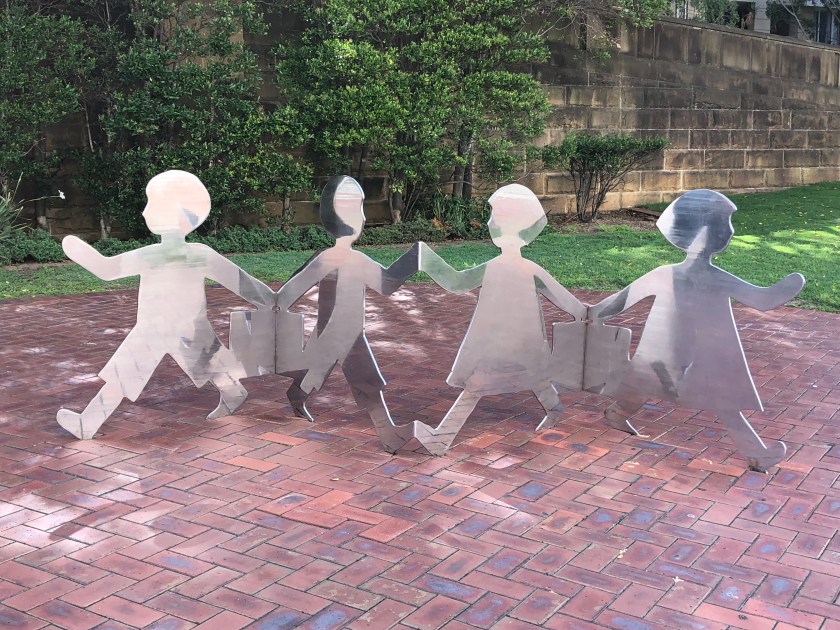
What a contrast there is, in the few verses describing the crucifixion, in the use of hands, the magnificent creation of God and gift to His people. Imagine the soldiers’ rough, strong fingers tying shards of stone onto the ends of leather strips to make a many-corded whip for His flogging, and calloused hands that have just gripped that whip forming a crown of thorns and pressing it onto Jesus’s head, then balling into fists to strike him, then hammer metal through His skin. Pilate, in comparison, unnerved by the crowd fomenting violence, opened his weak, soft hands upward, shrugging, ‘I don’t get you and this is not my fault– you are making me do this,’ then washed them illustratively in front of them.

But our Savior’s hands, the carpenter’s careful, creative hands that had soothed the anxious and touched outcast lepers, written in the dirt and made mud for healing, raised bread to heaven in thanksgiving before breaking it to feed thousands, washed the disciples’ feet, served them wine, these hands were pierced through, with thick nails, to a cross. These hands bore His weight as well as the weight of all our sin, and became, after the resurrection, the scarred hands that awakened faith and fed the disciples and lifted over them in the blessing of a call and power. (Matthew 28:18-20; Luke 24:50; John 20:25-28; 21:9-13)

Hands in sidewalk, Sydney

How do I position my hands? When I raise them high in worship, and open them to be used for God’s will, He infuses them with compassion, strength, gentleness, generosity, a knowing of where to go and whom to serve. But when I ball them up, clutching my selfish will and wants, I not only resist God’s prompting but can actually, driven by my own impulses, slap Him in the face, brush off His inspiration, push away His instruction, stop my ears to His truth.

And how do I use my hands? Do I deliver death, or life? Do I construct edifices to self, amass what does not last, busy myself with meaningless activity, idle them in sloth? Or am I serving others, creating beauty that shines God’s loveliness, expressing affection, writing encouragement, touching away tears, holding hands of the sad, lonely?

Lord, take my hands and let them move at the impulse of Thy love, as Yours always have for me. (Inspired by Frances Havergal)

“Blessed Is Everyone Who Fears The Lord!”

“Blessed is everyone who fears the Lord!” “The fear of the Lord is the beginning of knowledge.” “The fear of the Lord is hatred of evil.” “The fear of the Lord is the beginning of wisdom, and the knowledge of the Holy One is insight.” “In the fear of the Lord one has strong confidence, and his children will have a refuge. The fear of the Lord is a fountain of life, that one may turn away from the snares of death.” “The fear of the Lord is instruction in wisdom.” “By the fear of the Lord one turns away from evil.” Psalm 128:1; Proverbs 1:7; 8:13; 9:10; 14:26-27; 15:33; 16:6 

When I ponder the fear of the Lord, I think about the current confusion between truth and feeling. I heard a modern poet quoted yesterday as saying, ‘People will not remember what you said, but how you made them feel.’ In so many spaces in our culture today, feelings have trumped truth as the raison d’être, the standard for making decisions and legislation, the justification for action and reaction.

The fear of God felt by most in the world stems not from accurate knowledge of Him but from perceptions rooted in feelings that can change on a whim. Media and societal dictates, inner struggles with changing emotions, guilt, and misunderstanding, the insatiable desire to have my opinions validated as gospel, have a right to do things my way, and have my choices condoned and celebrated, all confuse the true image of God. These misperceptions drive me to assume He is mean, a kill-joy, an angry, bellicose tyrant; therefore, I can only tremble but never approach Him.

NZ, beach w snow-topped mountains, sun in clouds

God’s word teaches us a different perspective. The fear we are to have of the Lord is not one of feeling, but one based on truth; it is a proper understanding of, with consequent humble reverence for, all our great and infinite God is. When we grow in our understanding of His creative perfection, justice, love, purity, sovereignty, He is magnified, and we recognize our rightful smaller place before Him. We are not diminished in any way, we do not cower or cringe; we are His image-bearers of whom He is benevolently mindful, crowned with glory and honor, treasured by Him, yet beneath Him. (Psalm 8:3-6)

Our fear of the Lord brings the blessings of wisdom, knowledge, understanding; it gives us strong confidence and is a fountain of life. Fearing God guards our way from evil, giving hatred for it and strength to turn from it. Over the years, I have prayed our children and grandchildren will fear the Lord, develop a deep understanding of His supremacy and worship Him appropriately. I desire they be filled with wisdom and guarded in their ways. This is the life He promises to bless!

Almighty, sovereign King of kings, teach me to fear You aright, in humility, love, gratitude, and praise. You are very great, and by Your redemption You make me worthy to be called Your own. You are God, and I am not. May I worship You always in Spirit and truth. (John 4:23-24)


All the Work

Thus all the work of the tabernacle of the tent of meeting was finished, and the people of Israel did according to all that the LORD had commanded Moses; so they did. Then they brought the tabernacle to Moses, the tent and all its utensils, its hooks, its frames, its bars, its pillars, and its bases; the covering of tanned rams’ skins and goatskins, and the veil of the screen; the ark of the testimony with its poles and the mercy seat; the table with all its utensils, and the bread of the Presence; the lampstand of pure gold and its lamps with the lamps set and all its utensils, and the oil for the light; the golden altar, the anointing oil and the fragrant incense, and the screen for the entrance of the tent; the bronze altar, and its grating of bronze, its poles, and all its utensils; the basin and its stand; the hangings of the court, its pillars, and its bases, and the screen for the gate of the court, its cords, and its pegs; and all the utensils for the service of the tabernacle, for the tent of meeting; the finely worked garments for ministering in the Holy Place, the holy garments for Aaron and his sons for their service as priests. According to all that the Lord had commanded Moses, so the people of Israel had done all the work. And Moses saw all the work, and behold, they had done it; as the LORD had commanded, so had they done it. Then Moses blessed them.” Exodus 39:32-43

All the details, precision, artistry, exact measuring, carving, weaving, constructing… all the work God had prescribed was completed, and Moses blessed the people. I imagine his hands lifted, his countenance bright, his words of favor and God’s delight in their work washing over them like welcome spring rain. Well done, good and faithful servants. You have listened, set your minds and hands to task, persisted to completion, and your Master is satisfied.

DSC_0034

When opportunities are presented and invitations extended, I need to make sure they align with God’s plans for me. I know from experience that when I add “fluff,” I steal energy, time, and concentration from what matters for what does not. Do I expend effort for His kingdom first, seeking eternal treasure, making the best use of time, or waste my days and resources on insignificant pastimes? The Lord had a grand plan to unite His people in the work that would prepare them for worship, ultimately for intimate life with Him at the center and fore, and though each had a separate and specific part, and sometimes that was a menial task, in His plan every segment was worthy and would fit together. He calls us to do our part for the proper working of His big plan, His high and broad purposes. (Matthew 6:19-21,33; Romans 12:11,16; Ephesians 5:15-16)

Lord, may I be diligent to accomplish the works, large and small, for which You have made and sent me, while it is still day. Teach me to redeem my time, grant me the will to heed Your instruction and wisdom to build until all my work is complete, all for Your blessing and glory. (Psalm 90:12; Proverbs 14:1; John 4:34; 9:4)