Take With You Words

“Return, O Israel, to the Lord your God, for you have stumbled because of your iniquity. Take with you words and return to the Lord; say to him,Take away all iniquityAssyria shall not save us; we will not ride on horses; and we will say no more, Our God,to the work of our hands. In you the orphan finds mercy. Hosea 14:1-3

In a culture of fractured civility, ruthless violence, almost non-existent courtesy; in a world rife with pride run amok, injustice, persecution, why is it so hard to admit sin? How can we see so clearly the splinters in others’ eyes and not the planks in our own? How can we be certain of another’s nefarious motives and not recognize the malice in ours? (Matthew 7:1-5) Hosea calls us here to return to the Lord, and specifically to use words when confessing sin. Name them, lay them out, pin them to the cross.

God’s word exposes us to its spotlight of truth, it’s standard of righteousness. For the word of God is living and active, sharper than any two-edged sword, piercing to the division of soul and of spirit, of joints and of marrow, and discerning the thoughts and intentions of the heart.Taking time in it shows up our faulty thinking, convicts of our every unkind remark, sigh of spirit, condescending attitude, penchant for recognition, self-focused insecurity, prejudice against others and for our own comforts, inordinate affections. It takes discipline and desire to allow the Spirit to convict and teach us the words to bring in repentance, but the reward is great. (Hebrews 4:12)

Hosea goes on to say God will heal, love freely, turn His anger, be like our dew, cause to blossom and take root and spread out in beauty and fragrance and flourish beneath His shadow. What blessings we miss in not returning to Him! What goodness and fulfillment He has for us!

O God, I have heard Your call to return; I come. You are my God, my Lord and the strength of my salvation, and I know You hear the voice of my pleas for mercy. Cleanse, restore, that I may flourish for Thee. (Psalm 140:6)

Early My Song Shall Rise

“This is the day the LORD has made; let us rejoice and be glad in it.” Psalm 118:24

Our little grandson was lying awake one morning when I went in to his room and asked, “Have you been awake long? What have you been doing?” With a contented, peaceful expression he replied, “I’ve just been lying here thinking about all the things God made.”

“The steadfast love of the Lord never ceases, His mercies never come to an end, they are new every morning.” Lamentations 3:22-23

For many years I have prayed our children’s first thought in the morning and last thought before falling asleep would be Jesus.

“Holy, Holy, Holy, Lord God Almighty, early in the morning my song shall rise to Thee; Holy, holy, holy, merciful and mighty, God in three persons, blessed Trinity.” ~Reginald Heber (1826)

I recently asked a dear friend who is suffering with cancer what she thought about when she awoke. She said she recites the Covenant Prayer:

“I am no longer my own, but Yours, put me to what You will, rank me with whom You will; put me to doing, put me to suffering; let me be exalted for You or brought low for You; let me be full, let me be empty; let me have all things, let me have nothing; I freely and heartily yield all things to Your pleasure and disposal. And now, glorious and blessed God: Father, Son, and Holy Spirit, You are mine, and I am Yours. So be it. And the covenant I have made on earth, let it be ratified in heaven.”

Most mornings when I awaken, I sing a refrain I learned in Sunday school as a child, “Thank You, Lord, for saving my soul; thank you, Lord, for making me whole; thank you, Lord, for giving to me my great salvation so rich and free.” Other favorites are simple hymns we sang in school: “God, be in my hands, and in my doing, God be in my mind and in my understanding…” and “Awake, my soul, and with the sun my daily stage of duty run; shake off dull sloth and joyful rise, to pay thy morning sacrifice!”

Often I also pray Psalm 19:14, “May the words of my mouth and the meditations of my heart be pleasing in Thy sight, O Lord, my Rock and my Redeemer,” or the commitment of Romans 12:1-2: “I offer my body a living sacrifice, holy and pleasing to You as a spiritual act of worship. Let me not be conformed to this world, but be transformed by the renewing of my mind, so I may prove what is Your good, pleasing and perfect will.”

Each new day is a gift from God and an opportunity to live for Him, to rejoice and thank Him, to offer ourselves to Him for His kingdom purposes and glory. What occupies its first moments?

Bright Morning Star, captivate me when I awake each day, and fix my gaze, my thoughts, my affections on Thee. You know what lies ahead, and a praise-filled attitude will influence all as I connect with You first to set my priorities right and to know the way to go. Stamp every agenda, each list, concern, motivation, task, effort, with a blazoning “REJOICE.” (Revelation 22:16; 1 Thessalonians 5:16-17).

The Test of Treasures

“And Hezekiah had very great riches and honor, and he made for himself treasuries for silver, for gold, for precious stones, for spices, for shields, and for all kinds of costly vessels; storehouses also for the yield of grain, wine, and oil; and stalls for all kinds of cattle, and sheepfolds. He likewise provided cities for himself, and flocks and herds in abundance, for God had given him very great possessions. And Hezekiah prospered in all his works. And so in the matter of the envoys of the princes of Babylon, who had been sent to him to inquire about the sign that had been done in the land, God left him to himself, in order to test him and to know all that was in his heart. But Hezekiah did not make return according to the benefit done to him, for his heart was proud.” 2 Chronicles 32:27-31;25

“At that time Merodach-baladan the son of Baladan, king of Babylon, sent envoys with letters and a present to Hezekiah, for he heard that Hezekiah had been sick. And Hezekiah welcomed them, and he showed them all his treasure house, the silver, the gold, the spices, the precious oil, his armory, all that was found in his storehouses. There was nothing in his house or in all his realm that Hezekiah did not show them. Then Isaiah the prophet came to King Hezekiah, and said to him, ‘What did these men say? And from where did they come to you?’ And Hezekiah said, ‘They have come from a far country, from Babylon.’ He said, ‘What have they seen in your house?’ And Hezekiah answered, ‘They have seen all that is in my house; there is nothing in my storehouses that I did not show them.’ Then Isaiah said to Hezekiah, ‘Hear the word of the Lord: Behold, the days are coming, when all that is in your house, and that which your fathers have stored up till this day, shall be carried to Babylon. Nothing shall be left, says the Lord.’” 2 Kings 20:12-17

I love King Hezekiah, have always been moved by his whole heart for God, his expense of will, effort, energy in leading his people for God’s cause and glory. And I get frustrated at his lapse near the end of his life- I want him to be perfect! But gracious God, as He always does, keeps interest in our hearts, and gives a test by way of an envoy from Babylon who visits him after he’s healed from what would have been a life-ending illness. We’re told humble, righteous Hezekiah allows the puff of his success to gnarl into pride, and once he opens a door, he can’t stop opening. Is the order, the beauty, the sheer amount of his treasure, intoxicating? Has it become an idol he can’t help but flaunt? His new identity before fawning foreigners? Surely, it is his downfall, a sad decline after a life spent for his God.

Yet God, Who is rich in mercy, intervenes. “But Hezekiah humbled himself for the pride of his heart…so that the wrath of God did not come upon them in [his] days.” (2 Chronicles 32:26)

What has God entrusted to me that I am tempted to call my own, to claim as my accomplishment? Where am I tempted to security in my buffer, or beautiful things, or comforts? Is there anything I have valued that has taken on too much value to me- family members? Role or position? Work? Relationships? Place or things? In what areas am I tempted to treasure first anything apart from Christ? (Matthew 6:19-21,33)

Lord, You give such bounty. May I never ‘graze and become full, and being filled, let my heart be lifted up.’ With a loose hold on every treasure, may I love You with all my heart, mind, soul and strength, and ever voice Your excellencies and praise. (Hosea 3:6; Matthew 6:22:37)

When the Heat Turns Up

“As soon as King Hezekiah heard it, he tore his clothes and covered himself with sackcloth and went into the house of the Lord. And he sent Eliakim, who was over the household, and Shebna the secretary, and the senior priests, covered with sackcloth, to the prophet Isaiah. They said to him, ‘lift up your prayer for the remnant that is left. Isaiah said to them, Say to your master, Thus says the Lord: Do not be afraid because of the words that you have heard, with which the servants of the king of Assyria have reviled me.“‘ … Hezekiah received the letter from the hand of the messengers and read it; and Hezekiah went up to the house of the Lord and spread it before the Lord. And Hezekiah prayed before the Lord and said: O Lord, the God of Israel, enthroned above the cherubim, you are the God, you alone, of all the kingdoms of the earth; you have made heaven and earth. Incline your ear, O Lord, and hear; open your eyes, O Lord, and see; and hear the words of Sennacherib, which he has sent to mock the living God. Truly, O Lord, the kings of Assyria have laid waste the nations and their lands and have cast their gods into the fire, for they were not gods, but the work of men’s hands, wood and stone. Therefore they were destroyed. So now, O Lord our God, save us, please, from his hand, that all the kingdoms of the earth may know that you, O Lord, are God alone.Then Isaiah the son of Amoz sent to Hezekiah, saying, Thus says the Lord, the God of Israel: Your prayer to me about Sennacherib king of Assyria I have heard.‘” 2 Kings 19:1,4,6,14-20

We learn in chapter 18 that godly King Hezekiah, who “trusted and held fast to the LORD,” was faced with formidable military hostility from Sennacherib king of Assyria, as well as his taunting- if other gods had not saved the countries he’d already conquered, how would Israel’s God save them? Hezekiah was fit with God’s armor- the belt of truth and breastplate of righteousness- and he held fast to his shield of faith and sword of God’s true word, so his immediate response to the threats was to turn to Him. He requested prayer from his trusted advisor, the prophet Isaiah, and went to the Lord himself, praying reverently, boldly, and specifically. He filled his mind with God, not himself or his circumstances. He pled according to God’s power and for the honor of His name and reputation among the nations. (Ephesians 6:12-18)

Hezekiah did not wring his hands, he did not fret. He did not consult with others or waste time complaining about his enemy or plotting strategies against him. He knew that he knew that the LORD was great and above all gods, and he knew he could trust his impossible need with Him. Am I inclined to do the same? (Psalm 135:5,13,15-18)

O King of kings and God of gods, in the heat of conflict, threats, blatant immorality, ravages of disease, pain of sin’s consequences, You are our impenetrable Defense and perfect Offense. You are God alone, and knowing all, You do all You have determined. Keep me in the secret place of prayer and full trust, and act for Your fame in every situation. (2 Kings 19:25,27)

Once…, but Now

“In the place where it was said to them, ‘You are not my people,’ it shall be said to them, ‘Children of the living God.’” “Once you were not a people, but now you are God’s people; once you had not received mercy, but now you have received mercy.” Hosea 1:10; 1 Peter 2:10

“We ourselves were once foolish, disobedient, led astray, slaves to various passions and pleasures, passing our days in malice and envy, hated by others and hating one another. But when the goodness and loving kindness of God our Savior appeared, he saved us, not because of works done by us in righteousness, but according to his own mercy, by the washing of regeneration and renewal of the Holy Spirit, whom he poured out on us richly through Jesus Christ our Savior, so that being justified by his grace we might become heirs according to the hope of eternal life.” Titus 3:3-7

Between the ‘onces’ and ‘nows’ in our lives can lie moments or months, crises or celebrations, circumstances beyond our control or willful decisions. What is sure is that in spiritual onces and nows, it is the great God Who intervenes in marvelous mercy and kindness. He is the amazing change agent.

Fall trees, St. Louis

No matter how much effort I expend to “better myself,” to change my habits, to “get through this, solve this,” God so works in my life to prove it is only He Who quickens the rebel spirit, transforms the affections, gives life to the dead, inspires the will, makes enemies friends, redeems the lost. ‘Onces’ can only become certain ‘nows’ by being plunged into His deep work of mercy and grace, accomplished by Jesus in His death and resurrection. No human toil or resolve can do the work only He can do— but thanks be to God, He does it! (Ephesians 2:1-5;5:8)

Father, with You is steadfast love and plentiful redemption; You alone redeem me from all my iniquities. You alone call me out of darkness into Your marvelous light, and I marvel at Your mercy. Take all that is dark, mean, resistant, unkind, self-absorbed in me and make it “once.” Plant me in Your “now,” so with a grateful and whole heart, and with all my doing, I ever proclaim Your excellencies. (Psalm 130:7-8; 1 Peter 2:9)

Postures of Prayer

In the first year of Darius’s reign, I, Daniel, perceived in the books the number of years that, according to the word of the Lord, must pass before the end of the desolations of Jerusalem, namely, seventy years. Then I turned my face to the Lord God, seeking him by prayer and pleas for mercy with fasting and sackcloth and ashes. I prayed to the Lord my God and made confession, saying, ‘O Lord, the great and awesome God, who keeps covenant and steadfast love with those who love him and keep his commandments, we have sinned and done wrong and acted wickedly and rebelled, turning aside from your commandments and rules. To you, O Lord, belongs righteousness. To us, O Lord, belongs open shame, to our kings, to our princes, and to our fathers, because we have sinned against you. To the Lord our God belong mercy and forgiveness, for we have rebelled against him and have not obeyed the voice of the Lord our God by walking in his laws. O Lord, according to all your righteous acts, let your anger and your wrath turn away from your city Jerusalem because for our sins. Now therefore, O our God, listen to the prayer of your servant and to his pleas for mercy, and for your own sake, O Lord, make your face to shine upon your sanctuary, which is desolate. O my God, incline your ear and hear. Open your eyes and see our desolations, and the city that is called by your name. For we do not present our pleas before you because of our righteousness, but because of your great mercy. O Lord, hear; O Lord, forgive. O Lord, pay attention and act. Delay not, for your own sake, O my God, because your city and your people are called by your name.’

“While I was speaking and praying, confessing my sin and the sin of my people Israel, and presenting my plea before the Lord my God for the holy hill of my God, while I was speaking in prayer, the man Gabriel, whom I had seen in the vision at the first, came to me in swift flight at the time of the evening sacrifice. He made me understand, speaking with me and saying, ‘O Daniel, I have now come out to give you insight and understanding. At the beginning of your pleas for mercy a word went out, and I have come to tell it to you, for you are greatly loved. Therefore consider the word and understand the vision.’” Daniel 9:1-5,7-10,16-23

There are several things that strike me about Daniel’s postures of prayer in this exquisite passage. When he, knowing the calendar, thoughtfully contemplates God’s specific promises to Israel, he brings his plea directly to the Lord. No picking up his phone, no gathering of friends, no “Who should I tell or discuss this with?”— his posture was always to pray. God was his closest confidante as well as the Sovereign over time and times, the One Who was personal and merciful and would hear his plea.

And when he turns to prayer, his posture is humility before his exalted King of kings, appealing to His grace and benevolence. Daniel does not appear at his Benefactor’s throne as a rightful beneficiary with a list of requests, but as one who gratefully, humbly understands even his access to Him is a merciful gift. He confesses personal and national sin (though no sin of his is ever recorded), acknowledging that his plea is based solely on God’s merciful kindness. What beauty in the statement, “While he was praying…”! It is in the very posture of worship and dependence, pleading and waiting, that God is at work answering!
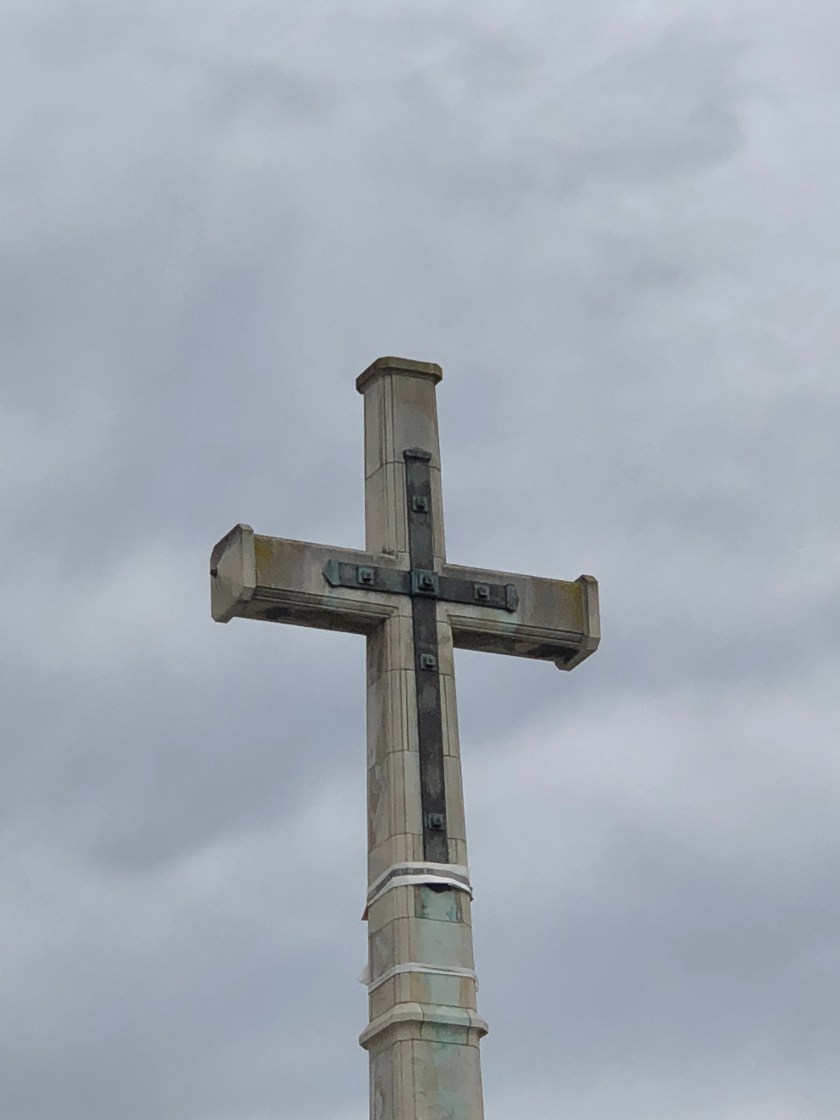
Cross, Christchurch, NZ

How often do I approach God in my haste and swagger, with my agenda and timeline, and dictate how I think He should answer? Is it my posture to stand, tapping my foot, ready to grasp with my hands, rather than to humbly bow in repentance, and be still before my holy Lord? It is clear that Daniel’s life posture was worship and surrender, and his prayer unleashed great power for God’s people.

God Almighty, may prayer to You be my first action and reaction in every situation. Give me wisdom to understand the times, spiritual eyes to detect every impulse of sin, and the to bow before You in honor and full dependence. (1 Chronicles 12:32; 2 Timothy 3:1)

Ruler of Rulers

“The sentence is by the decree of the watchers, the decision by the word of the holy ones, to the end that the living may know that the Most High rules the kingdom of men and gives it to whom he will and sets over it the lowliest of men… You shall be driven from among men, and your dwelling shall be with the beasts of the field. You shall be made to eat grass like an ox, and you shall be wet with the dew of heaven, and seven periods of time shall pass over you, till you know that the Most High rules the kingdom of men and gives it to whom he will.” Daniel 4:17,25,32

God had divine intent for the great Nebuchadnezzar, king of Babylon, and for all who would read his story. God is God and he was, and we are, not. The King of kings so orchestrated the events in Nebuchadnezzar’s life and reign that He would show him Who was really in control, Who really ruled the kingdoms of men and owned all—“that he/we would know,” is an ongoing theme through scripture that should startle us all awake and to heed. Through visions and using Daniel as interpreter, God revealed to this prideful regent, who saw his kingdom as “the great Babylon, which I have built by my mighty power as a royal residence and for the glory of my majesty,” that he would be humbled to know only the Most High ruled. And God always fulfills His word.

Redwood, Christchurch Botanical Gardens, NZ

“Immediately the word was fulfilled against Nebuchadnezzar. He was driven from among men and ate grass like an ox, and his body was wet with the dew of heaven till his hair grew as long as eagles’ feathers, and his nails were like birds’ claws. At the end of the days I, Nebuchadnezzar, lifted my eyes to heaven, and my reason returned to me, and I blessed the Most High, and praised and honored him who lives forever, for his dominion is an everlasting dominion, and his kingdom endures from generation to generation; all the inhabitants of the earth are accounted as nothing, and he does according to his will among the host of heaven and among the inhabitants of the earth, and none can stay his hand or say to him, ‘What have you done?’” Daniel 4:33-35

Whatever a ruler’s domain and decisions, they are determined by The King of kings. However great his power, it is endowed by Almighty God. Whatever my plans, God directs my way. Whatever I have has merely been entrusted to me from the great Provider; He owns all and rules all; He raises up and brings low. (Job 12:23; 41:11; Proverbs 21:1,30; 16:1; James 1:17; 1 Chronicles 29:11-12)

Lord of all, order the intricacies of my life to remind me, as much as I need reminding, that You are the Most High God Who rules the kingdom of men. I am not. Your will is good, Your ways can be trusted. I gladly bow before Your dominion, my King.

An Enviable Rhythm

Now when the Lord was about to take Elijah up to heaven by a whirlwind, Elijah and Elisha were on their way from Gilgal. And Elijah said to Elisha, ‘Please stay here, for the Lord has sent me as far as Bethel.’ But Elisha said, ‘As the Lordlives, and as you yourself live, I will not leave you.’ So they went down to Bethel. And the sons of the prophets who were in Bethel came out to Elisha and said to him, ‘Do you know that today the Lord will take away your master from over you?’ And he said, ‘Yes, I know it; keep quiet.’ Elijah said to him, ‘Elisha, please stay here, for the Lord has sent me to Jericho.’ But he said, ‘As the Lord lives, and as you yourself live, I will not leave you.’ So they came to Jericho.  The sons of the prophets who were at Jericho drew near to Elisha and said to him, ‘Do you know that today the Lord will take away your master from over you?’ And he answered, ‘Yes, I know it; keep quiet.’ Then Elijah said to him, ‘Please stay here, for the Lord has sent me to the Jordan.’ But he said, ‘As the Lord lives, and as you yourself live, I will not leave you.’ So the two of them went on. Then Elijah took his cloak and rolled it up and struck the water, and the water was parted to the one side and to the other, till the two of them could go over on dry ground. When they had crossed, Elijah said to Elisha, ‘Ask what I shall do for you, before I am taken from you.’ And Elisha said, ‘Please let there be a double portion of your spirit on me.’” 2 Kings 2:1-6, 8-9

This chapter is poignant to me: Elisha following Elijah his final days, then succeeding him after he is taken to heaven. Elijah, prophet sent by the LORD, journeys to Bethel- place of meeting with God, to Jericho- place of battle and victory against strongholds, to the Jordan- place of crossing to new life, the blessed life, with death to the old self. And Elisha walks the route with him, mulling over (and being repeatedly reminded) that this great mentor will be leaving him soon, revisiting the places of life-altering encounters with God. Then, when dear Elijah asks him to name whatever he wants, he asks for a double portion of his spirit before Elijah’s death. What a touching look into a man of God’s final days, and into the heart of one who would take up the mantle after him. It is the intimate moments with God that have made, and will make, the difference.

Pathway, W Coast NZ

This passage offers a rhythm of life for us: meet with God, in worship and dependence; triumph against strongholds and temptations at God’s leading and in His supernatural power; and continually dying to self and proceeding in faith to take possession of His land and life and intentions for us, all adorned and endowed richly with His Spirit.

Lord, may this be my daily pattern, in prayer and planning, at home and work. I am Yours, You are my Prophet, Priest and King. You ordain for me every Bethel, Jericho, and Jordan. May I walk with You, and whether seeing You or not, be cloaked with Your power and countenance for each new step. Amen.

Affliction’s Reward, or, The Making of Sand

This is my comfort in my affliction, that your promise gives me life. Before I was afflicted I went astray, but now I keep your word. You are good and do good; teach me your statutes. It is good for me that I was afflicted, that I might learn your statutes. If your law had not been my delight, I would have perished in my affliction. I will never forget your precepts,
for by them you have given me life.” 
Psalm 119:50,67-68,71,92-93

Receiving and being thankful for comfort in affliction is one thing, but being thankful for the affliction itself is quite another, and the psalmist learned the secret. It was borne of a focus not on the affliction itself, but on God’s unfailing word. It was God’s promise that gave him life, redirection, hope, and comfort. He chose, rather than to squirm and chafe in his pain, injustice, taunting, persecution, grief, loneliness, to delight in God’s law, His abiding and true word. Through it he learned, by experience and trust, that its Author was good, and does good, that the God Who gives comfort is Comfort Himself. The afflictions had buffeted him, but through their crashing power had molded him, shaped him to rest and rejoice in his loving God. It is God Who makes useful and beautiful His people through affliction.

Watching powerful waves stir and roar on the rocky coast imprints a good picture of affliction’s reward. Jagged rocks along the coast are softened to smaller round ones, and through the constant friction of tumbling in rough waves, those are ground into soft sand, shaped by the water’s force and wear. Once granular, the sand can be made into something beautiful, as in remarkable ‘blooms’ made by some mollusk at work. What a marvelous God!

Lord, may I welcome afflictions as Your instruments of refinement and learning of You. Turn my vision to what You would teach, what You promise and fulfill. Keep me delighting in Your Word made flesh, my great Redeemer Jesus, and bring forth from every affliction what will bring You glory.


Whatever the Season

You visit the earth and water it; you greatly enrich it; the river of God is full of water; you provide their grain, for so you have prepared it. You water its furrows abundantly, settling its ridges, softening it with showers, and blessing its growth. You crown the year with your bounty; your wagon tracks overflow with abundance. The pastures of the wilderness overflow, the hills gird themselves with joy, the meadows clothe themselves with flocks,
the valleys deck themselves with grain, they shout and sing together for joy.” Psalm 65:9-13

We drove yesterday through lush agricultural land blanketed with grasses, dotted with sheep and cattle against the backdrop of the majestic snow-peaked “Southern Alps,” then sueded softer peaks, some splashed with gold. Vineyards and orchards spread like ordered tablecloths in the foothills, vines carefully pruned for a new year of growth and young trees adorned with crepey blossoms announcing upcoming fruit. Early spring has brought rhododendron blooms, glorious forsythia, and cheery bulbs, yet the river beds are still dry. The land is on tiptoe awaiting the full extravagance of summer’s bounty.

Whatever the season, my divine Farmer is at work, pruning, nurturing in seeming dormancy, pushing out and testing early growth, or bringing to full fruit through soaking rains and warm sun. He provides all that is needed however the climate in life changes, through waiting, sorrow, expansion of responsibility, test of faculties and virtues. He tends carefully to His own that we may be strong in His might and bear much fruit. By this my Father is glorified, that you bear much fruit and so prove to be my disciples… You did not choose me, but I chose you and appointed you that you should go and bear fruit and that your fruit should abide.” (Ephesians 6:10; John 15:8,16)

Lord, let me welcome the seasons, put down deep roots of faith, and submit well to Your visits and honing. Overflow Your abundance through me. I am Yours to bear fruit that will last and bring You glory.