Love Bouquets

“Love one another: just as I have loved you, you also are to love one another. By this all people will know that you are my disciples, if you have love for one another.” “Let love be genuine… Love one another with brotherly affection. Outdo one another in showing honor. Do not be slothful in zeal, be fervent in spirit, serve the Lord.” “Through love serve one another.” “Above all, keep loving one another earnestly.” “Beloved, let us love one another, for love is from God, and whoever loves has been born of God and knows God.” John 13:34-35; Romans 12:9-11; Galatians 5:13; 1 Peter 4:8; 1 John 4:7

The first bouquet was a text, words from a friend hundreds of miles away that bathed me with blessing and loving affection. Then flowers arrived for a colleague, a bright splash of fragrance and color from a friend, simply to celebrate her and cheer her day. The third was a ride to the hospital, companionship, and care to a loved one in a new city, from a friend who said, ‘friends don’t let friends go to the hospital alone.’ Love bouquets come in different styles and forms, but are all palpable gifts that sweeten our moments with the deep sense of being loved, not only by the giver, but by God Who plants the thought and prompts them to tell us so in a myriad of ways.

fullsizeoutput_6a22

Jesus loved best, in laying down His life for us, and continues in irrepressible, wide love today as He abides with us, sides with us, and intercedes for us. Loving others well means grasping the way Jesus loves, and practicing with the same generosity, compassion, and whole-hearted abandon He did. It means saying ‘no’ to self and selfish desires to say ‘yes’ to what someone else wants. It means relinquishing personal ambition and instead, making it my ambition to serve and love others. It means preferring others, taking active interest in their lives, weeping and rejoicing with them, going out of my way to bless their days. It may look like a care package to a young mother with sick children, a note, a spoken prayer, a meal, or even flowers. (John 15:13; Romans 8:31,34;  12:15; Philippians 2:3-4; John 3:16)

This is counter-cultural. Love bouquets are things we are taught to pick and arrange and spend money on to mollify our stresses or irritations, to pamper ourselves, so to prepare and deliver them to others is a rare and glorious gift that brings heaven’s balm into the ordinary. The ways of God are different from ours, often viewed as subversive and antithetical to the self-sufficient ways of the world. But as Christians we have the privilege of injecting His beauty into dark and arid places to display Who He is and how He loves. When someone sees the flowers and asks their reason, we can prod them to higher thinking, to the Source of genuine love. (Isaiah 55:8; 1 John 4:8)

Have I recognized and thanked God for the love bouquets He’s lavished on me? What am I doing to arrange and deliver them to those in my path? When I offer myself as a conduit of the Savior’s love, He will direct me to spread it abroad to the blessing of others.

Lord Christ, love through me, and so show forth Your greatest gift to the world.

 

High Above

Blessed be the name of the Lord from this time forth and forevermore! From the rising of the sun to its setting, the name of the Lord is to be praised! The Lord is high above all nations, and his glory above the heavens! Who is like the Lord our God, who is seated on high, who looks far down on the heavens and the earth?” “Praise the Lord from the earth, you great sea creatures and all deeps, fire and hail, snow and mist, stormy wind fulfilling his word! Mountains and all hills, fruit trees and all cedars! Beasts and all livestock, creeping things and flying birds! Kings of the earth and all peoples, princes and all rulers of the earth! Young men and maidens together, old men and children! Let them praise the name of the Lord, for his name alone is exalted; his majesty is above earth and heaven.” Psalm 113:2-6; 148:7-13

Who flecks the black expanse with white twinkling stars? Who smudges pink streaks across the end-of-night sky to announce the coming day? Who in silence shouts His glory so all who would look at the heavens, and watch, and wait, can hear? Whose majesty and power are limitless and cannot be contained? Who reigns high above the heavens, and rules over them and earth and all living things and the affairs of man and every lowly human heart? The God of gods, King of kings, and Lord of lords! The Friend of sinners and Lover of our souls! The Ruler of the universe Who condescends to show mercy and grace to His people! (1 Kings 8:27; Psalm 8:3-4; 19:1-2; 136:2-3; Matthew 11:19; Revelation 19:16)

cEH6e0bqQm+mlad92tKLOA

He is the merciful God Who stoops to lift us up. “For though the Lord is high, he regards the lowly.” His perfect eye beholds His creation and looks in compassion on all He has made. He watches us muddle in the lowlands, wandering like sheep without a shepherd, consumed with the world and blind, deaf, and lame to His glories. But He does not abandon us. He does not leave us in these waste places. In lavish grace He lifts us up to see His glorious majesty in a new, supernatural dimension of life. He forgives our sin, heals our infirmities, broadens our possibilities, and sets before us a higher way, a highway of holiness. He imparts spiritual wisdom to open our eyes to His heavenly work. He gives lasting meaning to our days in His divine purposes, and His Spirit awakens in us holy passion to know Him. (Psalm 18:35; 103:3-4; 138:6; Isaiah 35:2,5-6,8; Mark 6:34)

What will it take to begin and reside each day in the heights with Him, far above what so easily entangles us, and all our energy and senses, here below?

“I’m pressing on the upward way,
New heights I’m gaining every day;
Still praying as I onward bound,
‘Lord, plant my feet on higher ground.'”  ~Johnson Atman, Jr. (1856-1926)

Transcendent LORD, Holy Highness, I want to breathe Your air. Please heighten the quality of the way I love and live, and elevate my thinking, that I may know You better and lift high Your praises forever. (Exodus 33:13,18)

The Joy of Doing Your Part

“Now these are the chiefs of David’s mighty men, who gave him strong support in his kingdom, to make him king… Eleazar was with David at Pas-dammim when the Philistines were gathered there for battle. There was a plot of ground full of barley, and the men fled from the Philistines. But he took his stand in the midst of the plot and defended it and killed the Philistines… David was then in the stronghold, and… said longingly, ‘Oh that someone would give me water to drink from the well of Bethlehem that is by the gate!’ Then the three mighty men broke through the camp of the Philistines and drew water out of the well… and took it and brought it to David… at the risk of their lives. 

“The Spirit clothed Amasai, and he said, ‘We are yours, O David, and with you! For your God helps you.’ They helped David against the band of raiders, for they were all mighty men of valor and were commanders in the army… From day to day men came to David to help him, until there was a great army, like an army of God… [There were] men who had understanding of the times, to know what Israel ought to do; seasoned troops, equipped for battle with all the weapons of war, to help David with singleness of purpose; commanders with men armed with shield and spear; troops ready for battle. All these, men of war, arrayed in battle order, came to Hebron with a whole heart to make David king over all Israel. Likewise, all the rest of Israel were of a single mind to make David king… And they were there with David for three days, eating and drinking, for their brothers had made preparation for them. And also their relatives, from as far as Issachar and Zebulun and Naphtali, came bringing food on donkeys and on camels and on mules and on oxen, abundant provisions of flour, cakes of figs, clusters of raisins, and wine and oil, oxen and sheep, for there was joy in Israel.” 1 Chronicles 11:10,12-14,16-19; 12:18,21-22,32-34,36,38-40

Almighty God had promised to make David king, and He, in beautiful order, brought all the necessary parts and people together to make it happen. The sovereign Master anointed mighty men of valor with specific gifts of intellect, perception, agility, courage, strength, a willing spirit of unselfish cooperation, and He appointed each to his place to bring about His plans. The result was a humbled, grateful, effective ruler with unified support, people in place working for the good of the whole, and great joy at the realization that God’s purposes were being achieved with His blessing and favor. (1 Samuel 16:1,12-13)

fullsizeoutput_6a48

Whom has God called me to support, and how? What messages, bravery, resources, manual labor, talent am I contributing to bolster another’s position of leadership? Whether I offer physical respite or verbal defense of a reputation, loving encouragement or raisin cakes, I can and should actively serve and build up those God has called to lead.

Father, make me eager and bold to do my part in Your kingdom. Give me acuity, creativity, and gumption to come alongside and bless those You call to lonely places of great responsibility. And may Your joy and glory abound.

Hankering for the Heavenly City

By faith Abraham obeyed when he was called to go out to a place that he was to receive as an inheritance. And he went out, not knowing where he was going. By faith he went to live in the land of promise, as in a foreign land, living in tents with Isaac and Jacob, heirs with him of the same promise. For he was looking forward to the city that has foundations, whose designer and builder is God… These all died in faith, not having received the things promised, but having seen them and greeted them from afar, and having acknowledged that they were strangers and exiles on the earth. For people who speak thus make it clear that they are seeking a homeland. If they had been thinking of that land from which they had gone out, they would have had opportunity to return. But as it is, they desire a better country, that is, a heavenly one. Therefore God is not ashamed to be called their God, for he has prepared for them a city.” Hebrews 11:8-10,13-16

The ‘Hall of Faith’ in Hebrews 11 describes many other-worldly-thinkers and doers, men and women of God whose lives were not their own and whose treasure was with God. They were, here on earth, and in the turmoil and hardship of normal work and ministry, of complicated family relationships and moving and travel, fixed on the heavenlies. This perspective identified them and fueled their days.

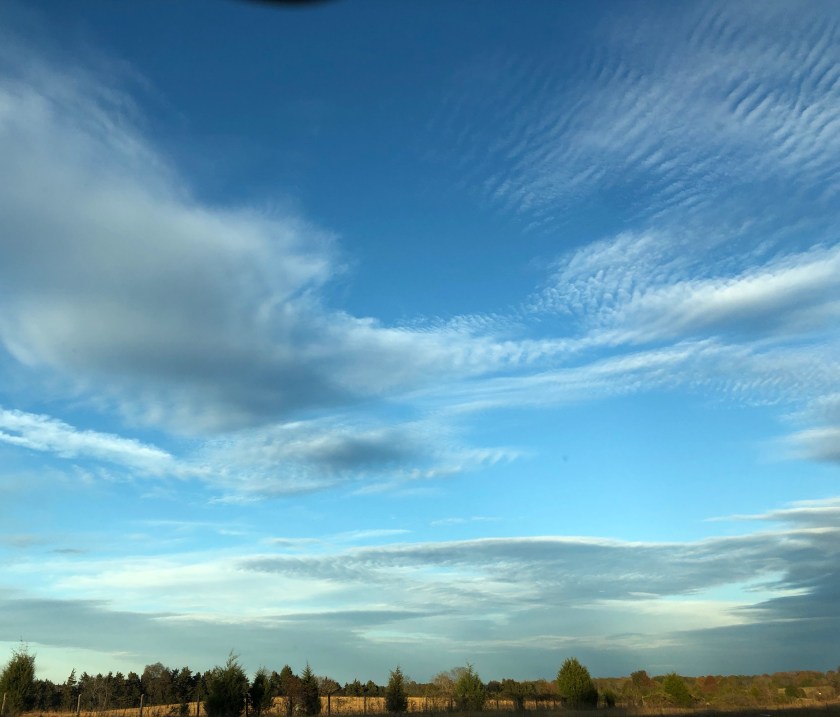
VIrginia countryside and swept sky, November

Set your minds on things that are above, not on things that are on earth. For you have died, and your life is hidden with Christ in God. When Christ who is your life appears, then you also will appear with him in glory.” Colossians 3:2-4

How strong is our pull to things of this earth? To the places we love, to comforts of routine and security of our homes and entitlement to the absence of pain and difficulty? Is it greater than our longing to see our Savior’s face, for the heavenly city whose architect and designer is God? Do I consider the gift of my days through the lens of heaven? What evidence is there in how I spend time and money, where I invest talent and energy, that I am looking forward to the heavenly home my Lord is preparing? (John 14:2-3; 1 Corinthians 13:12; 1 John 3:2)

Do not lay up for yourselves treasures on earth, where moth and rust destroy and where thieves break in and steal, but lay up for yourselves treasures in heaven, where neither moth nor rust destroys and where thieves do not break in and steal. For where your treasure is, there your heart will be also… Seek first the kingdom of God.” Matthew 6:19-21,33

Hankering for our heavenly city means we regard ourselves as strangers and aliens here, yet those who live with vital faith that infuses our present with robust hope and meaning. With a limited number of days, we can embrace our opportunities to proclaim and live out the gospel, to feed the hungry with the bread of life.

Lord God, compel me to sojourn toward my sure heavenly destination with a loose hold on things of this earth, generous living for others’ eternal good, and an eye for Your glory.

Sweetest Comfort

The sons of Ephraim: Shuthelah, and Bered his son, Tahath his son, Eleadah his son, Tahath his son, Zabad his son, Shuthelah his son, and Ezer and Elead, whom the men of Gath who were born in the land killed, because they came down to raid their livestock. And Ephraim their father mourned many days, and his brothers came to comfort him. And Ephraim went in to his wife, and she conceived and bore a son. And he called his name Beriah, because disaster had befallen his house. His daughter was Sheerah, who built both Lower and Upper Beth-horon, and Uzzen-sheerah. Rephah was his son, Resheph his son, Telah his son, Tahan his son, Ladan his son, Ammihud his son, Elishama his son, Nun his son, Joshua his son.” 1 Chronicles 7:20-27

There are nuggets of gold tucked in to the holy scriptures, if we would but search for them. We might list our favorite Bible characters as those known for humble leadership or military might, warriors, judges, kings, sophists, missionaries, but do we also treasure those who are tender and ‘human,’ who are remembered for the way God met them and redeemed their suffering? Ephraim, son of Jacob’s eleventh son Joseph, was a seemingly ordinary man, noted for his grief over his sons who were killed in an attempted raid. From his ‘disaster’ we see the beauty of God’s redemptive mercy, borne from the seed of shed blood, come to flower through a son born out of the comfort of familial and marital love. That son’s daughter became an accomplished woman, and his son the predecessor, over generations, of Joshua, one of the greatest men and leaders of Israel who ever lived.

4vCqf9I6Qra2OQw8bSIzbg

We can become numbed by pain in our lives, disasters of hurt from having been deceived or betrayed, from the punch-gut shock of losing a loved one suddenly, or the weary, draining sadness over a drawn-out suffering and good-bye. Our observation of long-standing, seemingly never-ending rebellion of a child, or our inability to shake off regret for what never came to be in our career or a relationship, can leave us frigid and in the dark, resigned to limited vision and thinking we will never get warm again. But God knows all our grief, His merciful Son bore it on our behalf, and He is nigh to brighten our soul’s winter with His light of hope. (Isaiah 53:4-5)

Almighty, omniscient God includes accounts like this in scripture to remind us He is intricately involved in every aspect of our lives, and is powerful to save, comfort, and redeem. Not one tear falls that He does not measure, not one pang pierces that He does not feel. He is indeed the God of all comfort, Who delights to exercise His perfect nature in our lives. (Psalm 121:3,8; Proverbs 15:3; 2 Corinthians 1:3-4)

The Lord your God is in your midst, a mighty one who will save; he will rejoice over you with gladness; he will quiet you by his love; he will exult over you with loud singing.” Zephaniah 3:17

Lord, thank You for Your loving and merciful light that permeates and dispels the darkest pain. Enable me to bring Your sweet comfort to those who mourn, that they are wrapped in warmth by Your palpable presence. (Matthew 5:4)


Every Name Known

Meonothai fathered Ophrah; and Seraiah fathered Joab, the father of Ge-harashim, so-called because they were craftsmen. The sons of Caleb: Iru, Elah, and Naam; and the son[c] of Elah: Kenaz. The sons of Jehallelel: Ziph, Ziphah, Tiria, and Asarel. The sons of Ezrah: Jether, Mered, Epher, and Jalon. These are the sons of Bithiah, the daughter of Pharaoh, whom Mered married; and she conceived and bore Miriam, Shammai, and Ishbah, the father of Eshtemoa. And his Judahite wife bore Jered the father of Gedor, Heber the father of Soco, and Jekuthiel the father of Zanoah. The sons of the wife of Hodiah, the sister of Naham, were the fathers of Keilah the Garmite and Eshtemoa the Maacathite… The sons of Shelah the son of Judah: Er the father of Lecah, Laadah the father of Mareshah, and the clans of the house of linen workers at Beth-ashbea; and Jokim, and the men of Cozeba, and Joash, and Saraph, who ruled in Moab and returned to Lehem … These were the potters who were inhabitants of Netaim and Gederah.” 1 Chronicles 4:14-19,21-23

Reading through chapters and chapters of hard-to-pronounce names in the Holy Bible is an exercise in wonder, not tedium. Every one of these individuals was created in the image of God, named, known, important, valued, a part in the whole of history, divinely memorialized in His scriptures.

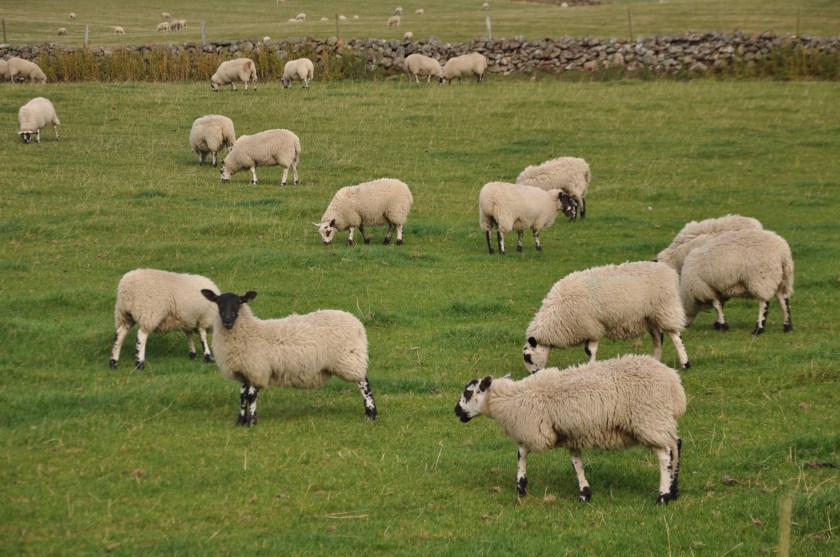
Sheep in England

Each one of us is created unique; God numbers our days and the hairs on our head. He knows who we are, what we are made of and gifted to do, and He calls us by name. We may feel at times we are insignificant, directionless, we do not belong, or cannot make a difference. Yet, when we listen to God’s voice, His messages affirm our personal significance, our value to Him, and our specific place in time, history, location, the world. (Psalm 139:13-18; Luke 12:6-7; Acts 17:24-28)

“Thus says the Lordhe who created you,.. he who formed you: ‘Fear not, for I have redeemed you; I have called you by name, you are mine… I am the Lord your God, the Holy One of Israel, your Savior. I give Egypt as your ransom, Cush and Seba in exchange for you. You are precious in my eyes, and honored, and I love you.'” Isaiah 43:1,3

Why fret? Why tarry in zeal, in serving, in living fully? If we would stop our ears to godless banter and social media that say we will never measure up, we find security in our Father Who beckons us by name to know and live for Him exactly where we are.

The sheep hear his voice, and he calls his own sheep by name and leads them out… He goes before them, and the sheep follow him, for they know his voice… I am the good shepherd. I know my own and my own know me..; and I lay down my life for the sheep.” John 10:3-4,14-15

Almighty God, may I thrive in the identity You have given me, and affirm value to every one of Your image-bearers.

Cause, Effect, and Purposes of the Word

“Do two walk together,
    unless they have agreed to meet?
Does a lion roar in the forest,
    when he has no prey?
Does a young lion cry out from his den,
    if he has taken nothing?
Does a bird fall in a snare on the earth,
    when there is no trap for it?
Does a snare spring up from the ground,
    when it has taken nothing?
Is a trumpet blown in a city,
    and the people are not afraid?
Does disaster come to a city,
    unless the Lord has done it?

For the Lord God does nothing
    without revealing his secret
    to his servants the prophets.
The lion has roared;
    who will not fear?
The Lord God has spoken.” Amos 3:3-8


The shepherd prophet Amos illustrates, with several common and understandable life instances, the power of cause and effect: nothing occurs without a first cause, and every cause necessitates an effect. He who carried God’s prophecies to Israel used the art of the words to describe the purpose of the Word, and like a lion, roared the meaning loud and clear. Every word of God was true and meaningful, and came as either cause, or effect.

fullsizeoutput_18

In other words, “Every word of God proves true.” None of God’s words falls to the ground without accomplishing its intended purpose. For as the rain and the snow come down from heaven and do not return there but water the earth, making it bring forth and sprout, giving seed to the sower and bread to the eater, so shall my word be that goes out from my mouth; it shall not return to me empty, but it shall accomplish that which I purpose, and shall succeed in the thing for which I sent it.” If every part of the Bible has meaning, how am I availing myself of its rich bounty? (Proverbs 30:5; Isaiah 55:10-11)

I cannot walk in step with Christ without committing to meet with Him, and learning His stride. How deliberately do I carve out uninterrupted time to worship, read His very words to me, listen for His instruction, blessing, comfort, wisdom for my need? Every challenge I encounter is designed with holy purpose, and I can miss out on seeing God’s providential hand, or participating in His work, when I fail to consider the divine cause of what comes my way, or the effects of how I respond or behave. His determinations are wise, and I would be wise to get in sync with them by seeking His intentions behind the scenes.

Am I rattled by difficulties? Do I fear or lose focus when things get off-kilter? Or will I look to the Master Architect of time and circumstances and look for His purpose in my hardships? Am I doubting His goodness, or accusing Him of arbitrary inflictions, without seeking understanding of His higher ways? What might He intend to reveal of Himself, or teach me? How might He desire to use or sanctify me?

Father God, You rule over all things visible and invisible, all beginnings and endings. Grant me keen insight through Your word, and compel me to take full advantage of Your every cause and effect, for the accomplishing of Your glorious purposes.


Opportunity with Slopportunity

“And the people complained in the hearing of the Lord about their misfortunes, and when the Lord heard it, his anger was kindled.” “These are grumblers, malcontents, following their own sinful desires; they are loud-mouthed boasters.” Numbers 11:1; Jude 16

Let no corrupting talk come out of your mouths, but only such as is good for building up, as fits the occasion, that it may give grace to those who hear. Let all bitterness and wrath and anger and clamor and slander be put away from you, along with all malice.” “Do all things without grumbling or disputing, that you may be blameless and innocent, children of God without blemish in the midst of a crooked and twisted generation, among whom you shine as lights in the world, holding fast to the word of life.” “Let your speech always be gracious, seasoned with salt, so that you may know how you ought to answer each person.” Ephesians 4:29,31; Philippians 2:14-16; Colossians 4:6 

Screens drone on with deep colors swathing the country’s heartland. Animated meteorologists warn with tones tinted with urgency and dread about snow and frigid temperatures. Chatter heightens and complains about the cold, the threat of weather, none of which we can control or change. As I am carried high in the plane, suspended in thick grey-white clouds, the storm could seem ominous if I let the negative talk seep in and unnerve me. But when I land, I am immediately taken in by happy white flakes blowing and blanketing the earth with breath-taking beauty. I cannot help but smile in wonder.

hwMwG8mIQ524CWc4Xt68nA

As with so many things in life, we can tend to take the ‘slopportunity’ to hate what is occurring, or fear what is coming, to rant, to ‘slop’ on others, to trash talk our circumstances, to dwell on the worst, the inconvenience, the discomfort and ‘can you believe they did that?!’ But in every slopportunity, we are given equal ‘opportunity’ to accept what is before us with optimism, to marvel at snow storms with grateful hearts, to wonder at the High God’s creative purposes, to try to understand why people behave and react as they do, and show compassion. When muddled in the low lands, we as God’s children are called to lift the atmosphere.

When caught in conversation that has hit the lowest common denominator and idled there, what will we do to elevate it? How can I heighten a low view of God, and turn a complaining into thankfulness, or at least a more positive spin? With what words do I fill my vocabulary? Instead of going along with complaining, or castigating another, or nit picking about all that was not up to my par in a situation, do I have the guts and wherewithal to inject the fruit of a grateful heart, a positive outlook, a different sense of understanding? Are there questions I can ask that steer in a fresh direction? In every sloppy storm there is beauty to behold, and sometimes I am the one appointed to unveil it.

Lord, please guide my thinking to see things as You do. Fill me with Your words of light that puncture the prevailing darkness with Your glory and greatness at every opportunity.


Lit From Underneath

You are the light of the world. A city set on a hill cannot be hidden. Nor do people light a lamp and put it under a basket, but on a stand, and it gives light to all in the house. In the same way, let your light shine before others, so that they may see your good works and give glory to your Father who is in heaven.” “Be careful lest the light in you be darkness. If then your whole body is full of light, having no part dark, it will be wholly bright, as when a lamp with its rays gives you light.” “In [Jesus] was life, and the life was the light of men.” Matthew 5:14-16; Luke 11:35; John 1:4

I watch as the sun, not yet risen, tints periwinkle the inky pre-dawn sky, then sets ablaze in red the underside of clouds. The white hot sun itself is not visible, but its effects are undeniable, captivating in their array of breathtaking beauty. While in this world we do not see God Himself, His light is reflected in numberless ways in His creation, and His people.

RR4OxtbIR6e+hgrYoHcBBg

To show most gloriously, His work needs to begin in our deeps, behind the masks of “everything is fine” we wear for others. His light must get underneath the layers of appearance we put on to impress, into the darkness of our self-convinced justification of godless attitudes and reckless treatment of others, all the way to the bottom of our self-centered hearts and dark recesses of our thought. When He burns inside and underneath, His refining fire can consume the root of our selfishness, our self-righteousness, our limited vision for what can be. His light cleanses, frees, transforms, and opens wide a new way before us. (Psalm 119:105; Isaiah 1:25; Malachi 3:2; Hebrews 12:29)

In order to shine His light in my world, I must tend the light in my life. Looking after the light takes effort and care in looking to the Light, receiving and applying the word of truth, making sure it fills every crevice of desire and insight. When do I set aside time to take in God’s light for me? I cannot expect to burn bright if I never come to the flame and let it ignite my passion, my drive, my plans.

When once He takes hold, I cannot hide His fire of contagious love and compassion. When He makes me wholly bright, He is evident in my every decision, undertaking, act of service. His light infuses my strategies, my priorities, my interactions with others. In His light I not only see light, but I spread it abroad. As every morning the sun’s light appears gradually, and it brightens until all the air is infused and nothing is untouched by its glory, so God’s people can shine Him to be recognized in every facet of life. (Psalm 36:9; Romans 5:5)

Begin deep, every day, my Lord. Burn warm and bright. Ignite Your glow in me and blaze Your glory in my countenance and actions so I reflect Your grace, power, joy, and love to others. (Numbers 6:26)

How Shall We Sing the Lord’s Song?

At that time the servants of Nebuchadnezzar king of Babylon came up to Jerusalem, and the city was besieged. Nebuchadnezzar took [Jehoiachin the king of Judah] prisoner in the eighth year of his reign… and carried off all the treasures of the house of the Lord and the treasures of the king’s house, and cut in pieces all the vessels of gold in the temple of the Lord, which Solomon king of Israel had made. He carried away all Jerusalem and all the officials and all the mighty men of valor, 10,000 captives, and all the craftsmen and the smiths. And he carried away Jehoiachin to Babylon. The king’s mother, the king’s wives, his officials, and the chief men of the land he took into captivity from Jerusalem to Babylon.” 2 Kings 24:10,12-15

By the waters of Babylon,
    there we sat down and wept,
    when we remembered Zion.
On the willows there
    we hung up our lyres.
For there our captors
    required of us songs,
and our tormentors, mirth, saying,
    ‘Sing us one of the songs of Zion!’ 

How shall we sing the Lord‘s song
    in a foreign land?
If I forget you, O Jerusalem,
    let my right hand forget its skill!
Let my tongue stick to the roof of my mouth,
    if I do not remember you,
if I do not set Jerusalem
    above my highest joy!” Psalm 137:1-6

How hard is it to sing when all seems lost? When a marriage is stressed to breaking and appears beyond repair, when rebellion or bitterness has wedged vitriol into a relationship, when disease wracks the body or mind of a loved one? Judah’s Babylonian captors, after wrenching them from everything they valued in the world- comforts of home, place of worship, treasures, identity through work, and pride, mockingly demanded a song, and the psalmist replied by pen with a beautiful dirge.

Our music may not always be light and melodious, but the Lord, with His undying love and mercies, and His very presence, still gives us songs in the darkness of our circumstances. We can sing with longing and lament, but always with hope, because He is good, and His ways are perfect and sure. He is our refuge and stronghold in every captivity of loneliness, fear, and heart-rending consequence of sin. He is our hope and trust. (Psalm 18:28,30; 33:11; 71:5; Joel 3:16-17; Colossians 1:27)

Where am I languishing in complaint? Are there circumstances that trigger despondency, criticism, whining, self-pity, that can instead prompt a song to the Lord, Who wondrously reigns over all? Might He be training me to look to Him in every shadow, every heartache, every impossibility, and trust Him? He is worthy of my confidence and music and praise all the time, not just when my life goes as I would prescribe. As we turn our eyes from self to Jesus, He Who authors our faith composes for us songs and loosens our lips to sing. (Hebrews 12:2)

God my Maker, You are my strength, and song, and salvation. Fill my mouth with Your song in sad night as well as glad day. May I ever sing unto Thee, for Your praise. (Job 35:10; Psalm 77:6; 118:14-15)