Fellowship’s Fancy

When the day of Pentecost arrived, they were all together in one place. And suddenly there came from heaven a sound like a mighty rushing wind, and it filled the entire house where they were sitting… And they were all filled with the Holy Spirit and began to speak in other tongues as the Spirit gave them utterance. Now there were dwelling in Jerusalem… devout men from every nation under heaven. And at this sound the multitude came together, and they were bewildered, because each one was hearing them speak in his own language. And they were amazed and astonished, saying, ‘Are not all these who are speaking Galileans? And how is it that we hear, each of us in his own native language? Parthians and Medes and Elamites and residents of Mesopotamia, Judea and Cappadocia, Pontus and Asia, Phrygia and Pamphylia, Egypt and the parts of Libya belonging to Cyrene, and visitors from Rome, both Jews and proselytes, Cretans and Arabians—we hear them telling in our own tongues the mighty works of God…’

And they devoted themselves to the apostles’ teaching and the fellowship, to the breaking of bread and the prayers… And all who believed were together and had all things in common. And they were selling their possessions and belongings and distributing the proceeds to all, as any had need. And day by day, attending the temple together and breaking bread in their homes, they received their food with glad and generous hearts,  praising God and having favor with all the people.” Acts 2:1-2,4-11,42,44-47

The pocked surface of the Gulf tickled my fancy this morning. In the vast pale blue green, there were dimples of dark, large round dish shapes moving slowly across the surface. Sparkling like strewn jewels, flashing bits of white – was it an errant crest of a tiny wave? No, a school of tiny silver fish, darting and sweeping in unison, ruffling the flat and catching the early mornings rays in twinkly glitter. Such is the artistry of hundreds of fish all swarming through the water together.

sH4ckWyqRjaVyQEImvq9Kg

And such is the beauty of fellowship in the Holy Spirit. As a multitude, we can marvel at our different languages speaking a common praise and message of love, the Body moving in unified devotion to proclaim and stand up for truth, to serve, meet needs. When we go it alone, our influence is limited, but traveling together in the stream of God‘s people, in mutual support and endeavor, we break through surfaces of resistance, we spread out and attract attention to the Light we reflect.

Antoine de St. Exupery wrote in his 1943 children’s classic, The Little Prince“Love consists not in gazing at each other, but in looking outward in the same direction.” In order to tickle a dark world with the gospel’s light and love, we must haste away from ourselves, put aside petty differences, and swim en masse with a God-ward focus. Fellowship’s delights are sweeter, and our testimony clearer, when we minister, love, work, and grow together.

Lord, do what You need to in me so I contribute to the winsome fellowship of Your Spirit. Love through me so others know I am Yours, and want to be Yours too. (John 13:35)

A Balm in Gilead

“My joy is gone; grief is upon me; my heart is sick within me… For the wound of the daughter of my people is my heart wounded; I mourn, and dismay has taken hold on me. Is there no balm in Gilead? Is there no physician there? Why then has the health of the daughter of my people not been restored?” “Weeping may tarry for the night, but joy comes with the morning.” Jeremiah 8:18,21-22; Psalm 30:5

Upon recently rejoicing, in emotion and joy without description or limits, at the birth of a tiny little life, I have had an exquisite taste of God’s bounty and grace. After immeasurable loss, years of grieving, longing, clinging, and waiting, this gift has been given. Hallelujah. And this cherished gift is received with grateful, careful hands, and the acute awareness of generosity, of the wide mercies of God, of boundless love and sweet healing and a hint of comprehension of His marvelous and mysterious ways. Indeed, I savor and am astounded at the Almighty’s handiwork, I marvel at the unsearchable depth of His riches. His balm is like no other. (Acts 13:41; Romans 11:33)

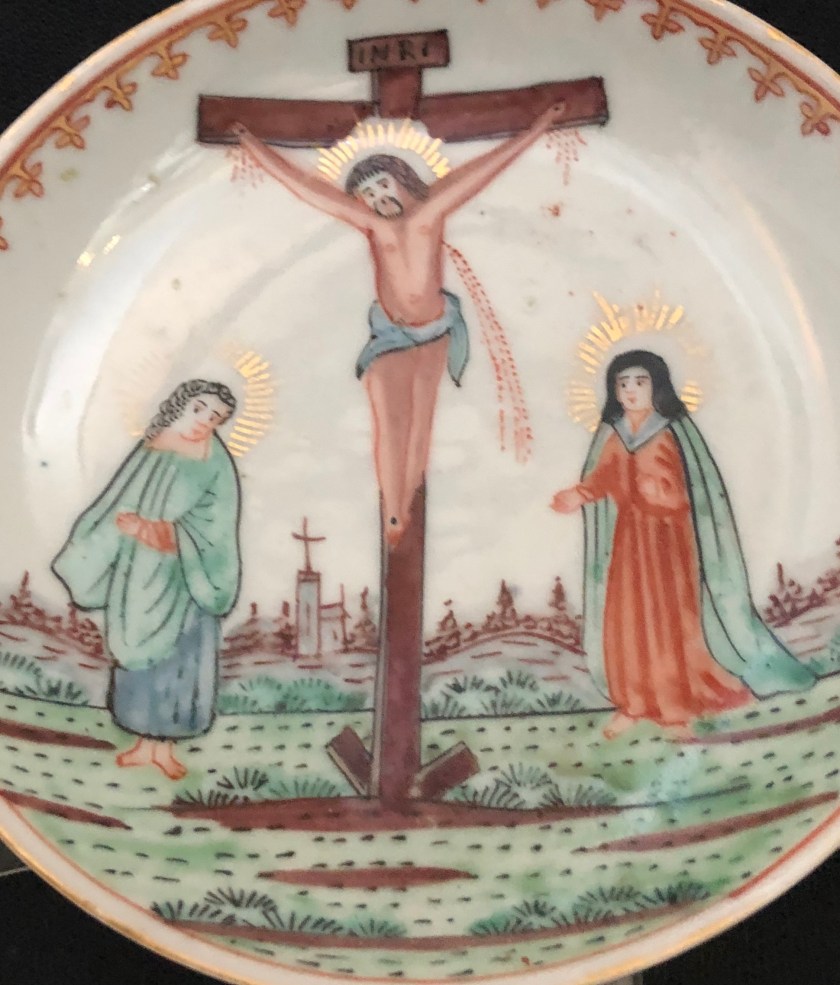
Jesus on the cross w blood, saucer 18th century

There are no guarantees that in this life we will receive back what we have lost, that we will be healed of the wasting disease, or that all relationships will be reconciled. There is no assurance that on this earth people will dwell together in peace, that perfect justice will be served, that we will live long and happily ever after. But what we know to be true is far greater, broader, deeper, and lasting. The balm God provides and applies is not the aromatic ointment drawn from resin from a flowering plant east of the Jordan River, but the invisible, eternal fragrance drawn from the root of Jesse, the righteous Branch, blood spilled out for us by Jesus on the cross. Our hope, our soul balm, is in Him alone. (Isaiah 11:1-6,9-10; Jeremiah 23:5-6; Romans 5:1-5; 2 Corinthians 2:14)

“There is a balm in Gilead, to make the wounded whole,
There is a balm in Gilead, to cure the sin-sick soul.”  ~Spiritual (1868)

Is not every suffering in this life a result of our sin-sick souls? It is man’s fall that our Savior came to redeem. We long for Eden; our sin and all its effects– our broken dreams, broken communication, broken affections, broken priorities, broken bodies and minds– cry out to be covered in His balm. Through the risen and glorified Jesus, God promises to make all things right in the end. He will dwell with them, and they will be his people, and God himself will be with them as their God. He will wipe away every tear from their eyes, and death shall be no more, neither shall there be mourning, nor crying, nor pain anymore, for the former things have passed away.” In this we have certain hope! (Revelation 21:3-4)

Isn’t our God gracious to give sweet glimpses, the most delicious tastes, of our future glory, in the living, breathing body of a precious new life? (Romans 8:18-21)

Lord of life, thank You for Your gift of new life that pulses with our eternal hope. In You we live and move and have our being, in the present and for all eternity. (Acts 17:28)


Busy but Based

“The word of God increased and multiplied. And Barnabas and Saul returned from Jerusalem when they had completed their service, bringing with them John, whose other name was Mark. Now there were in the church at Antioch prophets and teachers, Barnabas, Simeon, Lucius of Cyrene, Manaen a lifelong friend of Herod the tetrarch, and Saul. While they were worshiping the Lord and fasting, the Holy Spirit said, ‘Set apart for me Barnabas and Saul for the work to which I have called them.’ Then after fasting and praying they laid their hands on them and sent them off. So, being sent out by the Holy Spirit, they went down to Seleucia, and from there they sailed to Cyprus. When they arrived at Salamis, they proclaimed the word of God in the synagogues of the Jews. And they had John to assist them. [They went] through the whole island as far as Paphos.” Acts 12:24-13:6

Watching the early apostles go here and there, preaching, gathering their diverse teams, discussing, strategizing, packing and traveling, taking up new companions and dropping off others, we observe the multiplication of the churches and get caught up in the buzz of holy activity and numbers and busy-ness. We might miss the supernatural if we don’t pause, if we ignore the apostles’ ‘secret sauce.’ They regularly were still before their God. They worshiped, fasted, prayed, always basing their next steps on God’s leading. They listened for instruction, sensed the movement of the Spirit, were always willing to speak when He gave opportunity, to go when He said go, and stay or wait when He said no. (Acts 16:6-10)

F7ta71FdQIG99XMRkYKKjA

We busily go about our duties and activities, some in God’s flow and under His explicit direction, some in and under our own. The Lord does His work in our days, wonder upon wonder, but we often fail to see it, because in the flesh, we get frenetic with responsibilities, going and doing, fixing and fussing, planning and meeting, preparing and packing and getting on the road again. Unless we make time with Him a priority, our first thing, we may be breathing heavy with no air, toiling with no fruit, missing out on what He has for us and what He is already doing. When we base every day and choice on Him, we can face the details, the distance, the light or the darkest storm, with confidence, peace, and purpose. Busy begets frenzy, based begets fruitfulness. (Isaiah 29:14; Habakkuk 1:5; John 15:5; Acts 13:41)

Where have we lost grounding and focus? It’s not always in or because of the big things.  Great movements of God can be undermined by small areas of distraction, flesh temptations, casual gossip, missed warnings or opportunities. We must beware the little foxes, and be vigilant in moments, not just days. (Song of Solomon 2:15)

Lord, keep my mind set on the things of God, not of man, on things above, not things of the earth. In all You call and lead me to do, may I ever be before You. Base my schedule in Your calendar, my efforts in Your power, my every motivation and desire in Your Spirit and truth. (Mark 8:33; Ephesians 5:15-17; Colossians 3:1-2)

“If the LORD is With Us, Then Why?”

And the angel of the LORD appeared to him and said to him, ‘The LORD is with you, O mighty man of valor.’ And Gideon said to him, ‘Please, my lord, if the LORD is with us, why then has all this happened to us? And where are all his wonderful deeds that our fathers recounted to us, saying, “Did not the LORD bring us up from Egypt?” But now the LORD has forsaken us and given us into the hand of Midian.’” Judges 6:12-13

How often, in our finite reasoning, we make wrong assumptions of God! Because Israel was suffering under the oppression of Midian, Gideon questioned God– His goodness, His power. If God had delivered them from Egypt, would He not keep them free? Didn’t God’s presence mean freedom from trouble? Wasn’t God’s blessing defined by smooth happiness and rosy living? If God was almighty as His reputation claimed, and Israel belonged to Him, how could they be overpowered by this cruel nation? If God had promised a land of milk and honey, why was their produce being devoured, their land laid waste? But what Gideon failed to acknowledge was that Israel had fallen in love with Midian’s gods. (Judges 6:1-10)

fullsizeoutput_63a4

We readily believe God is a dispenser of blessing and bounty. We want Him to exact justice on evil people. We assume that if He is really on our side, we and those we love will be healthy, comfortable, without adversaries or obstacles. We select the attributes we prefer Him display- generosity, mercy, lovingkindness- but do not always like His holiness and righteousness. We count on Him to keep His promises, but are not so committed ourselves to keep (and excuse not keeping) His benevolent demands. We want Him to be trustworthy while we excuse our own slips. We are idol-makers. We live and move in the horizontal, reducing God to god and dictating what and how this god should behave. We attempt to manipulate Him to our image, and get thrown off when He rises up as the pure and powerful One He is.

By calling us to be set apart as His people, the Lord is inviting to us His eternal and high perspective. He is holy, and shares His glory with no-one. It is a good thing that He disciplines us, because His intent is our holiness and peace. If we would lay down our arms, our excuses, our finger-wagging, our rights, if we would be honest about the bent of our own hearts, our rebel affections, our contrived justifications, we would fly to the mighty arms of our merciful Savior and welcome His perfect work on our behalf. We would see things as He does, and we could make sense of His ways, at least as much as we can trust His character and goodness. (Isaiah 42:8; 2 Corinthians 5:21; Hebrews 12:5-11)

Holy God, so captivate my heart’s desires that I worship You alone. Show me my idols, and cleanse me from thinking my thoughts are Yours. Grant me Your perspective on things here below, that I marvel in You above.


Boldness That Runs

Now those who were scattered went about preaching the word. Philip went down to the city of Samaria and proclaimed to them the Christ… Now an angel of the Lord said to Philip, ‘Rise and go toward the south to the road that goes down from Jerusalem to Gaza.” And he rose and went. And there was an Ethiopian, a eunuch, a court official of Candace, queen of the Ethiopians, who was in charge of all her treasure. He had come to Jerusalem to worship and was returning, seated in his chariot, and he was reading the prophet Isaiah. And the Spirit said to Philip, ‘Go over and join this chariot.’ So Philip ran to him and heard him reading Isaiah the prophet and asked, ‘Do you understand what you are reading?’ And he said, ‘How can I, unless someone guides me?’ And he invited Philip to come up and sit with him…‘  And the eunuch said to Philip, ‘About whom, I ask you, does the prophet say this, about himself or about someone else?’  Then Philip opened his mouth, and beginning with this Scripture he told him the good news about Jesus.  And as they were going along the road they came to some water, and the eunuch said, ‘See, here is water! What prevents me from being baptized?’ And he commanded the chariot to stop, and they both went down into the water, Philip and the eunuch, and he baptized him. And when they came up out of the water, the Spirit of the Lord carried Philip away… [to] Azotus, and as he passed through he preached the gospel to all the towns until he came to Caesarea.” Acts 8:4-5,26-31,34-40

Once filled with the Holy Spirit, and having tasted persecution that compelled their faith to explode, perhaps with a sense of their time being short, the apostles were spiritually energized to keep pace with their invisible Lord. While we learn little of Philip during Jesus’s earthly ministry, we see him in bold action here. His running was no self-directed compulsion, no restless or aimless vigor, but a willing, eager response to his Master. Available, tuned in to the Spirit, Philip heard and heeded every instruction with zeal. Rise and go? He rose and went. Go and join? He ran and engaged. Come up and guide? He sat and explained the gospel. Wherever God led, by directive or direct placement, Philip boldly, effectively preached.

fullsizeoutput_63c7

What compels my movement, my direction? Do I just get started with untamed zeal, expecting the Lord to bless my efforts? Do I sit back, waiting for others to cajole me into action? Would I be like Philip, ready and waiting, listening for God’s next clear call, and running to meet the challenge, to make the appointment, to see what He will do in and through me? What deterrents need I set aside, how well am I disciplined, to listen and move at His command?

Lord, the place where You are working is the place I want to be. May Your Spirit give me boldness, and keep me on Your path, running Your direction and course. Fulfill Your will in and through me for the good of others and for Your glory.

Beware the Hard Heart

Again he entered the synagogue, and a man was there with a withered hand. And they watched Jesus, to see whether he would heal him on the Sabbath, so that they might accuse him. And he said to the man with the withered hand, ‘Come here.’ And he said to them, ‘Is it lawful on the Sabbath to do good or to do harm, to save life or to kill?’ But they were silent. And he looked around at them with anger, grieved at their hardness of heart, and said to the man, ‘Stretch out your hand.’ He stretched it out, and his hand was restored. The Pharisees went out and immediately held counsel with the Herodians against him, how to destroy him.” Mark 3:1-6

It seems remarkable, and profoundly sad, that those in the synagogue would care more about their rules than the man with a withered hand, and Jesus would agree. As He entered the synagogue, He was all eyes on the invalid. He sensed the Pharisees’ warped mental calculations, so after summoning the man to Himself, He inquired of them, giving them a chance to weigh their haughty reasoning against compassion. If they looked inside themselves, they might realize how rigid and legalistic they had become. If they looked at Him, they would see His kind care for the man with the withered hand. And if they looked at the man, and saw him as needy instead of an intrusion or a trap for Jesus, they might be sympathetic to his plight. But Jesus’s question appears not to have penetrated their hard determination; there was no softening, no seeing below the surface, no compromising their strict policies. They were indeed stuck in their mindset and ways, so they could not reply.

Masai Mara flat rocks reflections

Jesus acted on His nature. Angry at their refusal to repent, grieved at their hard hearts, He spoke tenderly and authoritatively to the man, invited his faith, and healed his hand. The religious leaders, bound in legalistic traditions, blind to sentiment, callous to love, saw no freed, restored man, but only a broken rule. They moved from plotting to accuse to contriving how to destroy Jesus. Unbelievable!

But really? Are there areas in my own life where I have grown so stuck in my ways– habits, perspectives, routines, or rules of my making– that any missing, any transgressing, and crossing, any questioning, raises my ire? Where has rigidness blocked off empathy, narrow pursuit closed off an opportunity for kindness or a new way? Where has my preconception dulled my understanding of another’s story, my calculated answer refused another’s voice, my stubbornness grown to callousness, my self-tinted lenses blinded me to God’s higher view?

To beware this hard heart is to be self-aware, and cautious. It means being on the alert for signs of coldness, reactions that smack of legalism, callous comments or quick answers that interrupt or leave no room for discussion. Keep your heart with all vigilance, for from it flow the springs of life.” (Proverbs 4:23)

Compassionate, gracious, and powerful Lord, I want a heart like Yours that beats with Your pulse.

“Take my will and make it Thine,
It shall be no longer mine.
Take my heart, it is Thine own,
It shall be Thy royal throne.”  ~Frances Havergal (1874)

Amen.


Teaching to the Test

Now these are the nations that the LORD left, to test Israel by them, that is, all in Israel who had not experienced all the wars in Canaan. It was only in order that the generations of the people of Israel might know war, to teach war to those who had not known it before. These are the nations: the five lords of the Philistines and all the Canaanites and the Sidonians and the Hivites who lived on Mount Lebanon, from Mount Baal-hermon as far as Lebo-hamath. They were for the testing of Israel, to know whether Israel would obey the commandments of the LORD, which he commanded their fathers by the hand of Moses. So the people of Israel lived among the Canaanites, the Hittites, the Amorites, the Perizzites, the Hivites, and the Jebusites. And their daughters they took to themselves for wives, and their own daughters they gave to their sons, and they served their gods. And the people of Israel did what was evil in the sight of the LORD. They forgot the LORD their God and served the Baals and the Asheroth.” Judges 3:1-7

The LORD is good in all His ways, full of wisdom and grace. He taught Israel to the test, giving clear instructions and commands, yet even with an ‘open book,’ left to their own devices and self-will, they failed. Was it a lack of experience with warfare by which they could plead ignorance? The allure of ease or distraction over taking up arms? Naivety over the nature of the enemy, underestimating their spiritually destructive effect? Was it weakness of the flesh– the enticement of the wiles of foreign women, or the temptation to make alliances through intermarriage that in their minds would be politically beneficial, and therefore justifiable? We do not know for sure; it could be a combination of all of the above. What we do know is that Israel clearly disobeyed, failing God’s deliberate test, and reaped the consequences, over and over.

sMAznlX9Rb6HJ2KcMQzvdg

We face tests all the time, opportunities to follow God’s directions and apply what we know of God Himself. He faithfully trains us for war, teaching His strategies and intelligence on the enemy, supplying strength, fitting us with armor. He wants us to pass, because He knows what is best for us, and He wants us to know Him– His power, victory, and blessing. But He allows us to exercise our wills and learn to align them to His; we grow strong through the exercise of faith, resistance, and brave resolve. (Psalm 18:34; 144:1; John 8:44; 17:15; Ephesians 6:10-18; 2 Thessalonians 3:3; James 4:7; 1 Peter 5:8-9)

Sometimes we learn the hard way, giving in to the flesh or lesser desires, weaknesses that distort our reasoning, the catty eye, the whining tongue, but even here, He offers grace. In Israel, again and again, merciful God sent judges to lead His people, giving one more chance to correct course, but their rest was always temporary. Again and again, after a time, they failed the tests. How committed am I to intense study and practice?

Lord on high, give me resolve to yield to Your training. Help me exercise faith and intelligent choices that set aside self to honor You, and so pass Your tests.


None Like God

“The beloved of the Lord dwells in safety. The High God surrounds him all day long, and dwells between his shoulders… There is none like God, O Jeshurun, who rides through the heavens to your help, through the skies in his majesty. The eternal God is your dwelling place, and underneath are the everlasting arms… Happy are you, O Israel! Who is like you, a people saved by the Lord!” Deuteronomy 33:12,26-27,29

A blessing is God’s favor and protection, or the pronouncing of such, and Moses, right before breathing his last, spoke these blessings over God’s chosen people. He graced them with truth and hope in their unique, amazing God Who was constantly with them and would be their home forever. Could he have granted a greater, more meaningful gift?

BO+q1Z%mT3ae+l0Il84JCQ

And we who believe on Jesus are also the beloved of the Lord, saved from destruction, anointed and indwelt by His Spirit, eternally secure, held, helped, happy. What difference does this make in our every day? The plans we make, the way we prioritize our hours and expenditures, the people we spend time with, what we read and watch and do with our bodies, all should be affected by the reality that God is ours, and we are His. Does knowing that we belong to the Lord, and He is ever with us, lift the drooping countenance and lighten the weight of circumstances? Does this brighten the eyes, and outlook? Does this stir hope and joy, and awaken expectancy? How can it not?

There is none- no one, nothing- like our God. Do we believe we can find wisdom in books, study, experience? “The fear of the Lord is the beginning of wisdom, and the knowledge of the Holy One is insight.” What credentials or things do we collect, what do we think we need to do, to secure abundance and satisfaction? “I came that they may have life and have it abundantly.” What practices or methods do we exercise to find or generate peace? “Peace I leave with you; my peace I give to you. Not as the world gives do I give to you. Let not your hearts be troubled, neither let them be afraid.” “Do not be anxious about anything, but in everything by prayer and supplication with thanksgiving let your requests be made known to God. And the peace of God, which surpasses all understanding, will guard your hearts and your minds in Christ Jesus.” Where are we looking for love and acceptance? “God is love.” (Proverbs 9:10; John 14:27; Philippians 4:6-7; 1 John 4:8)

Good Father, You overwhelm me with Your love and affection. Teach me to rest gladly and gratefully in Your arms, never chafing at Your care or attempting to earn it. Thank You for Your bountiful blessing on me. Fill me to overflow that this grace showered on me may extend to others in this dark and needy world. May they, too, know that there is none like You.

Only Jesus

When he had entered Capernaum, a centurion came forward to him, appealing to him, ‘Lord, my servant is lying paralyzed at home, suffering terribly.’ And he said to him, ‘I will come and heal him.’ But the centurion replied, ‘Lord, I am not worthy to have you come under my roof, but only say the word, and my servant will be healed. For I too am a man under authority, with soldiers under me. And I say to one, “Go,” and he goes, and to another, “Come,” and he comes, and to my servant, “Do this,” and he does it.’ When Jesus heard this, he marveled and said to those who followed him, ‘Truly, I tell you, with no one in Israel have I found such faith… And to the centurion Jesus said, ‘Go; let it be done for you as you have believed.’ And the servant was healed at that very moment.” Matthew 8:5-10,13

A centurion was commander of a hundred soldiers, presumably having risen in the ranks, very capable, brave, holding sway with tough men. But this one was remarkable in his humility, tenderness of heart, and deep compassion. He had an uncanny understanding of worthy, and is commended by Jesus for his unmatched faith. He respected authority both above and below him, yet for him, the source of all authority and goodness and strength was only Jesus. He was unworthy to have Jesus come to his home, yet he knew Jesus was worthy to be called upon for this supernatural act of healing.

IMG952296

In contrast, Peter always wanted to add something, do something, contribute something, be in on everything. At Jesus’s transfiguration, Peter’s enthusiastic impulse was arrested by God’s voice saying, ‘This is my Son, listen to Him,’ then he ‘saw Jesus only.’ The centurion never presumed to make a fuss over Jesus or erect a shrine for Jesus; he didn’t even need to rub shoulders with Him as an inner-circle confidante. He simply knew Who He was and what He was capable of, and implored Him to have His marvelous way with his beloved servant. And so He did. (Matthew 17:1-8; John 20:3-6; 21:7) 

Do my eyes dart to and fro as I spend energy wanting or getting a special ‘public’ audience with Jesus, making much over a spiritual show for others to notice, telling Him how to answer my prayers? Or do I know Him well enough to appeal only to Him, and trust His power and goodness with the issues concerning me? Do I have to contribute my words, or will I take Him at His? Where I need healing in a relationship, my outlook, my habits of thought and practice, will I determine to see Jesus only?

“Spirit of the living God,… when You speak, when You move, when You do what only You can do, it changes us; it changes what we see and what we seek.” ~Vertical Worship (2015)

You alone, my Lord, know the burdens and needs of my heart. My eyes are toward you. Teach me, change me, that in every situation, I seek and see You only. (Psalm 141:8)

A Friend to the End

When it was evening, he reclined at table with the twelve. And as they were eating, he said,.. ‘One of you will betray me.’ And they were very sorrowful and began to say to him one after another, ‘Is it I, Lord?’ He answered, ‘He who has dipped his hand in the dish with me will betray me.’ Judas, who would betray him, answered, ‘Is it I, Rabbi?’ He said to him, ‘You have said so.’ When [Jesus] had dipped the morsel, he gave it to Judas. After he had taken the morsel, Satan entered into him. Jesus said to him, ‘What you are going to do, do quickly.’ So, after receiving the morsel of bread, he immediately went out. And it was night. 

“And when they had sung a hymn, they went out to the Mount of Olives… to a place called Gethsemane. Then Jesus said to them, ‘You will all fall away because of me this night.’ Then he said to [the disciples], ‘Sleep and take your rest later on… Rise, let us be going; see, my betrayer is at hand.’ While he was still speaking, Judas came, one of the twelve, and with him a great crowd with swords and clubs, from the chief priests and the elders of the people. [He] had given them a sign, saying, ‘The one I will kiss is the man; seize him.’ And he came up to Jesus at once and said, ‘Greetings, Rabbi!’ And he kissed him. Jesus said to him, ‘Friend, do what you came to do.’ Then they came up and laid hands on Jesus and seized him.” Matthew 26:20-23,25,30-31,36a,45-50; John 13:26-27,30

How prone we are to turn from, even against, those who hurt us, deceive us, do not agree with us. We put up walls of protection, justifying our fortresses with rights and our resentment with self-absorbed reason. We cut off communication so we can sit comfortably and preach to the choir while criticizing those who sing a different song.

Jesus betrayed with a kiss, 18th century Dutch Delft

Yet Jesus was prone a different way. He nurtured, valued, maintained to the end His friendship with the one who would betray Him unto death. He knew Judas would turn from Him, yet He welcomed him at the table, warned him, offered food to him, looked in his eyes and said, ‘Go ahead and turn Me in,’ and allowed him to leave, in the darkness of his soul, into the night. He kept loving.

Buffeted by hurt when the other disciples then fell asleep, burdened by the agony of the impending cross, Jesus’s wound of betrayal by Judas through a poisoned sign of affection gave Him every reason to hate this man in whom He had invested so much. Yet, He loved on, even after the kiss, and called him friend.

Would I boldly be such a friend to those who mistreat me? Can I? Indeed, my Savior has so loved me, though I betray Him in my will, attitudes, words, and actions. (Matthew 5:44; 11:19)

“Jesus! What a friend for sinners!
Jesus! Lover of my soul;
Friends may fail me, foes assail me,
He, my Savior, makes me whole.”  ~John Wilbur Chapman (1910)

My Lord, thank You for loving me and calling me friend. Make me more, wholly, like You. (John 15:15)