Jebusites Among Us

“But the Jebusites, the inhabitants of Jerusalem, the people of Judah could not drive out, so the Jebusites dwell with the people of Judah at Jerusalem to this day.” “The Benjamites, however, did not drive out the Jebusites, who were living in Jerusalem; to this day the Jebusites live there with the Benjamites. When Israel became strong, they pressed the Canaanites into forced labor but never drove them out completely.” Joshua 15:63; Judges 1:21,28

“Jesus told them another parable: ‘The kingdom of heaven is like a man who sowed good seed in his field. But while everyone was sleeping, his enemy came and sowed weeds among the wheat, and went away. When the wheat sprouted and formed heads, then the weeds also appeared. The owner’s servants came to him and said, “Sir, didn’t you sow good seed in your field? Where then did the weeds come from?” “An enemy did this,” he replied. The servants asked him, “Do you want us to go and pull them up?” “No,” he answered, “because while you are pulling the weeds, you may uproot the wheat with them. Let both grow together until the harvest. At that time I will tell the harvesters: First collect the weeds and tie them in bundles to be burned; then gather the wheat and bring it into my barn.”‘” Matthew 13:24-30

Wheat grass

There are some people, situations, besetting sins that make life difficult. I had a friend who once said, “I could be holy if it weren’t for other people!” But in this life, we’ll always have ‘rubs,’ will struggle against flesh and have to contend with those who disagree with or work against us. Just as adverse growing conditions makes tea flavorful, adversity in our lives refines, sharpens, smooths and sanctifies us, making our ‘fruit and flavor’ robust.

Walking into tares presents a challenge, because they scratch immediately and entrap you; backing out cuts your skin to bleeding, moving very slowly and carefully forward is the only way to free yourself. Paul’s sticking thorn taught him God’s sufficient grace, and living and growing with Jebusites in our midst, among prickly tares, is God’s intent to teach us that grace too. (2 Corinthians 12:7-10)

Lord, give me Your attitude toward the Jebusites in my life. May my oppositions serve me, to make me more like You, rather than my falling to imitation, to their sway and consequent antagonism, discouragement, or distance from You. Strengthen my roots in You so I continue to grow undeterred, unentangled alongside the tares that would trap me in fear or idleness and choke my fruitfulness, my fragrance. Teach me to live for that glorious Day when all will be well.


Planted by Streams of Water

“Blessed is the man who trusts in the Lordwhose trust is the LordHe is like a tree planted by water, that sends out its roots by the stream, and does not fear when heat comes, for its leaves remain green, and is not anxious in the year of drought, for it does not cease to bear fruit.” Jeremiah 17:7-8

Old tree roots tell of long, slow inclination. By instinct, they know to grow toward their life source, and by a stream, can send them deep. While the tree grows up and out, reaching for the sun, stretching its arms to its fingertips that grow lush leaves and fruit and blossoms, the roots must keep drawing up the water. Constant nourishment yields fruit in season; apart from water, the tree withers.

What Jeremiah describes as “trusting in the Lord,” David elaborates on as “the blessed man [whose] delight is in the law of the Lord. He is like a tree planted by streams of water that yields its fruit in its season, and its leaf does not wither. In all that he does, he prospers.” (Psalm 1:1-3) 

As I busy my days in work, decisions, conversation, activity, and ministry, the tendency to rely on my own strength can lure me from my Source. I must enter those days reaching to Jesus, the living water, and constantly tend to my roots that they stay connected to God’s living word. Drought and heat will come. It is in the Lord Jesus that my sustenance and refreshment lie. He is my Lifeline.

O God, with You is the fountain of life. May I day by day draw nourishment from You, and never forsake You, the fountain of living water. (Psalm 36:9; Jeremiah 17:13)


Listen, Follow, Sing

“Paul wanted Timothy to accompany him. And they went through the region of Phrygia and Galatia, having been forbidden by the Holy Spirit to speak the word in Asia. And when they had come up to Mysia, they attempted to go into Bithynia, but the Spirit of Jesus did not allow them. So, passing by Mysia, they went down to Troas. And a vision appeared to Paul in the night: a man of Macedonia was standing there, urging him and saying, ‘Come over to Macedonia and help us.’  Immediately we sought to go on into Macedonia, concluding that God had called us to preach the gospel to them.” Acts 16:3,6-10

Path in woods at Queeny Park, St. Louis 10-17

Paul was on a mission, to take the gospel with whom and where God led him. His spirit was attuned to His Master, and He followed with eager willingness and flexibility. He scooped up a new mentee, Timothy, who grew under his tutelage and became a strong leader. He traveled with a small company that included Silas and Luke, at God’s direction, giving up his plans for the divine ones, and he witnessed the Lord. Upon arriving in the Roman colony and leading city of Philippi, he waited some days and found his ministry not with the city leaders, but “outside the gate at the riverside,” with women. The Lord opened the heart of a woman named Lydia, and they healed an annoying slave girl; then they were dragged, stripped, beaten, and imprisoned. Not exactly a glamorous mission trip, and very likely not what they had anticipated, but a yielded servant knows his master’s voice, and rejoices in following.

About midnight Paul and Silas were praying and singing hymns to God, and the prisoners were listening to them, and suddenly there was a great earthquake, so that the foundations of the prison were shaken. And immediately all the doors were opened, and everyone’s bonds were unfastened. When the jailer woke and saw that the prison doors were open, he drew his sword and was about to kill himself, supposing that the prisoners had escaped. But Paul cried with a loud voice, “Do not harm yourself, for we are all here.” And the jailer called for lights and rushed in, and trembling with fear he fell down before Paul and Silas. ‘Sirs, what must I do to be saved?’ And they said, ‘Believe in the Lord Jesus, and you will be saved.’ And he rejoiced along with his entire household that he had believed in God.”

God’s plans are always good. They may not look like ours, and they may lead us to unexpected, even unwelcome places. But when we follow His lead, we can rejoice that He is in charge of us and all the results of ministry.

Father and Guide, Your way is perfect and Your word proves true. Keep me sharp in distinguishing Your voice, and willing to heed it. And keep me singing no matter where You lead, knowing that even my song is used for Your purposes. To You be all the glory. (2 Samuel 22:31; John 10:3-5; Ephesians 5:19-20)

Whose Council for Counsel?

For who among them has stood in the council of the Lord to see and to hear his word, or who has paid attention to his word and listened? If they had stood in my council, then they would have proclaimed my words to my people.”  “Blessed is the man who walks not in the counsel of the wicked, nor stands in the way of sinners, nor sits in the seat of scoffers; but his delight is in the law of the Lordand on his law he meditates day and night.” “This is my beloved Son; listen to him.”  Jeremiah 23:18,22; Psalm 1:1-2; Mark 9:7 

How easy it is to stand in the council and counsel of the world. We hear a 24/7 drone of talk, “news,” experts, information, opinion, chatter that has been decided upon by an editorial board, that is repeated like a mantra until everyone listening thinks it’s gospel–and it is hard to break away, to think clearly and originally. Even music lyrics, or podcasts, or audio books, download into us words that are not the Word, and for enabling us to proclaim God’s (not man’s) counsel, are insufficient. At the transfiguration, “Jesus took with him Peter and James and John, and led them up a high mountain by themselves”— and He invites us away to stand with Him today. It takes time and alertness, standing and seeing and hearing and paying attention, listening, to be able to take on Jesus’s mind and counsel.


Morning clouds

As Jeremiah promises, standing with the LORD and soaking Him in permeates our words with His truth, His salt, His light and power. Acts 14 gives proof. “They spoke in such a way that a great number believed. They remained for a long time, speaking boldly for the Lord, who bore witness to the word of his grace. ‘We bring you good news, that you should turn from these vain things to a living God, who made the heaven and the earth and the sea and all that is in them.’ They preached the gospel to that city and made many disciples, strengthening the souls of the disciples, encouraging them to continue in the faith, and committed them to the Lord in whom they had believed. They declared all that God had done.”

Father, I choose to stand in Your council, in the heavenlies where You speak and show Yourself, that I might have salt in myself, take on Your mind, and speak boldly Your counsel of truth and wisdom. (Mark 9:50; 1 Corinthians 2:16; Ephesians 6:19-20; James 1:5; 3:17)

Tending to the Interior

Since Eden, the eyes have tripped us up, and our culture preys on them with declarations of what we need and deserve: wrinkle-less faces, gray-less hair, plump-less bodies (but plump-full lips!), the smartest, easiest, trendiest, newest everything to wear, carry, drive, and use. The ploy of our eyes is that they attract us to the exterior. But God is concerned with the interior. His eyes see through our veneer, and He knows that how we adorn ourselves, what we say and choose and post and pursue flows from within. As a society, we tend ‘not to go there,’ preferring shallow “fine, thank you”s and smiling selfies, boasts of achievement and constant noise through bluetooth or earbuds, over contemplative care of our interior and honesty about our sins.

Whistler, Canada, snowy mts beyond trees

This people honors me with their lips, but their heart is far from me. The things that come out of a person are what defile him. For from within, out of the heart of man, come evil thoughts, sexual immorality, theft, murder, adultery, coveting, wickedness, deceit, sensuality, envy, slander, pride, foolishness.  All these evil things come from within, and they defile a person.” Mark 7:6,16,21-23

The heart is deceitful above all things, and desperately sick; who can understand it?” We cannot be diligent enough. Uprooting these pervasive weeds by confession and renunciation as soon as they are recognized is a life-long practice as we follow Christ. God’s judgment in Noah’s time came because “The Lord saw that the wickedness of man was great in the earth, and that every intention of the thoughts of his heart was only evil continually,” and although we are being sanctified, until we see Jesus face to face we will struggle with our hearts of flesh. (Jeremiah 17:9; Genesis 6:5)

Lord, give me the courage to focus on my interior. Make me diligent to hide Your word in my heart, that I not sin against You, to guard and keep my heart with all vigilance as the wellspring of life, and to love You with all my heart. Create in me a clean heart, an undivided heart, and incline it always to You alone. (Psalm 119:11; Proverbs 4:23; Deuteronomy 6:5; Psalm 51:10; 86:11; 1 Kings 8:58)

“Come Away”

Having heeded Jesus’s call to go with minimal belongings and teach and minister to people, and after being shockingly interrupted to bury John the Baptist following his cruel, capricious death, Mark 6 reports, The apostles returned to Jesus and told him all that they had done and taught. Jesus knew that from the outset, they needed to learn that ‘doing and teaching’ must be balanced by alone time with Him. “He said to them, ‘Come away by yourselves to a desolate place and rest a while.’ For many were coming and going, and they had no leisure even to eat.” 

Ministry can be exhausting, and grief is wearying. The press of constant demands, needs, crowds, and work to be done can frenzy our thinking and our days. The pressure of finances, health, family matters, aging challenges, strained relationships, keeping up with changing technology can weigh us down with stress, distracted minds, heart and body pain, and we lose sense of the necessity of leisure and rest. It is Satan’s ruse to make us feel indispensable, to strangle us with the need to be always available, to distort our perspective on who God is–by tricking us into being gods ourselves.

Sky meets man at sunset, Austin

He Who often “took leave of them [and] went up on the mountain to pray” is the One Who bids us Come to me, all who labor and are heavy laden, and I will give you rest. Take my yoke upon you, and learn from me, for I am gentle and lowly in heart, and you will find rest for your souls.” It is He Who is my shepherd; I shall not want. He makes me lie down in green pastures. He leads me beside still waters.He restores my soul.” (Matthew 11:28-29; Psalm 23:1-3)

Lord, teach me to come away with You. My going and doing is meaningless and powerless if I do not take time with You, if I fail to rest with and in You. You alone restore my soul.

We Do vs. He’s Done

Peter’s bold Pentecost sermon to the men of Israel in Acts 2 explains the giving of God’s prophesied Holy Spirit, and it brought reaction. This Jesus, delivered up according to the definite plan and foreknowledge of God, you crucified and killed by the hands of lawless men.  God raised him up, loosing the pangs of death, because it was not possible for him to be held by it. This Jesus God raised up, and of that we all are witnesses. Being therefore exalted at the right hand of God, and having received from the Father the promise of the Holy Spirit, he has poured out this that you yourselves are seeing and hearing.  Let all the house of Israel therefore know for certain that God has made him both Lord and Christ, this Jesus whom you crucified.”  It is this last phrase that “cut them to the heart.” Their response, befitting anyone under conviction, was, “What shall we do?”

It is here that the beauty of the Christian gospel enters and transforms human bent and impulse. The ‘act’ required is to relinquish, to receive, not to work and perform. And Peter said to them, ‘Repent and be baptized [identify with Jesus] every one of you in the name of Jesus Christ for the forgiveness of your sins, and you will receive the gift of the Holy Spirit. For the promise is for you and for your children and for all who are far off, everyone whom the Lord our God calls to himself.’” Our natural inclination is to want to do something to save ourselves, to contribute, to earn and achieve. If we continue on this path, we are constantly unsettled, riddled with guilt and uncertainty, weary with effort that will always fall short, never be enough. We have no assurance. 

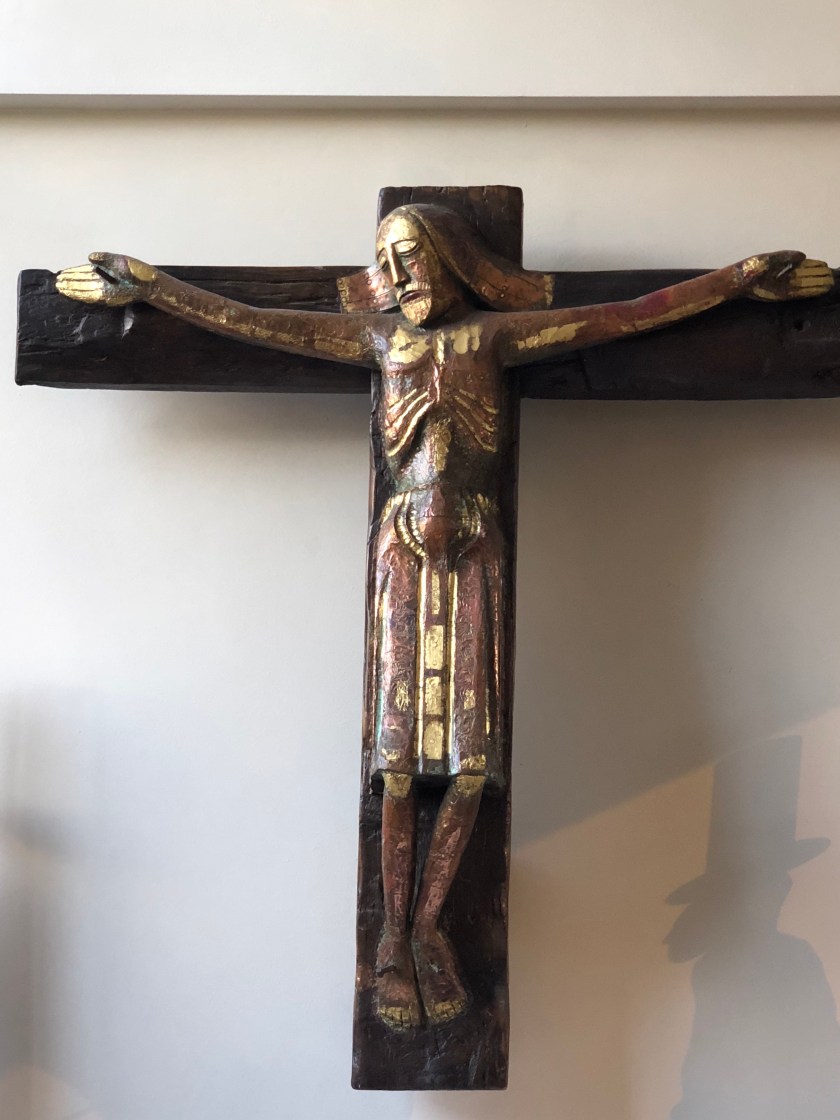
Crucifixion, Dutch Delft, 18th century

But the beauty of the gospel is that Jesus proclaimed, “It is finished”; He has finished the work of redemption, and it is complete. He has done it perfectly and forever. What we could not do Jesus has done once for all. (John 19:30; Romans 6:10; Hebrews 7:27; 9:12)

Lord Jesus, You are in me my hope of glory. Thank You for finishing Your work so I can be free to follow and serve You. (Colossians 1:27)

“Long my imprisoned spirit lay
Fast bound in sin and nature’s night;
Thine eye diffused a quick’ning ray,
I woke, the dungeon flamed with light;
My chains fell off, my heart was free;
  I rose, went forth and followed Thee.”                                                                                              – Charles Wesley (1738)


Barley Bread, Trumpets, and the Glory of God

Judges 7 is a must read for the newly-called and the overwhelmed. In chapter 6, Gideon the farmer had just been tapped by God as the mighty man of valor who would save Israel. His view of God was limited, and of himself, poor. But God had promised to be with him and assured Israel’s victory, and Gideon bravely begins to take on his new assignment. “The Spirit of the LORD clothed Gideon,” God graciously answers his test of the fleece, and Gideon rises early with his men to head to battle.

Then God begins to overturn natural practicality and do His supernatural thing. He says, “The people with you are too many for me to give the Midianites into their hand, lest Israel boast over me, saying, ‘My own hand has saved me.’” 22,000 are winnowed to 10,000 are trimmed to 300, and the LORD promises to save them and give the Midianites into their hand. He even detects Gideon’s fear, and tells him he and his servant can go to the camp and listen to what the enemy is saying, “‘and afterward your hands shall be strengthened to go down against the camp.’ Then he went down with Purah his servant to the outposts of the armed men who were in the camp. And the Midianites and the Amalekites and all the people of the East lay along the valley like locusts in abundance, and their camels were without number, as the sand that is on the seashore in abundance. When Gideon came, behold, a man was telling a dream to his comrade. And he said, ‘Behold, I dreamed a dream, and behold, a cake of barley bread tumbled into the camp of Midian and came to the tent and struck it so that it fell and turned it upside down, so that the tent lay flat.’ And his comrade answered, ‘This is no other than the sword of Gideon the son of Joash, a man of Israel; God has given into his hand Midian and all the camp.’ As soon as Gideon heard the telling of the dream and its interpretation, he worshiped.

Colorado summit

300 soldiers were indeed only a ‘loaf of barley bread’ compared to the vast army before them, but God’s kind affirmation fueled Gideon’s faith and strategy. He divided his troops into three groups, armed with trumpets and empty jars with torches, and advanced. And they blew the trumpets and smashed the jars that were in their hands. They held in their left hands the torches, and in their right hands the trumpets to blow. And they cried out, ‘A sword for the Lord and for Gideon!’ Every man stood in his place around the camp, and all the army ran. They cried out and fled. When they blew the 300 trumpets, the Lord set every man’s sword against his comrade and against all the army.” The powerful Midianites, who had oppressed Israel for seven years, turned on themselves in fear of trumpet blasts and fire, and fled only to be overtaken, captured, and killed. God had indeed brought victory.

In any new endeavor or weighty assignment, God is enough. He hears our doubts and answers them; He knows our fears and insecurities, and comes alongside to reassure us. When we feel small, incapable, insignificant, what matters is that God is big, able, and uses us to accomplish significant deeds. He clothes us with His Spirit, and equips us with His fire. He calls the ordinary to do extraordinary things, that He receive the glory. When “with man this is impossible, with God all things are possible.” (Psalm 34:4; Luke 24:49; Matthew 19:26)

Lord, You know the Midianites in my mind, spirit, and life, and they are not too much for You. Help me remember the barley loaf, and to take hold of the trumpet and blow with gusto and praise.


The Power of Prepositions

“Again he began to teach beside the sea. And a very large crowd gathered about him, so that he got into a boat and sat in it on the sea, and the whole crowd was beside the sea on the land.” Mark 4:1

Cape Coast, Ghana 10-16

Mrs. Striker’s ninth-grade-level seventh grade English grammar class comes to mind as I marvel at this verse, chock full of prepositions. Our Lord of language takes care even in the particular wording of the Scriptures, fashioning descriptions that bring truth to light and life, and it makes me smile. The Living Word teaches with words and uses them to their full for our greatest understanding and delight.

“The LORD is faithful in all his words.” “Every word of God proves true.” “It is no empty word for you, but your very life.” “These words are trustworthy and true.” Psalm 145:13; Proverbs 30:5; Deuteronomy 32:47; Revelation 22:6

The glorious prepositional purposes of God are to be savored from Ephesians 2:8-10: For by grace you have been saved through faith. And this is not your own doing; it is the gift of God, not a result of works, so that no one may boast. For we are his workmanship, created in Christ Jesus for good works, which God prepared beforehand, that we should walk in them.” How thankful I am to be saved by Jesus and able to draw near Him Who is always with me! I am in Christ, forever, bought by His blood; none can snatch me out of His hand.

Lord, none compares with You. There is no God above or beside You; You are Creator of all and over all things. May Your words continue to be to me a joy and the delight of my heart. Keep me abiding in them that I may go to the world with the hope of Christ. (Jeremiah 15:16)

Not To Be Served, But To Serve

“Whoever would be great among you must be your servant, and whoever would be first among you must be your slave, even as the Son of Man came not to be served but to serve, and to give his life as a ransom for many.” Matthew 20:26-28

Two meanings for “servant” are used here. Whoever would be great must be your diakanos, or one who serves others, as a ‘deacon.’ This is a horizontal service. Whoever would be first must be your doulos, one submissive to a Master. This is a vertical service. Jesus came, wholly submissive to His Father’s will and plan, and served unselfishly, with abandon, expending time and energy, comfort and His very life, for others. He calls me to do the same.

Serve God 18th century Dutch Delft plate

Serving must be fueled not by what I prefer to be needed (or do), not by my own strength and impetus, but by my submission to my Master. “As the eyes of servants look to the hand of their master, as the eyes of a maidservant to the hand of her mistress, so our eyes look to the Lord our God.” I cling to Him, I yield to Him, I get caught up in what He is doing. As I learn from Him and hear from Him, so shall I go. (Psalm 123:2)

“Where you go, I’ll go
Where you stay, I’ll stay
When you move, I’ll move
I will follow you.
Who you love, I’ll love
How you serve I’ll serve
If this life I lose, I will follow you
I will follow you”                                                                                                                                      -Chris Tomlin (2012)

So be it, Lord and Master.